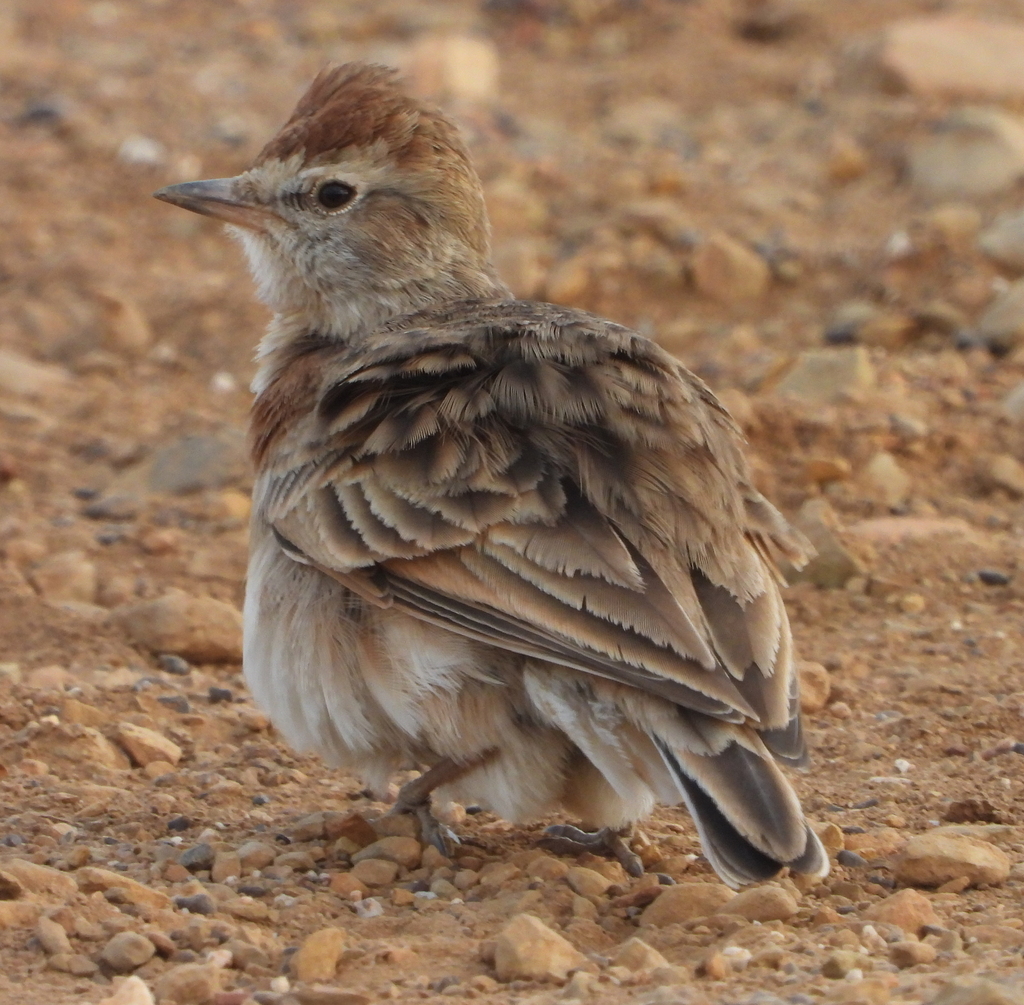
Red-capped Lark
Photo © Timothy Whitehead
Photo © Timothy Whitehead — CC BY 4.0 — Source: iNaturalist #160554283Identification
The red-capped lark is a small passerine, 14–15 cm in length, with a characteristically upright stance. This species is unmistakable in the field thanks to its distinctive rufous cap, white underparts, and bright red shoulders. The upperparts are streaked grey to brown, though coloration varies among subspecies. A short head crest is normally inconspicuous but becomes visible when raised during courtship displays. The sexes are similar in plumage. Juveniles are duller, lacking the red cap and shoulders of adults, instead showing dark spotting on the breast and white spots on dark brown upperparts.
In the field, listen for the red-capped lark's characteristic sparrow-like tshwerp call. Males deliver their song during display flights—a jumble of whistles and short trills—and the species is known to imitate other birds.
Range & Habitat
The red-capped lark breeds across eastern and southern Africa, from the highlands of Ethiopia and Somaliland southward through Kenya, Uganda, and the Congo basin, extending westward to Angola and south to the Cape in South Africa. Five subspecies are recognized across this vast range, each with subtle plumage variations.
This is a species of short grassland and fallow agricultural areas. In eastern Africa it typically inhabits highlands above 1000 m elevation, but in the cooler southern portions of its range it occurs down to sea level in suitable grassland habitat.
Behaviour & Diet
The red-capped lark forages on bare ground or in very short grass, using short runs to hunt for seeds and insects. It is sometimes found in flocks numbering hundreds of birds. The species breeds year-round, with peak breeding from September to December. Females build open-cup nests set into the ground near grass tufts, stones, or mounds, completing construction in 4–5 days. Clutches of 2–3 eggs are incubated by the female, who is fed by the male. Eggs hatch synchronously after 12–15 days, and chicks remain in parental care for 9–18 days.
Best Time & Places to See It
The breeding season from September to December offers good opportunities to observe territorial males and hear their characteristic song flights. However, this species is present year-round across most of its range. Look for red-capped larks in open grasslands and agricultural areas throughout eastern and southern Africa—particularly in the highlands of Kenya, Uganda, Zambia, Zimbabwe, and South Africa. Large flocks may be encountered in suitable habitat, making grassland habitats prime locations for productive viewing.
Photography Tips
The red-capped lark's rufous cap and bright red shoulders provide striking field marks for photography. Photograph birds on the ground in short-grass habitat to capture their characteristic upright posture and ground-feeding behaviour. Males in display flight offer dynamic shooting opportunities, though their small size and rapid movements present challenges. Early morning provides the best light for capturing the warm tones of the cap and shoulders. During breeding season, patient observation of territorial areas may yield opportunities to photograph males at their song posts or delivering their jumbled flight song.
Bwindi Impenetrable National Park
Aberdare National Park
Addo Elephant National Park
Agulhas National Park
Amboseli National Park
Arusha National Park
Bontebok National Park
Bwabwata National Park
Camdeboo National Park
Nothing matches these filters.
No community photos yet. Log in to add the first one.
No community observations of this species yet.