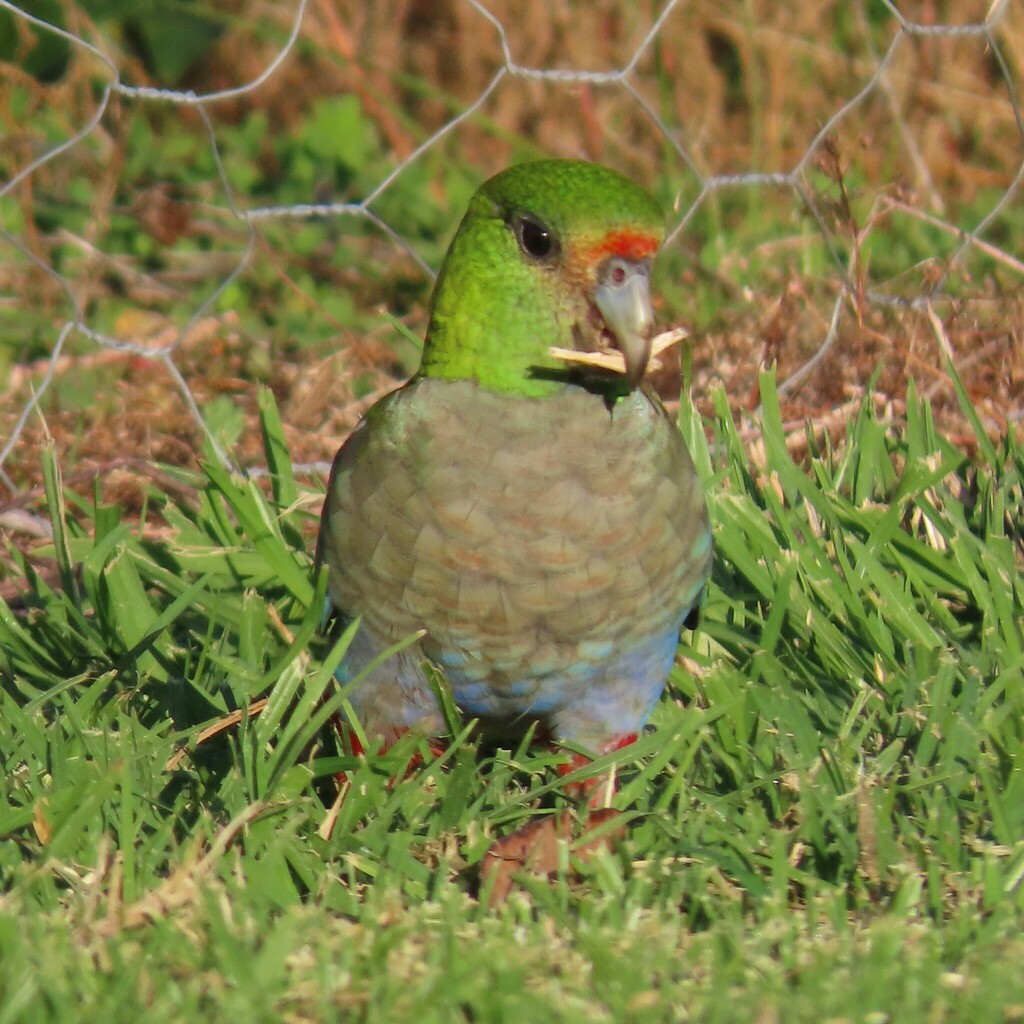
Red-capped Parrot
Photo © pimelea
Photo © pimelea — CC BY 4.0 — Source: iNaturalist #189927585The red-capped parrot (Purpureicephalus spurius) is a species of broad-tailed parrot native to southwestern Australia. It was described by Heinrich Kuhl in 1820, with no subspecies recognised. It has long been classified in its own genus owing to its distinctive elongated beak, though genetic analysis shows that it lies within the lineage of the Psephotellus parrots and that its closest relative is the mulga parrot (Psephotellus varius). Not easily confused with other parrot species, it has a bright crimson crown, green-yellow cheeks, and a distinctive long bill. The wings, back, and long tail are dark green, and the underparts are purple-blue. The adult female is very similar though sometimes slightly duller than the male; her key distinguishing feature is a white stripe on the wing under-surface. Juveniles are predominantly green. Found in woodland and open savannah country, the red-capped parrot is predominantly herbivorous, consuming seeds, particularly of eucalypts, as well as flowers and berries, but insects are occasionally eaten. Nesting takes place in tree hollows, generally of older large trees. Although the red-capped parrot has been shot as a pest and has been affected by land clearing, the population is growing and the species is considered of least-concern by the…
Fitzgerald River National Park
Fitzgerald River National Park, Australia
+209 birds+11 mammals
Where granite peaks rise above windswept heathlands and pristine river systems carve through untamed wilderness, one of Australia's most biodiverse landscapes unfolds across the southwestern corner…
VIEW NATIONAL PARKStirling Range National Park
Australia
+149 birds+7 mammals
Where ancient quartzite ranges rise abruptly from the southwestern Australian plateau, Stirling Range National Park unfolds as a realm of dramatic escarpments, deep valleys, and surprising…
VIEW NATIONAL PARKNo community photos yet. Log in to add the first one.
No community observations of this species yet.