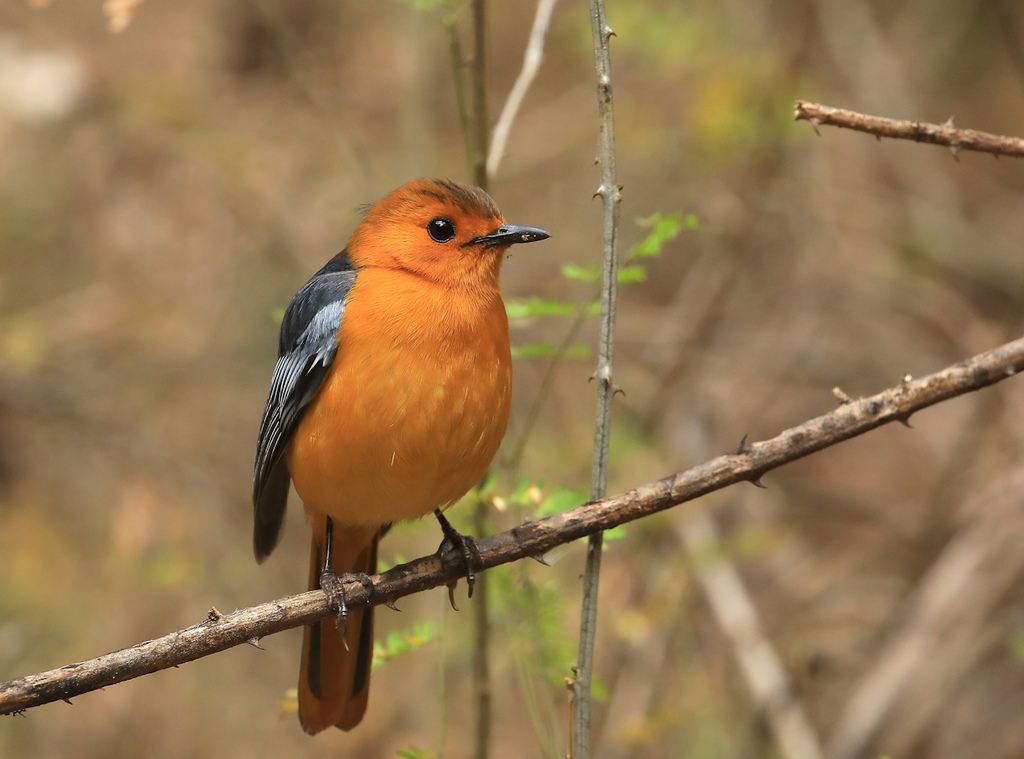
Red-capped Robin-Chat
Photo © Wynand Uys
Photo © Wynand Uys — CC BY 4.0 — Source: iNaturalist photo #93401454Identification
The red-capped robin-chat is a relatively large robin-chat, measuring 15.5 to 19 cm in length. Adults are unmistakable, featuring a striking orange-rufous head, face, breast and belly that contrasts sharply with dusky wings and upperparts. The plain face is dominated by a large dark eye, while the tail displays dark central feathers and bright orange outer feathers. Juveniles are more subdued, with mottled dark brown plumage and rufous-brown spots on the head and upper parts that become larger towards the belly. Subspecific variation exists across the species' range: the nominate subspecies (C. n. natalensis) has olive tones in the crown, while C. n. intensa shows a brighter reddish crown with no olive tones and slightly paler underparts. The subspecies C. n. larischi has darker upperparts and a slightly shorter tail.
Range & Habitat
This species has a wide distribution across central and eastern Sub-Saharan Africa, with three subspecies occupying distinct ranges. C. n. larischi occurs from central and southeastern Nigeria through Cameroon and Gabon to northern Angola. The most widespread subspecies, C. n. intensa, ranges from South Sudan, southwestern Ethiopia and southern Somalia south to Zimbabwe and Mozambique. The nominate subspecies inhabits southern Mozambique, Eswatini and South Africa from Limpopo Province through KwaZulu-Natal to the Eastern Cape.
The red-capped robin-chat is primarily a bird of evergreen forest undergrowth, including coastal forests, riverine forests, sand forests and highland forests below cloud forest level. During summer months, it expands into well-vegetated gullies and thickets in drier bushveld and thornveld habitats. In KwaZulu-Natal, it is particularly common in gardens with shrubberies. The species is both sedentary and partially migratory; first-calendar-year birds are nomadic, while northern populations show seasonal absences during winter months.
Behaviour & Diet
This is a monogamous, territorial species that vigorously defends its breeding territory against rivals. Both sexes build an open cup nest using highly variable materials—dead leaves, roots, twigs, dry grass, lichen, moss, bark fragments and other debris—typically placed in a hollow tree stump, rotten hole or branch cavity. The breeding season varies across the species' range but generally coincides with the rainy season. Clutches contain 2 to 4 eggs; the female incubates alone, and eggs hatch after approximately two weeks. Young fledge after 11 to 12 days (occasionally 17 days) and remain dependent on parents for around six weeks thereafter.
The red-capped robin-chat is both insectivorous and frugivorous, feeding on a wide variety of invertebrates and fruit. Its vocalizations include a plaintive, tremulous contact call and other fluty notes characteristic of robin-chats. The song comprises a long series of melodious whistles with considerable mimicry. The species is known to hybridize with the chorister robin-chat and may fall victim to brood parasitism by the red-chested cuckoo.
Best Time & Places to See It
For the best chances of encountering this species, visit forested areas in its range during the breeding season, which varies by location but typically aligns with the rainy season. In South Africa, KwaZulu-Natal offers reliable sightings, particularly in gardens with suitable shrubbery. The northern populations in South Sudan are most reliably present from early March onwards, becoming very rare from December to February. In Tanzania and Mozambique, the species appears as a dry season visitor to coastal areas, while in Zimbabwe it avoids higher elevations between March and late August. Those exploring central African forests, particularly in Nigeria, Cameroon and Gabon, should listen for the distinctive song and watch in forest undergrowth.
Photography Tips
The red-capped robin-chat's striking coloration makes it a rewarding subject, but patience is essential as it inhabits dense undergrowth. Focus on forest edges, gullies and shaded garden areas where the bird forage in lower vegetation. Early morning hours typically offer the best activity levels and light for photography. Use moderate shutter speeds to capture the bird's deliberate movements through vegetation. The bright orange-rufous plumage contrasts beautifully against dark forest backgrounds, so position yourself to maximize this contrast. Listen for the melodious song and tremulous call notes to locate individuals, then position yourself quietly downwind of the suspected location. The bird's habit of foraging in undergrowth means low angles and patient waiting often yield the most compelling images.
Serengeti National Park
Tanzania
+558 birds+57 mammals
Across Tanzania's northern plateau, where volcanic soils meet acacia woodland and open grassland, unfolds one of Earth's most dynamic ecosystems. The Serengeti National Park sprawls across…
VIEW NATIONAL PARKArusha National Park
Tanzania
+555 birds+16 mammals
Where the slopes of Mount Mawenzi rise above the Arusha region, a compact yet ecologically rich national park unfolds across montane forest, moorland, and alpine zones.…
VIEW NATIONAL PARKRubondo Island National Park
Tanzania
+99 birds+8 mammals
Across the waters of Lake Victoria's northeastern arm, Rubondo Island rises as a freshwater wilderness where papyrus swamps grade into acacia woodlands and dense thickets of…
VIEW NATIONAL PARKChobe National Park
Botswana
+446 birds+45 mammals
Where the Chobe River cuts a sinuous path through northern Botswana, the landscape transforms into one of Africa's most dynamic wetland-savanna mosaics. This national park encompasses…
VIEW NATIONAL PARKVirunga National Park
Uganda
+418 birds+13 mammals
Where the Western Rift Valley fractures the landscape of North Kivu, Virunga National Park sprawls across terrain as geologically dramatic as it is ecologically vital. Volcanic…
VIEW NATIONAL PARKBwindi Impenetrable National Park
Kanyashogi, Uganda
+603 birds+26 mammals
Steep ridges cloaked in montane forest rise from Uganda's southwestern borderlands, where the landscape grows so dense and tangled that early explorers named it impenetrable. At…
VIEW NATIONAL PARKVolcanoes National Park
Musanze District, Uganda
+152 birds+6 mammals
Where volcanic cones rise sharply above the montane forests of northern Uganda, Volcanoes National Park protects one of East Africa's most dramatic high-altitude ecosystems. The park's…
VIEW NATIONAL PARKMgahinga Gorilla National Park
Cyanika, Uganda
+429 birds+6 mammals
Where the Virunga Mountains rise steeply from the Uganda–Rwanda–Democratic Republic of Congo frontier, montane forest cloaks the volcanic slopes in a dense, moisture-laden embrace. Mgahinga Gorilla…
VIEW NATIONAL PARKLake Mburo National Park
Uganda
+505 birds+24 mammals
Rolling acacia woodland and scattered lakes define this intimate savanna preserve in southwestern Uganda, where the rift valley's geological drama shapes every water source and grassland.…
VIEW NATIONAL PARKTsavo East National Park
Athi ward, Kenya
+468 birds+50 mammals
Across the semi-arid lowlands of southeastern Kenya, where acacia woodland fragments into scrubland and the landscape rolls toward the Indian Ocean horizon, lies one of Africa's…
VIEW NATIONAL PARKTsavo West National Park
Mwatate, Kenya
+513 birds+49 mammals
Where volcanic ridges and weathered lava flows meet the semi-arid lowlands of south-central Kenya, Tsavo West National Park unfolds across a landscape sculpted by fire and…
VIEW NATIONAL PARKMount Elgon National Park
Matumbei ward, Kenya
+164 birds+7 mammals
Where the volcanic slopes of Mount Elgon rise above the Trans-Nzoia landscape, a montane wilderness unfolds across multiple ecological zones, each harbouring distinct communities adapted to…
VIEW NATIONAL PARKAmboseli National Park
Etonet/Lenkism ward, Kenya
+501 birds+43 mammals
Where the Amboseli basin opens toward the Tanzanian frontier, a shallow alkaline lake mirrors vast skies across one of East Africa's most iconic savanna landscapes. The…
VIEW NATIONAL PARKTarangire National Park
Tanzania
+527 birds+50 mammals
Acacia woodland and grassland sweep across the Manyara Region where the Tarangire River carves through low hills and volcanic soils, creating one of East Africa's most…
VIEW NATIONAL PARKNgorongoro Conservation Area
Tanzania
+626 birds+55 mammals
Volcanic calderas and open grassland dominate this high plateau in northern Tanzania, where the landscape rises above 2,000 metres and ancient geological forces have shaped both…
VIEW WILDLIFE MANAGEMENT AREAQueen Elizabeth National Park
Uganda
+672 birds+30 mammals
Across the southwestern escarpment of Uganda, where the Western Rift Valley descends through ancient volcanic terrain, Queen Elizabeth National Park sprawls across more than 8,300 square…
VIEW NATIONAL PARKMabamba Swamp
Memere, Uganda
+464 birds+2 mammals
Across the Central Region of Uganda spreads one of Africa's most biodiverse freshwater wetlands, a sprawling nature reserve of roughly 283 square kilometres where papyrus swamps…
VIEW NATURE RESERVEGarden Route National Park
George, South Africa
+353 birds+54 mammals
Sweeping across the Western Cape's coastal and mountainous terrain, this sprawling national park encompasses over five thousand square kilometers of extraordinarily diverse landscape—from coastal limestone cliffs…
VIEW NATIONAL PARKKruger National Park
Ba-Phalaborwa Local Municipality, South Africa
+540 birds+91 mammals
Across the low-lying savanna of northeastern South Africa unfolds one of Africa's largest and most ecologically intact protected areas, where acacia woodlands merge into mopane scrub…
VIEW NATIONAL PARKAddo Elephant National Park
Sundays River Valley Local Municipality, South Africa
+388 birds+55 mammals
Where the Eastern Cape's semi-arid scrublands meet transitional woodland, Addo sprawls across 13,478 square kilometres of one of southern Africa's most biodiverse landscapes. The terrain rises…
VIEW NATIONAL PARKIthala Game Reserve
uPhongolo Local Municipality, South Africa
+328 birds+26 mammals
Rolling thornbush savanna and acacia woodland dominate the landscape of this 494-square-kilometre national park in KwaZulu-Natal's uPhongolo Local Municipality, where granite outcrops punctuate grassland plateaus and…
VIEW NATIONAL PARKZiwa Rhino and Wildlife Ranch
Nakasongola, Uganda
+359 birds+11 mammals
Where papyrus wetlands merge into sprawling savanna, Uganda's central landscape opens into one of East Africa's most vital rhino recovery zones. Ziwa Rhino and Wildlife Ranch…
VIEW WILDLIFE SANCTUARYAbijata-Shalla Lakes National Park
Ethiopia
+438 birds+7 mammals
Two crater lakes of contrasting chemistry define this remote corner of Ethiopia's Rift Valley, where soda lakes and freshwater basins create a mosaic of distinct aquatic…
VIEW NATIONAL PARKAberdare National Park
Mweiga ward, Kenya
+394 birds+30 mammals
Where the central highlands of Kenya rise to their elemental grandeur, the Aberdare range unfolds across Nyeri County as a montane stronghold of cool, misty forest…
VIEW NATIONAL PARKMeru National Park
Igembe Central, Kenya
+408 birds+38 mammals
Granite outcrops and acacia woodland rise across the northern reaches of Meru, where semi-arid savanna transitions into drier scrubland under the fierce equatorial sun. The park's…
VIEW NATIONAL PARKRuma National Park
Suba, Kenya
+250 birds+8 mammals
Where the Winam Gulf narrows toward the Kenyan mainland, Ruma National Park rises as a sanctuary of evergreen woodland set within the humid tropics of Homa…
VIEW NATIONAL PARKOl Donyo Sabuk National Park
Matungulu North ward, Kenya
+200 birds
Granite peaks rise abruptly from the highland plateau of Matungulu North, their weathered slopes clothed in scattered woodland and montane grassland that shifts between verdant and…
VIEW NATIONAL PARKWatamu Marine National Park
Dabaso ward, Kenya
+328 birds+12 mammals
Where mangrove channels meet coral gardens and sandy shallows blend into the warm waters of the Indian Ocean, Watamu Marine National Park unfolds across the Kilifi…
VIEW NATIONAL PARKNo community photos yet. Log in to add the first one.
No community observations of this species yet.