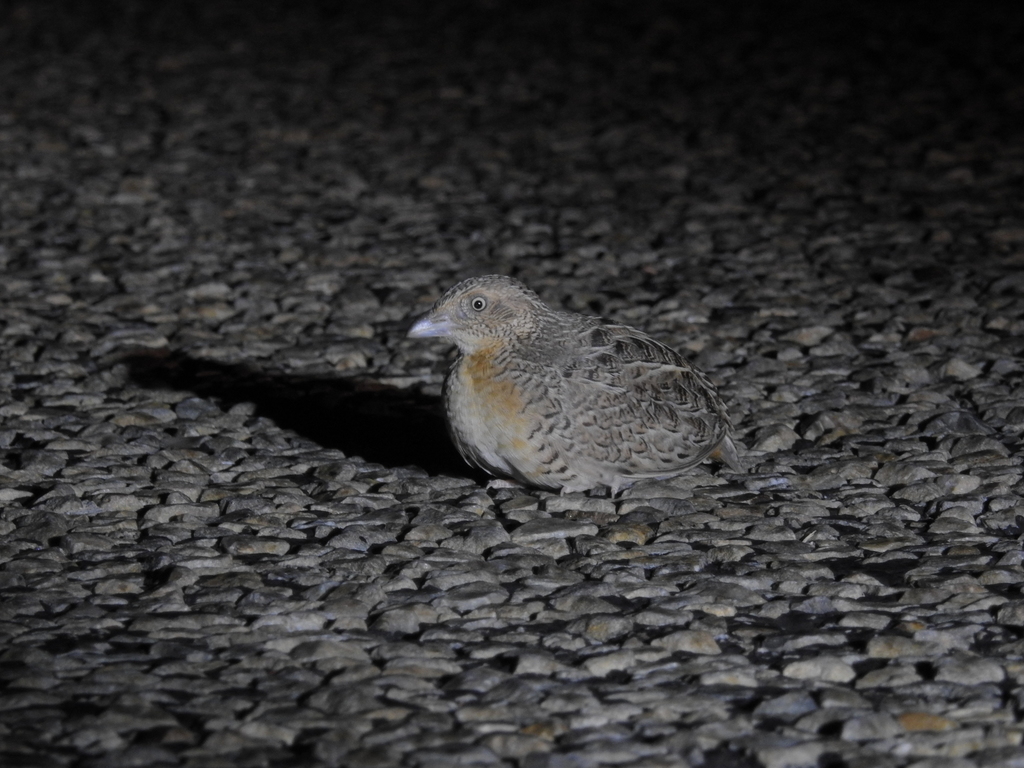
Red-chested Buttonquail
Photo © Nathan Ruser
Photo © Nathan Ruser — CC BY 4.0 — Source: iNaturalist photo #176221290Identification
The red-chested buttonquail is a diminutive ground-dwelling bird, measuring 12–16 cm in length. Adults display a characteristic pale grey upper-wing and back when viewed from behind, with an obvious rufous wash visible from the side. The species features a distinctive thick blue-grey beak, pink legs and feet, and pale eyes. Females are noticeably brighter than males, with more vivid rufous colouration on the underparts extending over the throat to the sides of the head, and finer barring on the flanks. Males are duller overall. Juveniles appear darker above with white streaks, bold white spots on the wing-coverts, and white underparts marked by a rufous-brown gorget and scalloped upper breast.
The red-chested buttonquail is most easily distinguished from its relatives by its uniform grey-brown upper-side tone with orange-chestnut flecking. It differs from the little buttonquail, which has distinctly reddish-brown or pinkish underparts with contrasting wing tones, and from the red-backed buttonquail, which displays a darker slate-grey upper-side with dark underparts except for a contrasting wing panel.
Range & Habitat
Endemic to Australia, this species is widespread though uncommon across New South Wales, Queensland, northern Western Australia, and the Northern Territory, while classified as Vulnerable in Victoria. It does not occur in Tasmania. Red-chested buttonquails inhabit dense grasslands and open, grassy woodlands dominated by Acacia, river red gum, black box, or Melaleuca, as well as crops and weedy fields with dense ground cover. They occur from coastal plains to 1000 metres elevation, preferring moister, denser vegetation than the little buttonquail, yet also inhabiting semi-arid zones. The essential habitat features are bare ground with abundant leaf litter, minimal understorey, and patches of tussock grass or sedges.
Behaviour & Diet
These ground-running birds strongly prefer to remain close to the ground and avoid flying when possible; when disturbed, they scuttle through grass or fly low with whirring wings, often revealing white flanks before dropping to cover. Red-chested buttonquails feed on grass seeds, crop seeds including wheat and panic grass, and insects such as cockroaches, ants, flies, and larvae. They forage throughout the day, though they are reported to be nocturnal and crepuscular feeders. Their distinctive foraging technique involves creating small platelets—circular bare patches—by gleaning and scratching in leaf litter while rotating on one foot and raking with the other.
The species exhibits remarkable breeding behaviour: females are sequentially polyandrous, initiating courtship with several males and expelling rival females from their territory. Males incubate eggs and rear chicks alone. The female constructs a simple grass-lined depression nest sheltered by a tussock. Four white eggs marked with chestnut-brown are laid February–September in the north and September–February in the south. Incubation lasts 13–18 days, and chicks fledge in 6–8 weeks, reaching sexual maturity at six months.
Best Time & Places to See It
The red-chested buttonquail is more commonly sighted in woodland habitats than grasslands. Look for them in tussock grasslands, spinifex country, and Melaleuca woodlands across eastern Australia and the top of the Northern Territory and Western Australia. Breeding occurs February–September in the north and September–February in the south, making these seasons prime viewing periods. Early morning and late afternoon are optimal times for observation, as the species is crepuscular and may be nocturnal.
Photography Tips
Photographing this elusive ground-dweller requires patience and careful approach. Position yourself near dense grasslands or leaf-litter areas where the birds forage. Move slowly and deliberately to avoid startling them into flight. The species' preference for staying close to the ground means low-angle photography will be most effective. Look for the telltale small dust clouds created during foraging in dry periods—these indicate active birds nearby. Early morning light is ideal for capturing the rufous wash on the upperparts and the bright colouration of females.
Given their cryptic habit of scuttling rather than flying, use a fast shutter speed to freeze motion through grass. The characteristic white flanks, visible when the bird flushes, provide a useful identifying detail for your shots. Wide depth-of-field will help ensure the entire bird remains sharp against the complex background of tussocks and leaf litter typical of their habitat.
Uluru-Kata Tjuta National Park
Petermann, Australia
+146 birds+10 mammals
Uluru-Kata Tjuta National Park is one of Australia’s most iconic protected areas, renowned for its breathtaking desert landscapes, extraordinary geological formations, and deep cultural significance. Located…
VIEW NATIONAL PARKKroombit Tops National Park
Valentine Plains, Australia
+152 birds+6 mammals
Where eucalypt woodlands rise into sandstone plateaus, Kroombit Tops unfolds across nearly 906 square kilometres of northeastern Queensland's most biodiverse terrain. The park's defining feature is…
VIEW NATIONAL PARKKakadu National Park
Kakadu, Australia
+273 birds+46 mammals
Kakadu National Park is Australia’s largest national park and one of the world’s most remarkable protected areas, covering nearly 20,000 square kilometres in the tropical north…
VIEW NATIONAL PARKDaintree National Park
Dedin, Australia
+362 birds+37 mammals
Daintree National Park is one of the world’s oldest and most biologically diverse tropical rainforests, protecting an extraordinary landscape where ancient forests meet the Great Barrier…
VIEW NATIONAL PARKChiltern-Mt Pilot National Park
Australia
+229 birds+12 mammals
Granite ridges and eucalyptus woodlands define this 869-square-kilometre park straddling the border between Victoria and New South Wales, where rugged terrain rises sharply from gentler foothill…
VIEW NATIONAL PARKCleland National Park
Australia
+127 birds+14 mammals
Eucalypt woodlands rise and fall across Adelaide's nearby hills, where Cleland National Park sprawls across some twenty square kilometres of native South Australian bushland. The terrain…
VIEW NATIONAL PARKRinyirru National Park
Lakefield, Australia
+258 birds+7 mammals
Where the savanna grasslands of far north Queensland meet seasonal wetlands and eucalypt woodlands, Rinyirru National Park sprawls across more than 12,500 square kilometres of rugged,…
VIEW NATIONAL PARKLitchfield National Park
Australia
+175 birds+15 mammals
Where weathered sandstone plateaus rise above the savanna woodlands of Australia's Top End, Litchfield National Park unfolds as a landscape of dramatic contrasts shaped by a…
VIEW NATIONAL PARKNitmiluk National Park
Australia
+186 birds+27 mammals
Dramatic sandstone gorges carved by the Katherine River slice through the tropical savanna of Australia's Top End, creating a landscape where escarpments tower above crystalline pools…
VIEW NATIONAL PARKWooroonooran National Park
Australia
+240 birds+28 mammals
Where the Great Dividing Range rises sharply inland from Queensland's tropical coast, Wooroonooran National Park encompasses a landscape of steep, forested gorges and cascading waterways carved…
VIEW NATIONAL PARKKosciuszko National Park
Australia
+211 birds+52 mammals
Where the Great Dividing Range reaches its highest peaks in southeastern Australia, Kosciuszko National Park encompasses a landscape of windswept plateaus, rocky ridges, and deep river…
VIEW NATIONAL PARKMungo National Park
Australia
+135 birds+7 mammals
Across the semi-arid inland plains of New South Wales, where sparse shrubland and scattered grassland stretch beneath enormous skies, lies a landscape shaped by ancient geological…
VIEW NATIONAL PARKNo community photos yet. Log in to add the first one.
No community observations of this species yet.