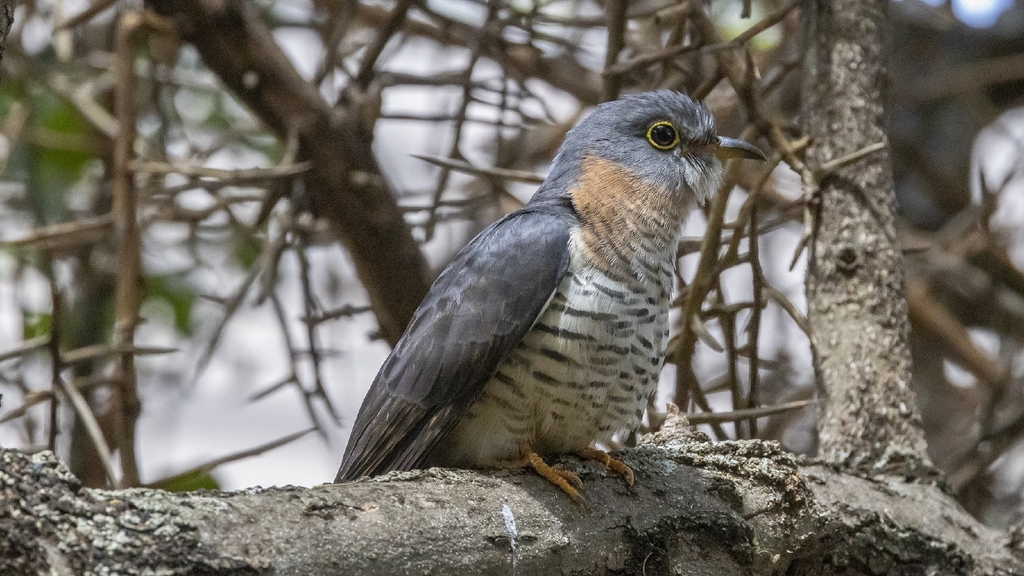
Red-chested Cuckoo
Photo © Barry Stewart
Photo © Barry Stewart — CC BY 4.0 — Source: iNaturalist photo #661233577Identification
The red-chested cuckoo is a medium-sized cuckoo measuring approximately 31 cm in length. Males are distinctive with slate-grey upper parts, a pale grey throat and sides of the head, and a dark grey tail tipped with white. The most striking feature is the rufous or cinnamon breast, often with barring, contrasting with a creamy-white or pale buff belly. Females are similar in pattern but display a duller breast colour with variable amounts of barring, making them slightly less conspicuous than their male counterparts.
Range & Habitat
This African cuckoo is found south of the Sahara across a vast range spanning 35+ countries, from West Africa through Central Africa to Southern Africa. In Southern Africa, it is a common breeding migrant found throughout the region except in the drier western areas. The red-chested cuckoo shows a strong preference for woodland habitats, including forests and plantations. It is characteristically solitary, rarely seen in the company of other members of its species.
Behaviour & Diet
Highly vocal and typically solitary, this species is an opportunistic feeder with a diverse diet. It consumes insects including hairy caterpillars, spiders, centipedes, and millipedes, along with slugs, snails, small vertebrates, and berries. Like all cuckoos, the red-chested cuckoo is an obligate brood parasite, laying its eggs in the nests of other bird species and leaving the hosts to raise its chicks. The bird is polygamous, laying around 20 brown eggs per season across multiple nests. Approximately 15 small bird species serve as hosts, with the Cape robin-chat, Cape wagtail, and white-throated robin-chat being the most frequently victimized species.
Best Time & Places to See It
In Southern Africa, this species is best observed during the breeding season when it is a common migrant. Woodland habitats throughout the region offer the highest probability of encounters, with the exception of arid western areas. The bird's highly vocal nature makes it easier to locate by ear than by sight, especially during the breeding season when males call frequently to establish territories and attract mates.
Photography Tips
Photographing the red-chested cuckoo presents challenges due to its solitary nature and preference for dense woodland. Focus on capturing the diagnostic rufous breast and slate-grey upperparts in good light to showcase the species' identifying features. The bird's vocal behaviour can be used to your advantage—listening for calls will help you locate individuals, allowing you to position yourself in woodland clearings or at forest edges where light is more favourable for photography. Patient observation during the breeding season will increase your chances of successful encounters.
Bwindi Impenetrable National Park
Lake Mburo National Park
Mabamba Swamp
Murchison Falls National Park
Queen Elizabeth National Park
Aberdare National Park
Abijata-Shalla Lakes National Park
Addo Elephant National Park
Amboseli National Park
Nothing matches these filters.
No community photos yet. Log in to add the first one.
No community observations of this species yet.