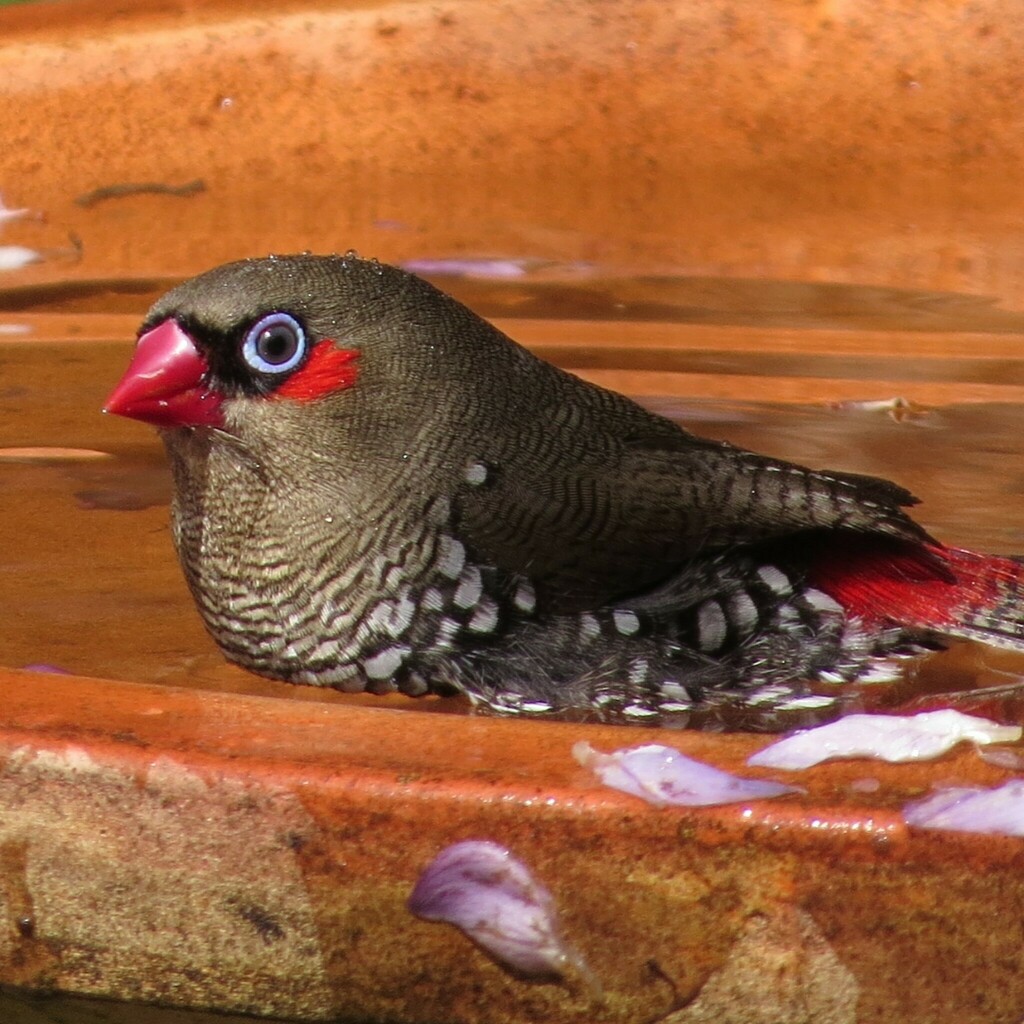
Red-eared Firetail
Photo © pimelea
Photo © pimelea — CC BY 4.0 — Source: iNaturalist #190292950The red-eared firetail (Stagonopleura oculata), also known as the boorin, is a small finch-like species of bird. It occurs in dense wetland vegetation of coastal to sub-coastal regions in Southwest Australia. Its appearance is considered appealing, with white spots, black barring and vivid crimson marks at the ear and upper tail. Red-eared firetails are usually only glimpsed briefly, if at all, as they move rapidly and discreetly through their habitat. Most observations occur when their soft voice is heard, or in flight when flushed from the dense scrub. Males and females are similar in colouring and bond as lifelong pairs that occupy a territory centred on their roosting and brooding nest site. The species occupies a similar ecological niche to the beautiful firetail (Stagonopleura bella) found in the east of Australia, although unlike other species of the genus they only occasionally group together and are almost never seen in large flocks. The red-eared firetail is rare in captivity, being neither recommended nor generally permitted, as they require expertise and a large specialised environment to maintain their secretive habits; however, the observations in avicultural literature have supported and contributed to knowledge of its behaviour. Despite their shyness toward other birds and…
Fitzgerald River National Park
Fitzgerald River National Park, Australia
+209 birds+11 mammals
Where granite peaks rise above windswept heathlands and pristine river systems carve through untamed wilderness, one of Australia's most biodiverse landscapes unfolds across the southwestern corner…
VIEW NATIONAL PARKStirling Range National Park
Australia
+149 birds+7 mammals
Where ancient quartzite ranges rise abruptly from the southwestern Australian plateau, Stirling Range National Park unfolds as a realm of dramatic escarpments, deep valleys, and surprising…
VIEW NATIONAL PARKNo community photos yet. Log in to add the first one.
No community observations of this species yet.