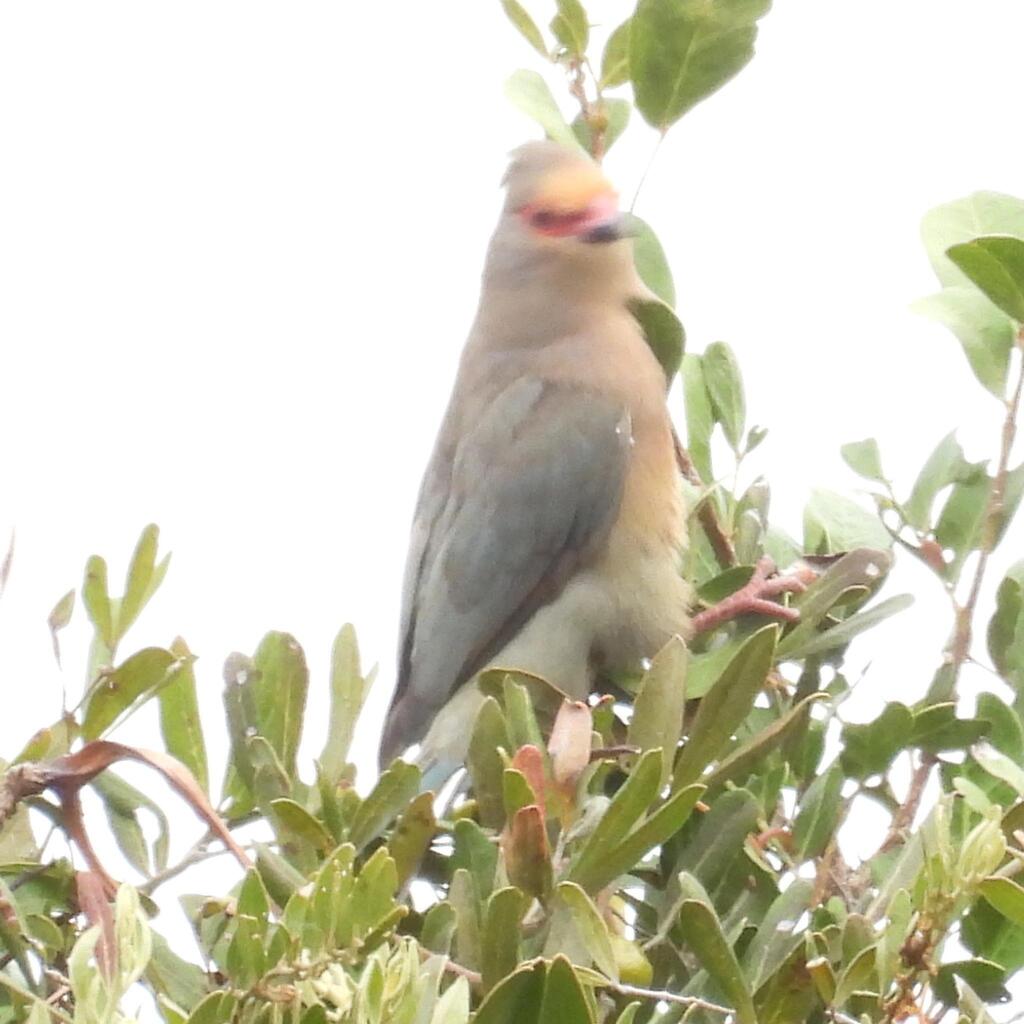
Red-faced Mousebird
Photo © Henry de Lange
Photo © Henry de Lange — CC BY 4.0 — Source: iNaturalist #325853433Identification
The red-faced mousebird is a distinctive 34 cm bird, with the tail accounting for approximately half its length. Its most striking features are the pale cinnamon crested head and breast, contrasting sharply with a bright red bill and red eye mask. The upperparts and tail are blue-grey, with a notably paler grey rump, while the belly is whitish. The sexes are similar in appearance, though juveniles lack the crest and display a green mask instead of red. Its characteristic call is a distinctive tree-ree-ree whistle, repeated regularly and delivered whether the bird is perched or in flight.
Range & Habitat
This common species is widespread across southern Africa, ranging from the Democratic Republic of Congo, Zambia, and Tanzania southward to the Cape. Five recognized subspecies occur across different regions, with distributions spanning from Angola and Namibia in the west to Mozambique and South Africa in the east. The red-faced mousebird favours savanna with thickets, fynbos scrub, open woodland, gardens, and orchards—diverse habitats that provide abundant fruit and vegetation.
Behaviour & Diet
Red-faced mousebirds are highly social outside the breeding season, typically feeding together in small groups of around six birds, though gatherings of 15 or more occasionally occur. These groups fly and interact in tight formations with characteristic fast, strong, and direct flight between feeding areas. The species is frugivorous, subsisting primarily on fruits, berries, leaves, seeds, and nectar. They engage in mutual preening and communal roosting at night, though they are notably more wary than other mousebird species.
Best Time & Places to See It
As sedentary birds, red-faced mousebirds remain in their range year-round and can be encountered throughout the year. However, breeding occurs between June and February, a period when birds may be particularly active. Look for them in fruiting trees and scrub habitats across their southern African range, particularly in areas with reliable fruit sources. Their gregarious nature and characteristic calls make them relatively easy to locate once you learn their tree-ree-ree whistle.
Photography Tips
The red-faced mousebird's striking facial markings and pale cinnamon plumage make it an attractive photographic subject. Their fast, direct flight demands quick reflexes and anticipatory positioning. Early morning and late afternoon often provide the best light for capturing the red mask and blue-grey plumage. Since they feed in small groups in fruiting trees, positioning yourself near productive feeding areas with good light angles will maximize opportunities. Their tendency to roost communally at dusk can also provide rewarding group photography.
Addo Elephant National Park
Agulhas National Park
Augrabies Falls National Park
Bontebok National Park
Bwabwata National Park
Camdeboo National Park
Cederberg Wilderness Area
Chobe National Park
Dorob National Park
Nothing matches these filters.
No community photos yet. Log in to add the first one.
No community observations of this species yet.