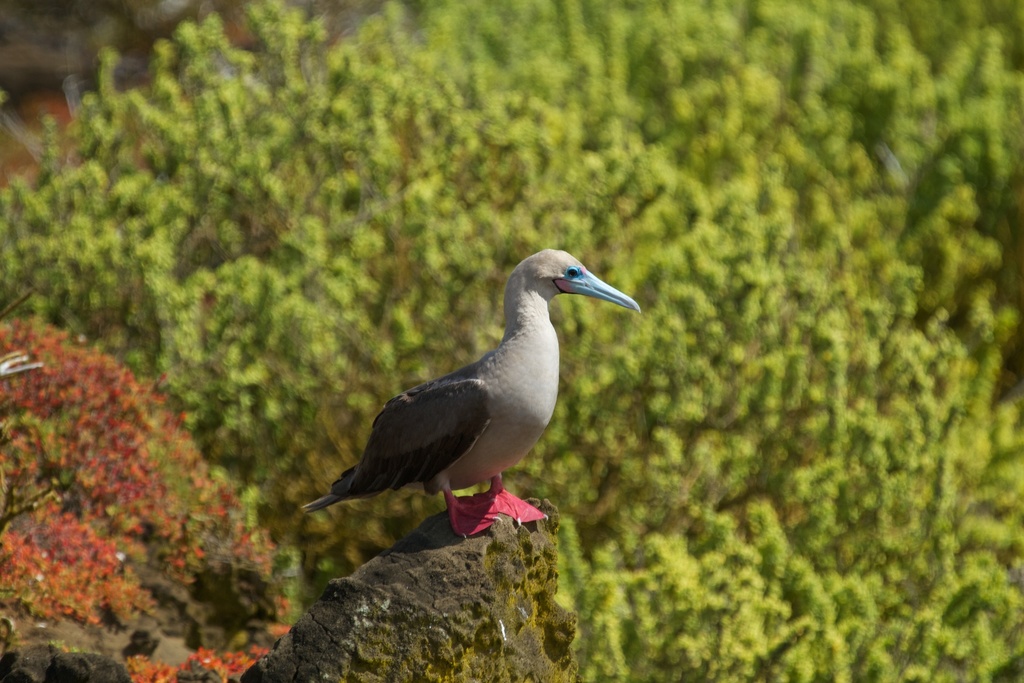
Red-footed Booby
Photo © Brian Gratwicke
Photo © Brian Gratwicke — CC BY 4.0 — Source: iNaturalist photo #259142The red-footed booby (Sula sula) is a large seabird of the booby family, Sulidae. Adults always have red feet, but the colour of the plumage varies. They are powerful and agile fliers, harnessing the wind to fly efficiently, but they are clumsy in takeoffs and landings. They forage by catching flying fish from above the ocean's surface and by performing shallow dives. They are found widely in the tropics, and breed colonially in coastal regions, especially isolated islands such as St. Brandon, Mauritius (Cargados Carajos shoals), and the Chagos Archipelago. Although its population is declining, it is considered to be a least-concern species by the International Union for Conservation of Nature (IUCN). It faces threats from climate change, competition with fisheries, human disturbance, and invasive species. == Taxonomy == The red-footed booby was formally described by the Swedish naturalist Carl Linnaeus in 1766, in the twelfth edition of his Systema Naturae. He gave it the binomial name Pelecanus sula and described it based on a specimen from Barbados. The present genus Sula was introduced by the French scientist Mathurin Jacques Brisson in 1760. The word Sula is Norwegian for a gannet. There are three subspecies: S. s. sula (Linnaeus, 1766)…
Corcovado National Park
Puerto Jiménez, Costa Rica
+444 birds+48 mammals
Where the Osa Peninsula juts into the Pacific, rainforest descends almost to the tide line, and Corcovado National Park protects one of Central America's most intact…
VIEW NATIONAL PARKManuel Antonio National Park
Quepos, Costa Rica
+426 birds+22 mammals
Where tropical rainforest descends steeply to a rocky Pacific coastline, Manuel Antonio National Park distills Central American biodiversity into one of Costa Rica's most compressed and…
VIEW NATIONAL PARKTortuguero National Park
Roxana, Costa Rica
+420 birds+23 mammals
Canals and lagoons thread through a labyrinth of lowland rainforest where the Caribbean coast of Costa Rica meets the wetland frontier. This is terrain shaped by…
VIEW NATIONAL PARKSanta Rosa National Park
Santa Elena, Costa Rica
+359 birds+30 mammals
Where Pacific-facing slopes descend from volcanic uplands toward the Guanacaste lowlands, Santa Rosa National Park unfolds across a mosaic of tropical dry forest, gallery woodland, and…
VIEW NATIONAL PARKHawaiʻi Volcanoes National Park
Hawaiʻi County, United States
+84 birds+2 mammals
Where volcanic slopes descend toward the Pacific across more than five thousand square kilometers, Hawaiʻi Volcanoes National Park presents one of Earth's most dynamic laboratories of…
VIEW NATIONAL PARKParque Nacional de Galápagos
Santo Tomás, Ecuador
+139 birds+23 mammals
Volcanic peaks and weathered lava fields dominate this remote archipelago in the Pacific, where the interplay of cold ocean currents and tropical latitude creates an ecological…
VIEW ISLAND & ARCHIPELAGOCoiba National Park
Montijo, Panama
+260 birds+10 mammals
An archipelago of volcanic and sedimentary islands rises from the Pacific waters off Panama's southwestern coast, its densest rainforest canopy unbroken for millennia. Coiba National Park…
VIEW NATIONAL PARKSoberanía National Park
Cristóbal, Panama
+495 birds+34 mammals
Rainforest and riverine woodland blanket the rolling terrain of this 714-square-kilometre national park in Colón Province, where the Caribbean watershed feeds a maze of streams and…
VIEW NATIONAL PARKKomodo National Park
Komodo, Indonesia
+155 birds+14 mammals
Where volcanic peaks rise dramatically from turquoise waters, a primordial landscape unfolds across three main islands and countless smaller ones scattered throughout the Lesser Sunda archipelago.…
VIEW NATIONAL PARKSian Ka’an
Chunyaxché, Mexico
+350 birds+16 mammals
Where the Yucatán Peninsula dissolves into wetland and mangrove, a vast mosaic of forest, lagoon, and coastal margin creates one of Mexico's most biodiverse strongholds. Across…
VIEW BIOSPHERE RESERVEEl Vizcaíno
Laguna San Ignacio, Mexico
+317 birds+29 mammals
Where the Baja California peninsula thins into a tapestry of salt lagoons and coastal desert, one of Mexico's most biodiverse reserves sprawls across half a million…
VIEW BIOSPHERE RESERVEParque Nacional Isla Isabel
Santiago Ixcuintla, Mexico
+107 birds+2 mammals
A volcanic island sanctuary rises from the Pacific waters off Nayarit's coast, where three dormant cones define a landscape of sharp ridges, coastal cliffs, and sheltered…
VIEW NATIONAL PARKParque Nacional Arrecife Alacranes
Chicxulub, Mexico
+93 birds
Coral formations rise from turquoise shallows off the Yucatán Peninsula, their limestone skeletons built over millennia into a living archipelago where the Caribbean meets the Gulf…
VIEW NATIONAL PARKBiscayne National Park
Miami-Dade County, United States
+263 birds+7 mammals
Coral reefs and mangrove shallows dominate this marine sanctuary where the Florida Keys meet the Atlantic, creating a mosaic of shallow seagrass meadows, patch reefs, and…
VIEW NATIONAL PARKChannel Islands National Park
Santa Barbara County, United States
+330 birds+15 mammals
A chain of eight volcanic islands rises from the cold Pacific waters off the California coast, their rugged sea cliffs and windswept terrain shaped by millions…
VIEW NATIONAL PARKDry Tortugas National Park
Monroe County, United States
+211 birds+1 mammals
Seventy miles west of Key West, where the Gulf of Mexico surrenders to the Atlantic, lies a constellation of low coral keys that rise barely above…
VIEW NATIONAL PARKVirgin Islands National Park
Cruz Bay, United States
+119 birds+3 mammals
Coral reef and mangrove ecosystems define the tropical maritime landscape of this national park, where St. John's mountainous spine rises sharply from turquoise bays fringed with…
VIEW NATIONAL PARKAlaska Maritime National Wildlife Refuge
Alaska, United States
+391 birds+58 mammals
Where the North Pacific collides with Alaska's rugged coastline, a sprawling archipelago of islands, rocky outcrops, and coastal headlands forms one of North America's most remote…
VIEW WILDLIFE SANCTUARYFarallon National Wildlife Refuge
San Francisco, United States
+384 birds+16 mammals
Windswept granite peaks rising abruptly from the Pacific, the Farallon Islands form a wildlife sanctuary of extraordinary seabird abundance and ecological significance just twenty-seven miles west…
VIEW WILDLIFE SANCTUARYKīlauea Point National Wildlife Refuge
Kilauea, United States
+79 birds+1 mammals
At the northernmost tip of Kauai, where the Pacific trades collide with volcanic rock, Kīlauea Point National Wildlife Sanctuary crowns a dramatic headland overlooking one of…
VIEW WILDLIFE SANCTUARYMidway Atoll National Wildlife Refuge
United States
+91 birds+1 mammals
Straddling the international date line roughly midway between North America and Asia, this atoll sanctuary rises from the North Pacific as a cluster of coral and…
VIEW WILDLIFE SANCTUARYMarino Ballena National Park
Bahía Ballena, Costa Rica
+336 birds+8 mammals
Where mangrove forests meet coral-fringed shorelines along Costa Rica's southern Pacific coast, Marino Ballena National Park encompasses a marine and terrestrial mosaic that ranks among Central…
VIEW NATIONAL PARKBarra del Colorado National Wildlife Refuge
Tortuguero, Costa Rica
+462 birds+36 mammals
Where the Caribbean's restless waters meet the Limón Province coastline, Barra del Colorado National Wildlife Sanctuary unfolds across a landscape of extraordinary ecological complexity. This equatorial…
VIEW WILDLIFE SANCTUARYNo community photos yet. Log in to add the first one.
No community observations of this species yet.