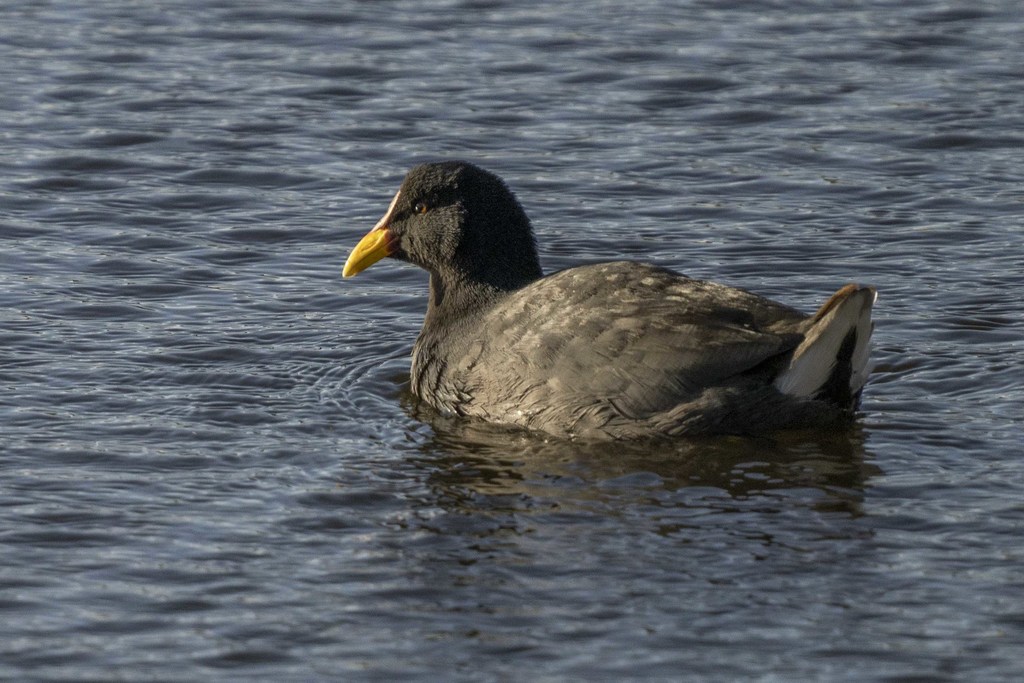
Red-fronted Coot
Photo © Luciano Massa
Photo © Luciano Massa — CC BY 4.0 — Source: iNaturalist photo #127554025Identification
The red-fronted coot is a medium-sized waterbird measuring 38 to 43 cm in length, with males weighing between 685 and 735 grams and females around 550 grams. The most striking feature is its dark chestnut-red frontal shield contrasting with a bright yellow bill. Adults display almost entirely dark slate-gray plumage offset by white undertail coverts, olive legs and feet, and notably unlobed toes—a unique characteristic among coots. The sexes are alike in appearance, making identification straightforward for observers.
Juveniles are more challenging to identify, featuring a blackish bill, gray-brown plumage with white spots on the throat, and the same white undertail coverts as adults. The white undertail coverts present in both age classes provide a useful diagnostic feature when viewing birds in profile or in flight.
Range & Habitat
The red-fronted coot inhabits coastal and inland waterways across much of southern South America, with a range extending from southern Peru and southeastern Brazil southward through Bolivia, Argentina, Chile, and Uruguay. Vagrant sightings have occurred in Paraguay and historically in the Falkland Islands, with records extending to Tierra del Fuego. This species shows a preference for lowland wetlands, typically occurring from sea level to 800 meters elevation, though it regularly reaches 3,700 meters at Alalay Lake in Bolivia and has been recorded as high as 2,100 meters in Argentina.
Red-fronted coots favor the shallows of semi-open marshes and reedy lakes, particularly those abundant with floating vegetation such as duckweed. They appear to be winter inhabitants only in the northern portions of their Brazilian range, suggesting some seasonal movement patterns within their distribution.
Behaviour & Diet
These coots employ both surface feeding and diving techniques to obtain food, primarily pecking at vegetation but also diving for submerged food items. When their marsh habitats dry seasonally, they are known to graze in nearby terrestrial areas. Red-fronted coots typically feed in small flocks, sometimes joining mixed-species groups with red-gartered coots. They are highly vocal birds, producing long, chattering call sequences described phonetically as "togo togo togo," "cu cu cu," and "puhúh puhúh puhúh," along with sharp "tuc" alarm calls.
The species is monogamous, with breeding seasons varying geographically: September to October in Chile, May to November in Argentina, and September to January in Peru. Nests are constructed from plant material positioned low over water in floating or emergent vegetation, with clutches typically containing five to six eggs, though ranging from two to nine. The black-headed duck is a known nest parasite of this species.
Best Time & Places to See It
The red-fronted coot is considered "not uncommon" throughout much of its range and abundant in the marshes of the Pampas region. Timing varies by location: visit Chilean marshes in September and October, Argentine wetlands between May and November, or Peruvian lakes from September through January to coincide with breeding activity. The species' stable population and large geographic range make it a reliable subject for patient observers in appropriate habitats.
Focus your search on shallow, vegetation-rich marshes and reedy lakes with duckweed and other floating plants. The Pampas wetlands of Argentina offer particularly productive viewing opportunities where these birds are abundant.
Photography Tips
The red-fronted coot's contrasting chestnut-red frontal shield and yellow bill provide excellent subjects for close-range photography. Early morning or late afternoon light will enhance the distinctive coloring of the frontal shield and highlight the white undertail coverts as the bird moves. Since these coots often feed in small flocks, patience allows opportunities to capture behavioral sequences such as surface feeding, diving, or interactions with other birds.
The white undertail coverts offer a useful framing feature when composing shots. Because they frequent relatively open marshes with floating vegetation, approach slowly from downwind and use vegetation for concealment. Remember that their unlobed feet—unique among coots—make an interesting detail shot if you can capture them clearly during feeding or roosting moments.
Peixe National Park Lagoon
Brazil
+293 birds+4 mammals
Where the coastal plains of Rio Grande do Sul meet the Atlantic, Peixe National Park Lagoon sprawls across nearly 2,200 square kilometres of shallow waters, reed…
VIEW NATIONAL PARKPatagonia National Park
Cochrane, Chile
+133 birds+8 mammals
Where the Andes meet the Patagonian steppe, vast grasslands and shrublands sweep across rolling terrain carved by ancient glaciation, their contours softened by distance and dramatic…
VIEW NATIONAL PARKParque Provincial Península de Magallanes
Argentina
+125 birds+4 mammals
Granite peaks and windswept steppe converge across this 415-square-kilometre peninsula jutting into the cold Atlantic waters of southern Patagonia, where the Magallanes landscape embodies the raw,…
VIEW NATIONAL PARKLos Glaciares National Park
Argentina
+121 birds+3 mammals
Where granite peaks and sprawling ice fields dominate the landscape, Los Glaciares National Park encompasses over ten thousand square kilometres of Patagonian wilderness in southern Argentina.…
VIEW NATIONAL PARKCampos del Tuyú National Park
Argentina
+169 birds+5 mammals
Subtropical forest graces the borderlands where Misiones Province meets Paraguay, a landscape shaped by the Paraná Plateau's weathered topography and the warm, humid climate of northeastern…
VIEW NATIONAL PARKEl Rey National Park
Municipio de Las Lajitas, Argentina
+317 birds+4 mammals
Where the eastern slopes of the Andes descend into northwestern Argentina's subtropical transition zone, El Rey National Park unfolds across 841 square kilometers of dramatically varied…
VIEW NATIONAL PARKLanín National Park
Argentina
+128 birds+7 mammals
Where the volcanic spine of the Andes plunges into Patagonian steppe, Lanín National Park sprawls across nearly 4,700 square kilometers of one of Argentina's most visually…
VIEW NATIONAL PARKLos Alerces National Park
Argentina
+84 birds+3 mammals
Where the temperate rainforests of southern Patagonia sweep down towards crystalline lakes, Los Alerces National Park unfolds across nearly 3,000 square kilometres of one of South…
VIEW NATIONAL PARKNo community photos yet. Log in to add the first one.
No community observations of this species yet.