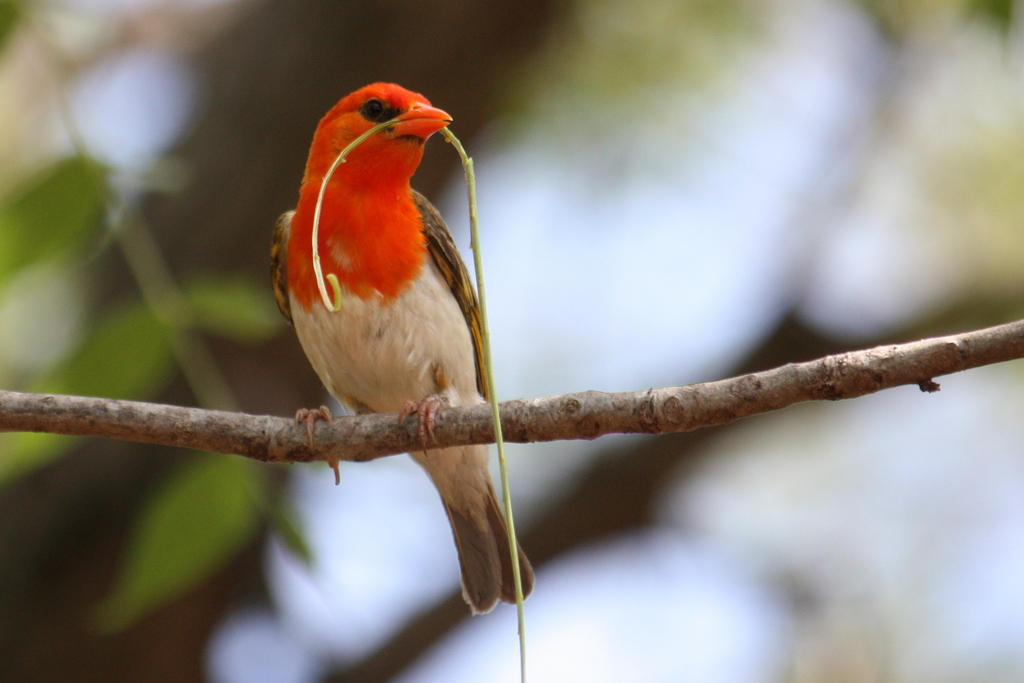
Red-headed Weaver
Photo © Kelly Abram
Photo © Kelly Abram — CC0 1.0 — Source: iNaturalist photo #175402835Identification
The red-headed weaver is a striking small weaver with distinctive plumage that varies by sex and geography. Males in northern populations display a bright red head that contrasts sharply with their white belly and brown wings, making them unmistakable in the field. Northern females are more subdued, with brown heads and similar brown-and-white plumage. Southern females show a more striking appearance with yellow heads and yellow accents on their wings. All red-headed weavers share a moderately long, pointed bill and short, strong claws—adaptations perfectly suited to their foraging lifestyle.
A typical flock consists of one male accompanying a group of eight or nine females. Their most distinctive feature is their intricately woven nest, suspended from tree branches and shaped like a raindrop. The nest's most characteristic element is its long entrance tunnel, a trait shared with the Malimbus genus of weavers, which helps protect eggs and chicks from predators and the elements.
Range & Habitat
The red-headed weaver is widely distributed throughout the Afrotropics, found across a vast range from Senegambia and Ethiopia in the north, extending through northwest Somalia and southward to Mozambique, northern and eastern Botswana, Zimbabwe, northern and northeast Namibia, northeast South Africa, eastern Eswatini, and northeast KwaZulu-Natal. The species is particularly common in eastern and southern Africa, including Zambia and most of Mozambique and Botswana.
These birds favour savanna biomes, bushland, and other wooded areas where acacia trees and mixed woodland provide both food and nesting opportunities. The population remains stable and concentrated throughout this range, showing no signs of fragmentation into isolated subpopulations.
Behaviour & Diet
The red-headed weaver is an active and acrobatic forager, typically searching for insects alone or in pairs. It gleans insects from leaves and branches, often hanging upside-down while prying open clusters of dead leaves with its pointed bill. It probes bark crevices methodically and even catches aerial insects in flight, such as alate termites and moths, which it beats against branches or surfaces to disable their wings before consumption. The bird also raids spider nests for prey and pecks at bark to extract hidden insects.
While primarily insectivorous, the red-headed weaver supplements its diet with plant material including acacia seeds, Premna fruit, and mistletoe berries, particularly from Tapinanthus species. It has been recorded feeding on nectar from diverse flowering plants such as baobabs, shea trees, and Carissa shrubs. Stomach analyses reveal a diet rich in bugs, beetles, mantids, and termites, with chicks fed on spiders, snails, and fruit pulp. The species occasionally forages on drying meat in open air, an opportunistic behaviour rarely documented in weavers.
Best Time & Places to See It
The red-headed weaver is a year-round resident throughout its range and can be encountered at any season. However, activity levels peak during breeding season when males are most vocal and visible as they defend territories and maintain their characteristic small flocks. Look for these birds in savanna woodlands, acacia groves, and mixed bushland habitats across Botswana, Zimbabwe, Mozambique, and Zambia, where they are regularly encountered. Early morning hours offer the best viewing opportunities, as birds are most active during dawn foraging.
Seek them in riparian woodlands and areas with mature trees suitable for nest suspension. Their social nature means that locating one individual often leads to spotting the entire flock, particularly during the breeding season when males are most conspicuous.
Photography Tips
Photograph red-headed weavers in early morning light when colours are most vibrant and birds are actively foraging. The males' red plumage photographs beautifully against the soft golden light of dawn, while the contrast between red head and white belly provides excellent compositional opportunities. Position yourself near favoured foraging trees and wait patiently for birds to approach, as their predictable foraging patterns make them relatively approachable subjects.
Focus on capturing the bird's acrobatic feeding posture, particularly when hanging inverted from branches—a characteristic behaviour that makes compelling images. Nest photography requires careful approach and patience from a distance to avoid disturbance. Use a telephoto lens (at least 300mm) to achieve frame-filling shots without disturbing these sensitive birds during breeding season.
Bwindi Impenetrable National Park
Lake Mburo National Park
Mabamba Swamp
Murchison Falls National Park
Queen Elizabeth National Park
Aberdare National Park
Abijata-Shalla Lakes National Park
Amboseli National Park
Arabuko Sokoke Forest Reserve
Nothing matches these filters.
No community photos yet. Log in to add the first one.
No community observations of this species yet.