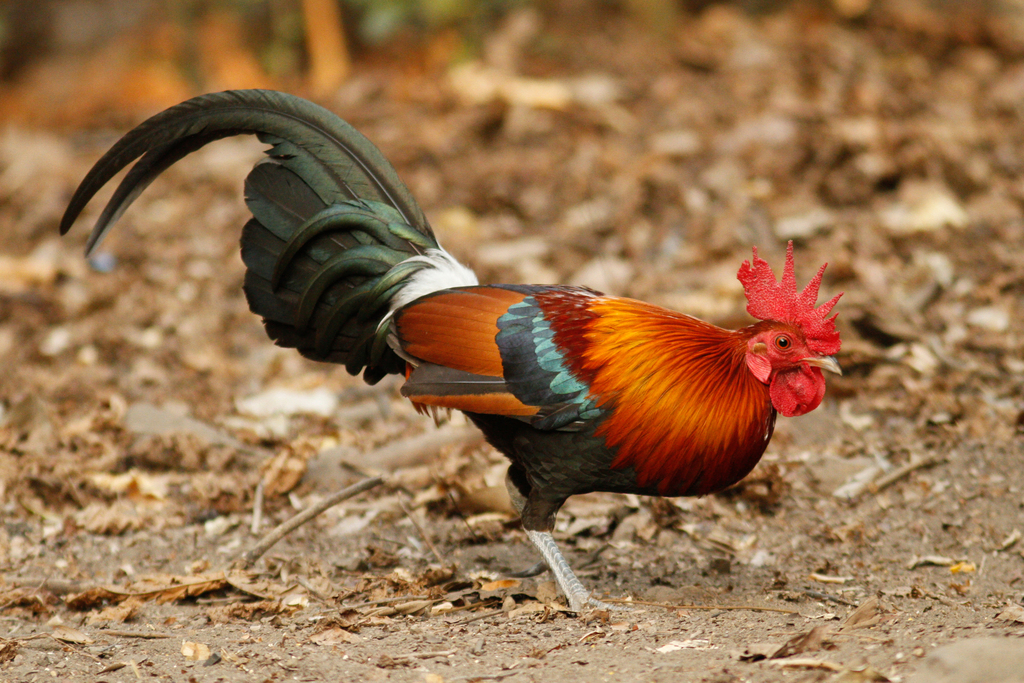
Red Junglefowl
Photo © Julien Renoult
Photo © Julien Renoult — CC BY 4.0 — Source: iNaturalist photo #3784873Identification
The red junglefowl is a striking galliform bird with pronounced sexual dimorphism. Males, called roosters, are significantly larger than females (hens), weighing around 1.5 kilograms compared to the hens' 1 kilogram. The most eye-catching feature is the rooster's brilliant plumage: a mantle of long, golden hackle feathers on the neck and back, and an iridescent tail of 14 feathers that shimmer with blue, purple, and green in sunlight. Some tail feathers curve elegantly and grow up to 28 centimetres long, with the whole bird reaching 70 centimetres in length. Male colouration varies by subspecies—some display golden-yellow coverts with greenish-black tails, while others are predominantly red with black tails. Males also possess a much larger comb and wattle than females, and sharp spurs on their legs used for defence and establishing dominance. Hens are drab and camouflaged, lacking the ornate feathers of males. Both sexes undergo a moult around June, with males acquiring an eclipse plumage featuring black feathers and scattered red-orange plumes until October.
Range & Habitat
The red junglefowl's native range spans much of Southeast Asia and parts of South Asia, extending from Pakistan, India, Nepal, Bhutan, and Bangladesh westward to southern China, Myanmar, Thailand, Cambodia, Laos, Vietnam, Malaysia, Singapore, the Philippines, Indonesia, and Timor-Leste. The species has also been introduced to Australia, Hawaii, Fiji, and various Pacific islands. Red junglefowl thrive in disturbed habitats and forest edges—both natural and human-modified landscapes. They favour deforested and regenerating forests, areas near human settlements, and regions recovering from slash-and-burn agriculture. Bamboo areas, tea plantations, and palm oil plantations often harbour populations. The species is attracted to the thick cover and abundant forage these habitats provide, which are especially valuable for nesting females. While red junglefowl drink surface water when available, they do not strictly require it, allowing them to inhabit areas where water is seasonal or scarce.
Behaviour & Diet
The red junglefowl is notably shy of humans, a contrast to its domesticated descendants that inhabit farms worldwide. The species forages in the varied habitats it frequents, taking advantage of insects, seeds, and vegetation. They roost in trees, with females and chicks using lower perches around 4 metres high, while other adults ascend to heights of up to 12 metres. Males are highly territorial and use their leg spurs to establish dominance within flocks and as a defence mechanism against predators. The birds are vocal, particularly males, which announce their presence and breeding status through characteristic calls.
Best Time & Places to See It
Red junglefowl are found throughout their range across Southeast Asia and South Asia in suitable habitats. Forest edges, regenerating woodlands, and areas adjacent to human settlements offer the best opportunities for encounters. Early morning is typically the most productive time for observation, when birds are most active. During the dry season in areas like north-central India, visits to water holes increase the likelihood of sightings. In Malaysia's Selangor state, palm oil plantations provide reliable habitat. The species' preference for disturbed and edge habitats means that visiting areas undergoing forest recovery or near agricultural lands may yield rewarding encounters.
Photography Tips
Photographing roosters during breeding season (before the June moult) captures their most spectacular plumage, with iridescent tail feathers and vibrant hackles at their most striking. The sexual dimorphism makes it worthwhile to photograph both sexes for comparison. Early morning light is ideal for capturing the metallic sheen of male tail feathers, which shimmer with blue, purple, and green hues in direct sunlight. Since red junglefowl are shy of humans, patience and a telephoto lens are essential. Roosting behaviour offers opportunities for elevated perspectives, as birds use trees for night perches. The contrasting drab plumage of hens against dense vegetation can present challenging lighting conditions, so be prepared to adjust exposure settings. Document the distinctive features that vary by subspecies, such as colouration differences in hackles and tail feathers.
Kanha Tiger Reserve
Alpilles Regional Nature Park
Bandhavgarh National Park
Banke National Park
Bardiya National Park
Barra del Colorado National Wildlife Refuge
Biscayne National Park
Bogani Nani Wartabone National Park
Camargue Regional Nature Park
Nothing matches these filters.
No community photos yet. Log in to add the first one.
No community observations of this species yet.