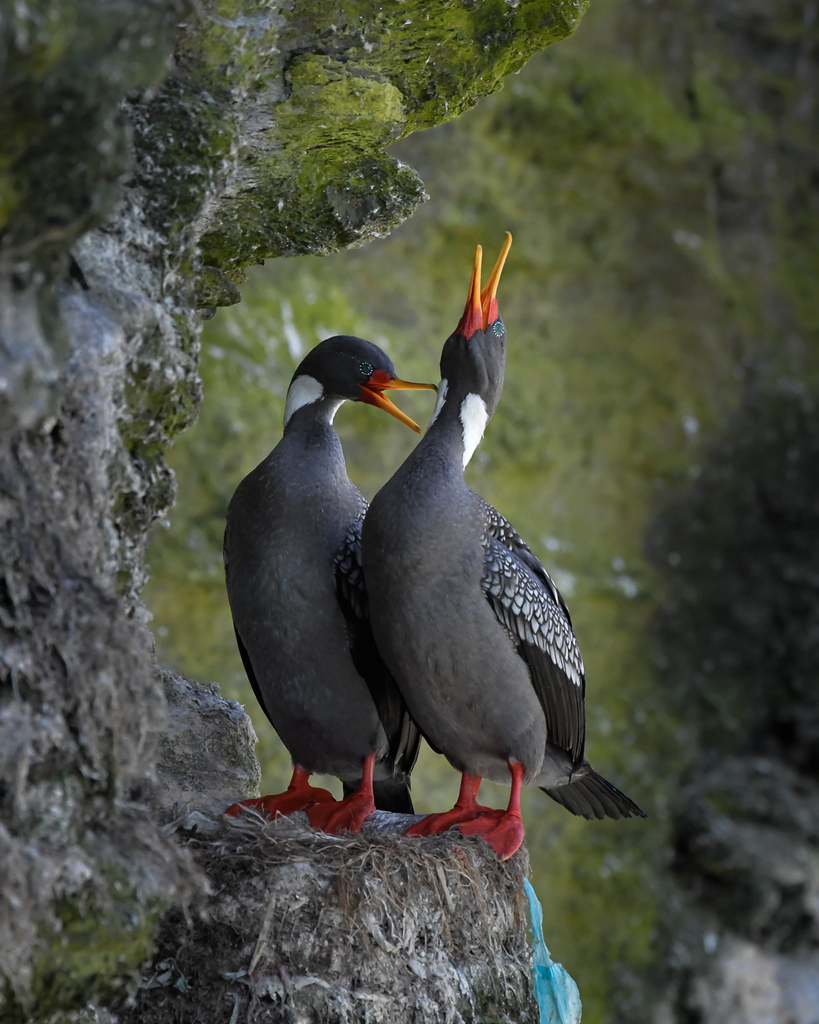
Red-legged Cormorant
Photo © felipejarafer
Photo © felipejarafer — CC BY 4.0 — Source: iNaturalist photo #619434469Identification
The red-legged cormorant is a medium-sized seabird measuring 71–76 centimetres in body length with an average wingspan of 91 cm, weighing 1.3–1.5 kilograms. Its appearance is unmistakable among South American seabirds. Breeding adults display a smoky grey body with a slightly paler underside, scattered white filoplumes behind the eyes and down the neck, and speckled silvery-grey wing coverts contrasting with broad black wing tips and tail. The most striking features are the green eyes surrounded by sixteen tiny blue marks, a yellow bill shading to orange at the base, vibrant orange or red gular skin, and distinctive coral-red legs and feet. Non-breeding adults are similar but lack the white filoplumes and have duller bill and gular colouration. Juveniles possess paler brown plumage with white speckling around the throat and show highly variable plumage colouration between Atlantic and Pacific coast populations.
Range & Habitat
The red-legged cormorant is native exclusively to South American coastlines. On the Pacific coast, it ranges from Macabi Island, Peru to Chiloe Island, Chile, with small isolated populations scattered across Santa Cruz, Argentina on the Atlantic coast. The species rarely occurs further south than the Strait of Magellan. These birds nest sparsely on steep rock faces including coastal cliffs, rocky islets, and sea caverns, where their speckled grey plumage provides effective camouflage against rocky outcrops—though their colourful bills and feet remain conspicuous. They forage within inshore bodies of water and shallow offshore waters.
Behaviour & Diet
Unlike most seabirds, the red-legged cormorant is remarkably non-colonial, living in pairs or small groups. The species has the unusual distinction of never having been observed wing-spreading, a behaviour typical of other cormorant species. Courtship occurs in January and February, featuring elaborate male displays including darting—where males chirp quietly while moving the head back and forth—and throwback postures with outstretched necks. Pairs are monogamous for at least one season. Egg laying occurs between October and January with clutches averaging three eggs; incubation lasts approximately 30 days with a chick-rearing period of 60–70 days.
Red-legged cormorants are generally solitary foragers, though pairs or small flocks may hunt together, typically remaining within 3 km of their nest. They hunt in inshore waters, estuaries, and shallow offshore areas, never entering exclusively fresh water. Many forage at low tide and can dive 8–10 metres in pursuit of prey. Their diet consists mainly of fish including eels, sprat, and anchovies, supplemented by planktonic crustaceans and squid. Their calls are distinctive among seabirds, consisting of high-pitched chirps and chirrups resembling songbirds rather than typical seabird vocalisations.
Best Time & Places to See It
Red-legged cormorants are resident year-round along South American coasts, making them accessible to wildlife travellers throughout the year. Breeding season (October–January in the Southern Hemisphere) offers opportunities to observe courtship displays and nesting behaviour. The Pacific coast from Peru to Chile provides the best viewing opportunities, with populations more established than the scattered Atlantic coast groups in Argentina. Focus on steep coastal cliffs and rocky islets where these birds nest and rest. Early morning hours may be productive for observing foraging activity, and low tide periods are particularly rewarding as many birds forage at this time.
Photography Tips
Photographing red-legged cormorants requires patience and careful positioning. The birds' preference for nesting on sheer cliff faces and rocky outcrops means approaching from water level often provides the best angles. The striking contrast between their smoky-grey plumage and vibrant coral-red legs and feet makes for compelling images—ensure adequate light to capture these colour details. During courtship displays in January and February, dramatic behavioural sequences can be documented, though maintaining distance is essential for non-colonial birds that may abandon nests if disturbed. The birds' distinctive colourful bills and gular skin are key identifying features worth highlighting in close-up shots. Early morning light often works best for capturing detail against rocky backgrounds.
Chiloé National Park
Dalcahue, Chile
+122 birds+6 mammals
Temperate rainforest cloaks the Chiloé archipelago's northwestern reaches, where granite ridges thrust through dense, moisture-laden canopy and freshwater streams carve ravines toward the Pacific. Across approximately…
VIEW NATIONAL PARKPan de Azúcar National Park
Chañaral, Chile
+74 birds+4 mammals
Where the Atacama Desert plunges toward the Pacific, Pan de Azúcar National Park sprawls across 727 square kilometres of one of Earth's most extreme transitions—a landscape…
VIEW NATIONAL PARKCorcovado National Park
Chaitén, Chile
+39 birds+1 mammals
Where temperate rainforest meets the raw Pacific coastline of Chilean Patagonia, Corcovado National Park sprawls across 6,585 square kilometres of some of South America's most pristine…
VIEW NATIONAL PARKMonte León National Park
Argentina
+100 birds+4 mammals
Where the Patagonian steppe meets the Atlantic, Monte León National Park protects a landscape of windswept coastal cliffs, rocky outcrops, and semi-arid grassland spanning over 1,200…
VIEW NATIONAL PARKArchipiélago Juan Fernández National Park
San Juan Bautista, Chile
+31 birds+2 mammals
Granite peaks rise abruptly from the South Pacific off the Chilean coast, their weathered slopes studded with native woodland and sweeping down to coves where seabirds…
VIEW NATIONAL PARKNo community photos yet. Log in to add the first one.
No community observations of this species yet.