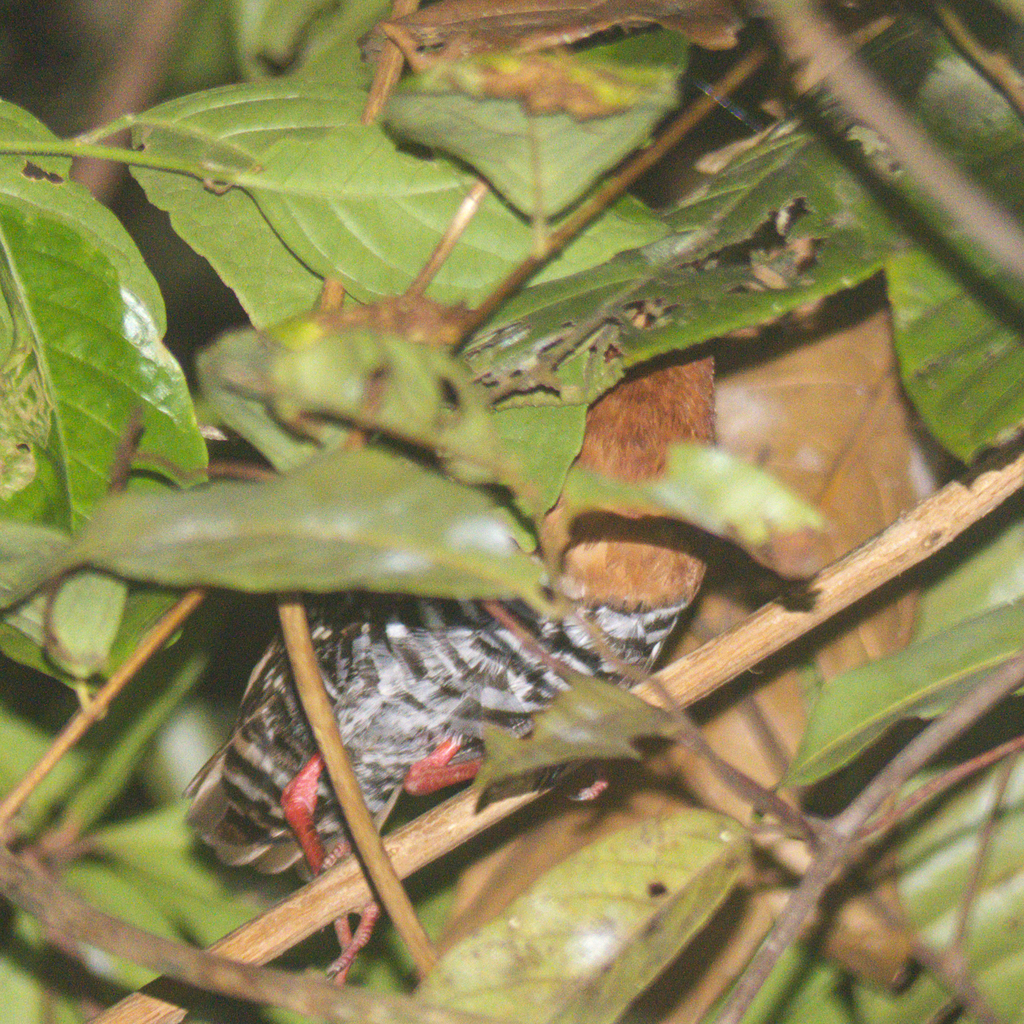
Red-legged Crake
Photo © Gerard Chartier
Photo © Gerard Chartier — CC BY 4.0 — Source: iNaturalist #63153470Identification
The red-legged crake is a medium-large rail measuring 24 cm in length. It is readily identified by its distinctive colouration: the head, neck, and breast are rich red-brown, becoming paler towards the throat. The upperparts are grey-brown, while the underparts and underwings display striking black and white barring. The bill is green and the legs are bright red—a striking field mark that gives the species its common name.
Range & Habitat
This species has a wide distribution across South and Southeast Asia, occurring in far north-eastern India, eastern Bangladesh, Burma, Thailand, Malaysia, Singapore, the Philippines, and Indonesia. It has also been recorded as a vagrant to north-western Australia, Lanyu near Taiwan, and Palau. The red-legged crake favours dense vegetation in close proximity to permanent wetlands, ranging from flooded paddy fields to dense rainforest. It is partly migratory, though the precise nature and timing of its movements remain poorly understood.
Behaviour & Diet
Little is known about the breeding behaviour of this elusive species. It produces a distinctive series of descending croaks, screams, and grunts—often the first indication of its presence in dense cover. The breeding clutch consists of 3–6 dull-white eggs, incubated by both parents. Upon hatching, the chicks are covered in dark brown down. Further details of its feeding ecology and daily behaviour remain to be documented.
Best Time & Places to See It
The red-legged crake is best encountered in its core range throughout the Thai-Malay Peninsula and Indonesian archipelago, particularly where extensive wetland systems remain intact. The species is difficult to observe due to its preference for impenetrably dense vegetation. Visiting during the non-breeding season may improve chances, as birds may be more vocal and mobile, though its migratory patterns are poorly charted. Patience and familiarity with its calls are essential.
Photography Tips
Photographing this secretive species requires considerable patience and skill. Early morning and late afternoon hours often yield the best opportunities, when the bird is most vocal and active. A telephoto lens (400–600 mm) is essential for capturing images from a distance while minimising disturbance. Focus on recording the striking red legs and distinctive head pattern. Recordings of the species' call may help attract individuals closer to observation points, though this should be done judiciously and ethically.
Bako National Park
Kaeng Krachan National Park
Taman Negara National Park
Way Kambas National Park
West Bali National Park
Nothing matches these filters.
No community photos yet. Log in to add the first one.
No community observations of this species yet.