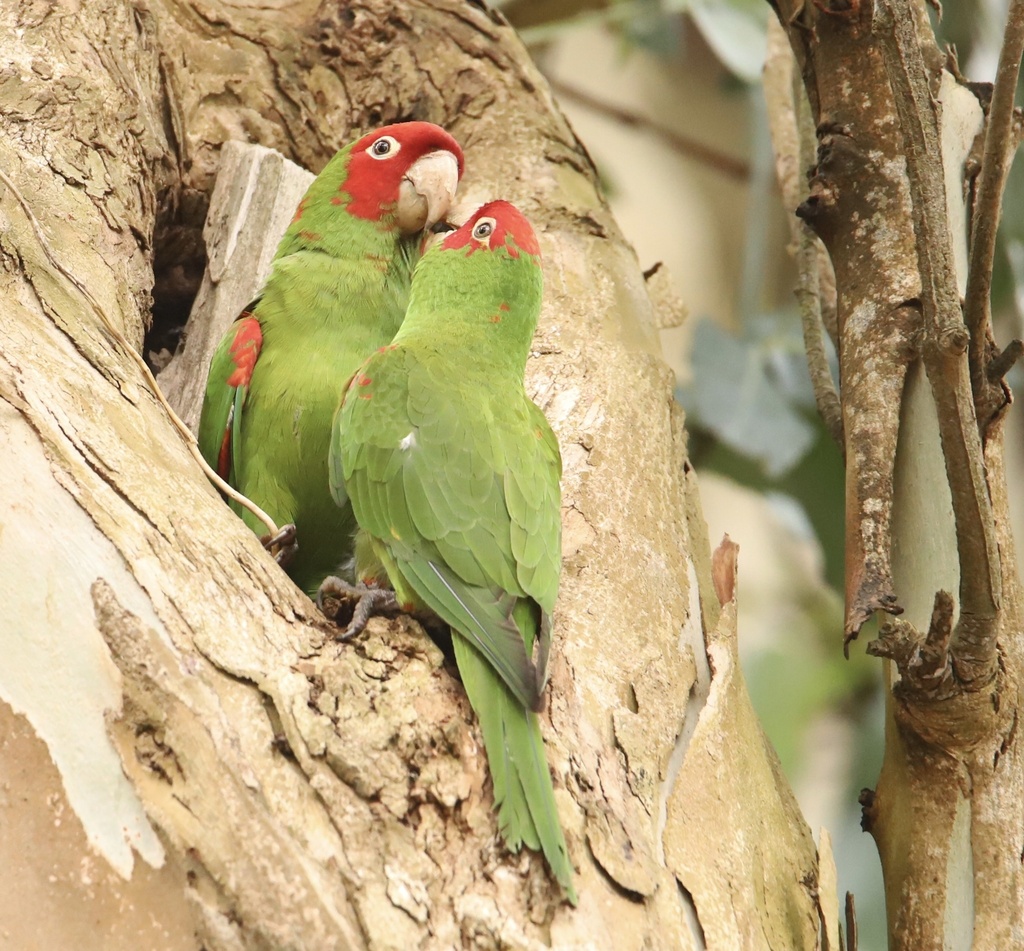
Red-masked Parakeet
Photo © Aitor
Photo © Aitor — CC BY 4.0 — Source: iNaturalist photo #209707207Identification
The red-masked parakeet is a medium-sized parrot averaging 33 centimetres in length, with the tail accounting for roughly half of this measurement. The most striking feature is its predominantly red head, which gives the species its common name, contrasted against bright green body plumage. The nape remains green, and a conspicuous pale eye-ring encircles each eye. Additional red colouration appears on the underwing coverts, neck, thighs, and leading edge of the wings. Juveniles are entirely green until their first red feathers emerge at around four months of age. The birds produce a distinctive two-syllabled, harsh and loud call that is easily recognisable in the field.
Range & Habitat
Native to southwestern Ecuador and northwestern Peru, red-masked parakeets inhabit jungle and deciduous forest environments, though they demonstrate remarkable adaptability to semiarid and suburban regions as well. They typically occur below 1,500 metres elevation, though they can survive at altitudes up to 2,500 metres above sea level. Their popularity as cage birds has led to established feral populations beyond their native range, particularly in the United States—notably in San Francisco, where they have become iconic residents documented in popular media. Smaller breeding populations exist in California cities including San Diego, Los Angeles, San Gabriel Valley, Sunnyvale, Orange County, Palo Alto and Long Beach. Escaped birds have also been recorded in Spain and Hawaii.
Behaviour & Diet
Red-masked parakeets are notably vocal and gregarious birds, living in small to medium groups. They are renowned among conures for their exceptional talking ability and are considered the best talkers of all conure species. In their native habitat and in feral populations, they feed on fruits and flowers, demonstrating considerable dietary flexibility across different environments. They nest in tree cavities and can breed successfully in small woodlots or even isolated trees within degraded forests. Breeding pairs produce clutches of three to four eggs, with incubation lasting 23 to 24 days. Juvenile birds fledge after approximately 50 days, initially displaying full green plumage before acquiring adult colouration.
Best Time & Places to See It
For travellers seeking red-masked parakeets in their native range, southwestern Ecuador and northwestern Peru offer the best opportunities, particularly within jungle and deciduous forest habitats at elevations below 1,500 metres. For those based in North America, San Francisco has become a reliable location for observing feral populations, where the birds feed on urban and suburban fruits and flowers. Early morning hours typically offer the best viewing, when the birds are most active and vocal. Their loud calls make them relatively easy to locate even when visibility is limited.
Photography Tips
The red-masked parakeet's vibrant plumage—particularly the striking red head contrasting with green body—makes it highly photogenic. The pale eye-ring provides excellent compositional focus for detailed portraits. Photograph birds in early morning or late afternoon light to capture the luminous quality of their red feathers. When photographing feral populations in urban settings, fruiting trees and palms offer productive perches. The birds' active, acrobatic behaviour and tendency to congregate in small flocks provide numerous photographic opportunities, though their rapid movements and loud calls require quick reflexes and patience.
L’Albufera Natural Park
València, Spain
+321 birds+18 mammals
Where shallow lagoons meet Mediterranean coastal marshland, L'Albufera Nature Park unfolds as one of Spain's most vital wetland complexes. This protected landscape, designated under IUCN Category…
VIEW NATURAL PARKSangay National Park
Cebadas, Ecuador
+320 birds+10 mammals
High in Ecuador's Andean spine, where the Western Cordillera rises to touch perpetual snow, a landscape of volcanic drama and ecological intensity unfolds across Sangay National…
VIEW NATIONAL PARKHawaiʻi Volcanoes National Park
Hawaiʻi County, United States
+84 birds+2 mammals
Where volcanic slopes descend toward the Pacific across more than five thousand square kilometers, Hawaiʻi Volcanoes National Park presents one of Earth's most dynamic laboratories of…
VIEW NATIONAL PARKEverglades National Park
Monroe County, United States
+345 birds+22 mammals
Where freshwater marsh meets subtropical sky, the Everglades sprawls across southwestern Florida as one of North America's most expansive wetland ecosystems. Spanning over 13,000 square kilometers,…
VIEW NATIONAL PARKCerros de Amotape National Park
District of San Jacinto, Ecuador
+246 birds+1 mammals
Arid mountains rise abruptly from Peru's northwestern frontier, their slopes clothed in xerophytic scrubland and seasonal deciduous forest that transforms these Andean foothills into one of…
VIEW NATIONAL PARKPodocarpus National Park
Zamora, Ecuador
+496 birds+6 mammals
Where the Andes descend toward the Amazon basin, Podocarpus National Park sprawls across nearly 2,800 square kilometres of the most biodiverse terrain in Ecuador's southern highlands.…
VIEW NATIONAL PARKCajas National Park
Cuenca, Ecuador
+190 birds+7 mammals
High in the Andes above Cuenca, where elevation ranges from 3,100 to 4,200 metres, the páramo landscape dominates—a windswept realm of cushion plants, alpine grasses, and…
VIEW NATIONAL PARKBiscayne National Park
Miami-Dade County, United States
+263 birds+7 mammals
Coral reefs and mangrove shallows dominate this marine sanctuary where the Florida Keys meet the Atlantic, creating a mosaic of shallow seagrass meadows, patch reefs, and…
VIEW NATIONAL PARKNo community photos yet. Log in to add the first one.
No community observations of this species yet.