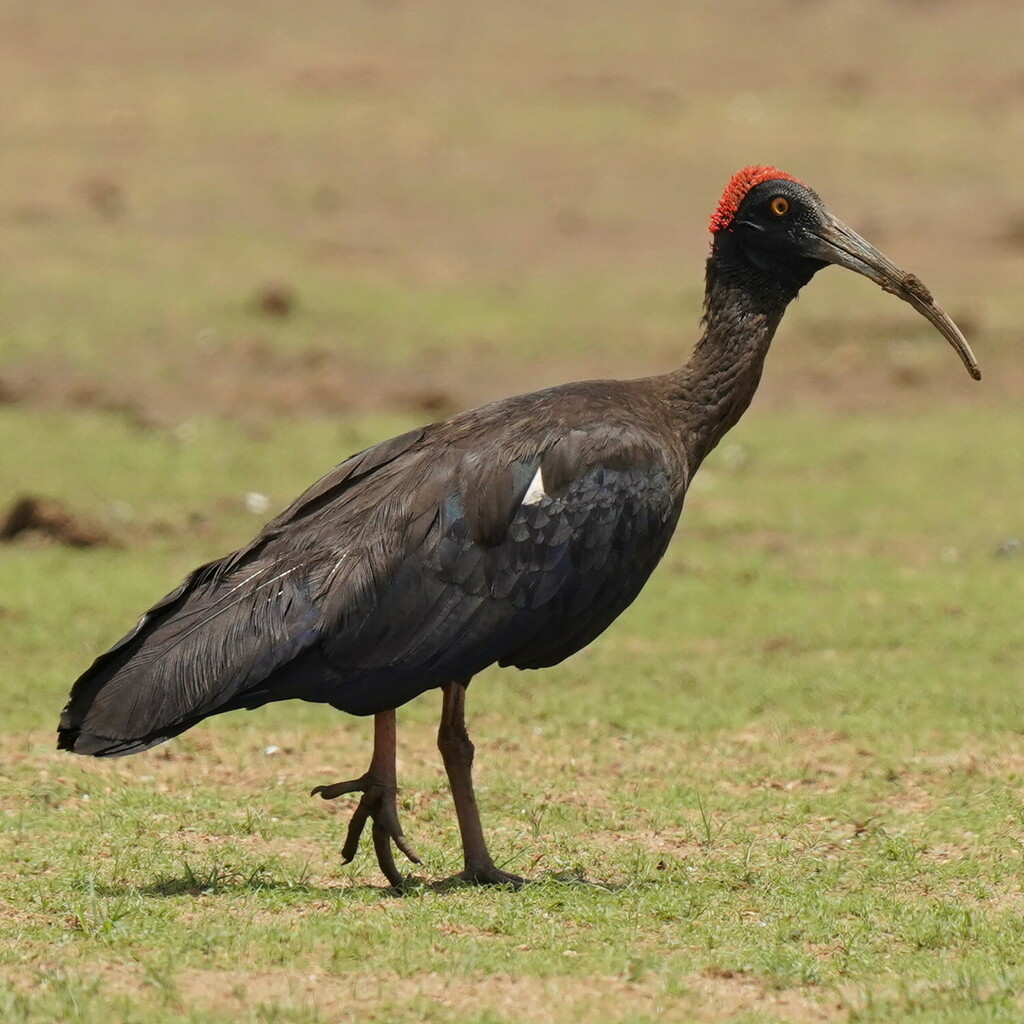
Red-naped Ibis
Photo © Daniel S. Katz
Photo © Daniel S. Katz — CC BY 4.0 — Source: iNaturalist photo #275803699Identification
The red-naped ibis is a large, strikingly dark bird with a distinctive bare head. Its nearly all-black plumage contrasts sharply with a prominent white patch on the shoulders, making it unmistakable even from a distance. The most striking feature is the bare, dark head crowned with a patch of bright red warty skin (technically called a caruncle) that forms a triangular patch from the crown to the nape. The long, downcurved bill, long legs, and orange-red iris complete the portrait. During breeding season, the bills and legs flush reddish, adding extra colour to breeding adults. Young birds are browner and initially lack the bare head and red crown patch. Both sexes are identical in appearance.
The red-naped ibis can be confused with the glossy ibis at distance, but the glossy ibis is smaller, more gregarious, associated with wetlands, lacks the distinctive white shoulder patch, and has a fully feathered head. The wing and tail feathers display a blue-green gloss, and the toes are slightly webbed at the base with a fringing membrane.
Range & Habitat
This species is widely distributed across the plains of the Indian subcontinent, where it is a common breeding resident in Haryana, Punjab, Rajasthan, and the Gangetic plains, extending southward but avoiding forested regions and the extreme arid southeast. It is notably absent from Sri Lanka. In Nepal's lowlands, it occupies both agricultural fields and forests. Unlike most ibises in the region, the red-naped ibis is not strictly dependent on water and thrives in dry fields, agriculture areas, and surprisingly, human settlements including villages, towns, and mega-cities.
The species shows flexibility in habitat use, foraging largely in dry, open land while being attracted to areas with more wetlands. It inhabits lakes, marshes, riverbeds, irrigated farmlands, dry fallow fields, and even urban environments. In semi-arid regions, birds typically occur in small flocks of 2–4 individuals, possibly family groups, with larger assemblies being relatively uncommon. Interestingly, in Rajasthan's Aravalli mountains, the birds are common in the plains but entirely avoid using the trees on the mountains themselves.
Behaviour & Diet
Red-naped ibises are usually silent but become vocal at dawn and dusk, and considerably noisier during breeding season. Their calls consist of loud, braying, squealing screams that descend in loudness—a dramatic sound that echoes across their habitat. Nocturnal calling is rare but has been observed in urban settings. The species is largely diurnal, foraging by day and roosting communally on trees or islands at night.
This omnivorous bird has a remarkably diverse diet. It feeds on carrion, insects (beetles, grasshoppers, crickets), frogs, other small vertebrates, crustaceans (prawns and crabs), scorpions, and grain. They forage mainly in dry open land and stubbly fields, walking and probing tactilely in soft ground, sometimes joining egrets on tilled land to feed on exposed earthworms and beetle grubs. They rarely wade but seek frogs in crab holes. Urban populations exploit garbage dumps for mammal and bird carcasses, hunt rock pigeons, and consume roadkill. Their historical appetite for crickets earned them the nickname "planter's friend" from indigo planters in British India.
Best Time & Places to See It
The red-naped ibis is best observed in the plains of northern and central India, particularly in Rajasthan, Punjab, Haryana, and along the Gangetic plains, where it is a common breeding resident. Lowland Nepal also offers reliable sightings. Look for them in agricultural fields, particularly during summer months when they increase their use of wetlands for foraging. Small flocks of 2–4 birds are typical, often seen in pairs or loose groups in dry, open habitats.
Urban birdwatchers can encounter this species in villages, towns, and even major cities, where they forage at garbage dumps and in built-up areas. During the breeding season, listen for their loud, braying calls at dawn and dusk, which will often reveal their presence. In semi-arid regions, birds concentrate in upland habitats away from wetlands, so focus on dry fields and fallow land rather than water bodies.
Photography Tips
The red-naped ibis's bold colouration and striking bare head make it visually rewarding to photograph. The contrast between the black body and white shoulder patch is dramatic and stands out well against most backgrounds. The bright red crown patch is particularly eye-catching during breeding season when the bills and legs also flush with colour. Photograph birds in early morning or late evening light to capture the blue-green gloss on the wing and tail feathers.
Position yourself in dry, open fields and agricultural areas rather than waiting at wetlands. Watch for small flocks of 2–4 birds probing in the soil—their tactile feeding behaviour offers dynamic shooting opportunities. In urban settings, birds visiting garbage dumps or roosting communally on trees provide excellent opportunities for habitat photography. During breeding season, locate their nests on tall trees, palms, or increasingly on cell phone and electricity towers for family-group shots. The best images will capture the distinctive bare head with its red caruncle in sharp detail.
Indravati National Park
Bijapur, India
+41 birds
Where the Indravati River cuts through the elevated plateaus of central India, a landscape of deciduous forest and open woodland unfolds across Bijapur district in Chhattisgarh.…
VIEW NATIONAL PARKRanthambhore National Park
Sawai Madhopur, India
+294 birds+20 mammals
Granite ridges and ravines carved through the Aravalli Range frame this protected landscape in eastern Rajasthan, where deciduous forest mingles with open scrubland and seasonal water…
VIEW NATIONAL PARKKanha Tiger Reserve
Kanha Kisli F.V., India
+321 birds+23 mammals
Where sal forests give way to emerald meadows and crystalline streams carve through ancient valleys, one of India's finest wilderness reserves unfolds across the Maikal Range.…
VIEW NATIONAL PARKTadoba National Park
Palasgaon Singru, India
+270 birds+20 mammals
Where sal forests meet open grasslands and rocky outcrops rise from red laterite soil, central India's landscape unfolds in raw, untamed beauty. Ancient teak woodlands and…
VIEW NATIONAL PARKBandhavgarh National Park
Garhpuri, India
+285 birds+17 mammals
Where granite ridges rise dramatically above sal and bamboo forests, one of India's most pristine tiger reserves unfolds across the Vindhyan plateau. Ancient rock formations tower…
VIEW NATIONAL PARKPanna National Park
Badgadi Kalan, India
+271 birds+17 mammals
Where granite gorges slice through central India's Vindhyan plateau, a landscape of stark beauty unfolds across nearly six hundred square kilometers. The Ken River carves through…
VIEW NATIONAL PARKKeoladeo National Park
Shreenagar Rural, India
+326 birds+14 mammals
Where shallow wetlands shimmer beneath vast Rajasthani skies, one of Asia's finest bird sanctuaries pulses with extraordinary life. This former maharaja's hunting reserve, now spanning 29…
VIEW NATIONAL PARKBandipur National Park
Hirehalli, India
+302 birds+19 mammals
Where the Western Ghats descend into the Deccan plateau, ancient deciduous forests blanket a landscape carved by the Nugu River. Bandipur unfolds across 880 square kilometres…
VIEW NATIONAL PARKNagarahole Tiger Reserve
Nalkeri Forest, India
+323 birds+23 mammals
Where granite escarpments rise above dense deciduous forests and the Kabini River carves through pristine wilderness, one of India's most biodiverse landscapes unfolds across the Western…
VIEW NATIONAL PARKGir National Park
Asundrali, India
+258 birds+13 mammals
Dry deciduous forests cloak the rolling hills of western Gujarat where the Gir landscape rises as a final sanctuary for one of the world's rarest felids:…
VIEW NATIONAL PARKNo community photos yet. Log in to add the first one.
No community observations of this species yet.