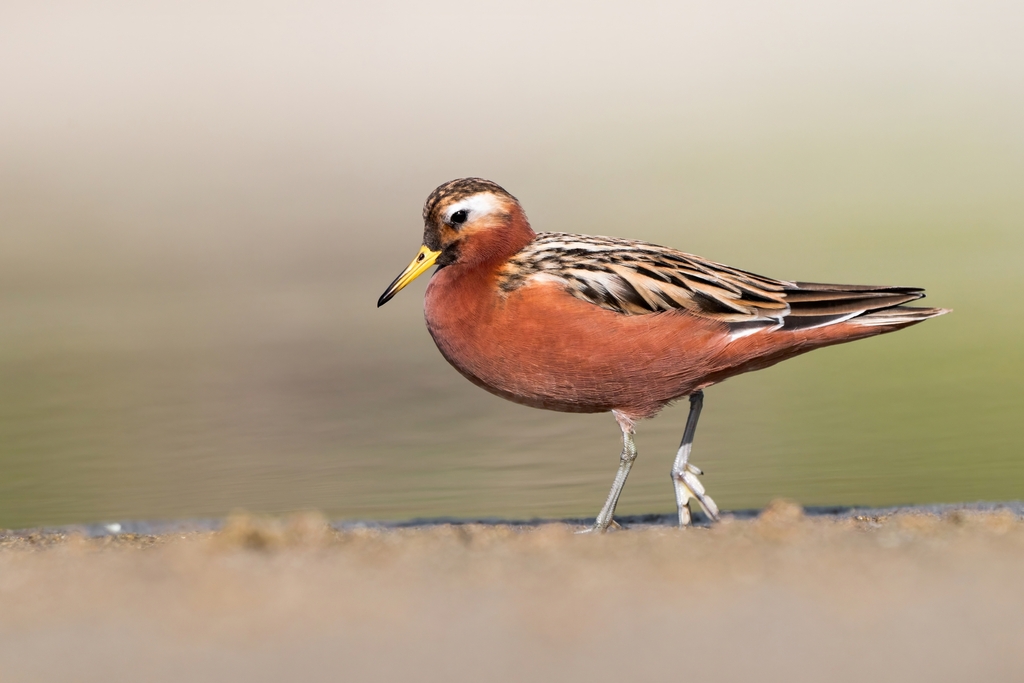
Red Phalarope
Photo © cello caruso-turiello
Photo © cello caruso-turiello — CC BY 4.0 — Source: iNaturalist photo #514385288Identification
The red phalarope is a small wader measuring about 21 cm (8.3 in) in length, distinguished by lobed toes and a straight bill that is somewhat thicker than its close relative, the red-necked phalarope. Breeding females are striking, with predominantly dark brown and black upperparts contrasted against red underparts and distinctive white cheek patches; the bill is yellow with a black tip. Breeding males are duller versions of females. Young birds appear light grey and brown above with buff underparts and a characteristic dark patch through the eye. In winter plumage, both sexes are essentially grey above and white below, though the dark eyepatch persists year-round, and the bill turns black. Their call is a short beek.
Range & Habitat
This phalarope breeds across the Arctic regions of North America and Eurasia. Unusually among waders, it is a highly pelagic migrant, traveling mainly on oceanic routes rather than overland. It winters at sea on tropical oceans, making it one of the few shorebirds that spend much of the year away from coastal habitats. Outside the breeding season, birds are found in open ocean environments, particularly in areas where converging ocean currents produce upwellings—zones often marked by the presence of feeding whales.
Behaviour & Diet
Red phalaropes exhibit a remarkable feeding technique: they swim rapidly in tight circles, creating a small whirlpool that draws food up from shallow water. The bird then plucks small insects and crustaceans from the vortex with its bill. They also occasionally hawk insects in flight. In breeding areas, chicks feed primarily on various fly species (Diptera), including midges and crane flies. Outside the nesting season, they travel in flocks and are often remarkably tame and approachable.
Best Time & Places to See It
Red phalaropes are best observed during migration periods when they pass through or over coastal waters and open ocean. Given their highly pelagic nature, seabird pelagic trips offer the most reliable viewing opportunities. The species is most encountered at sea rather than in traditional shorebird habitats, making ocean-based birding excursions the primary way to encounter them.
Photography Tips
The red phalarope's striking breeding plumage makes it photogenic when accessible, though photographing pelagic species requires boat-based opportunities. Patience is rewarded by their notably tame temperament. For winter birds, focus on capturing the subtle contrast between grey upperparts and white underparts, along with the distinctive dark eyepatch visible in all seasons. Ocean swell and distant subjects present typical seabird photography challenges; stabilization and longer lenses are essential for productive shots from vessels.
Nothing matches these filters.
Tombstone Territorial Park
Acadia National Park
Alaska Maritime National Wildlife Refuge
Archipiélago Juan Fernández National Park
Arctic National Wildlife Refuge
Bannau Brycheiniog National Park
Bardenas Reales
Bitter Lake National Wildlife Refuge
Blackwater National Wildlife Refuge
Nothing matches these filters.
No community photos yet. Log in to add the first one.
No community observations of this species yet.