Red-rumped Bush Tyrant
Photo © Dan Vickers
Photo © Dan Vickers — CC BY 4.0 — Source: iNaturalist #259481262Identification
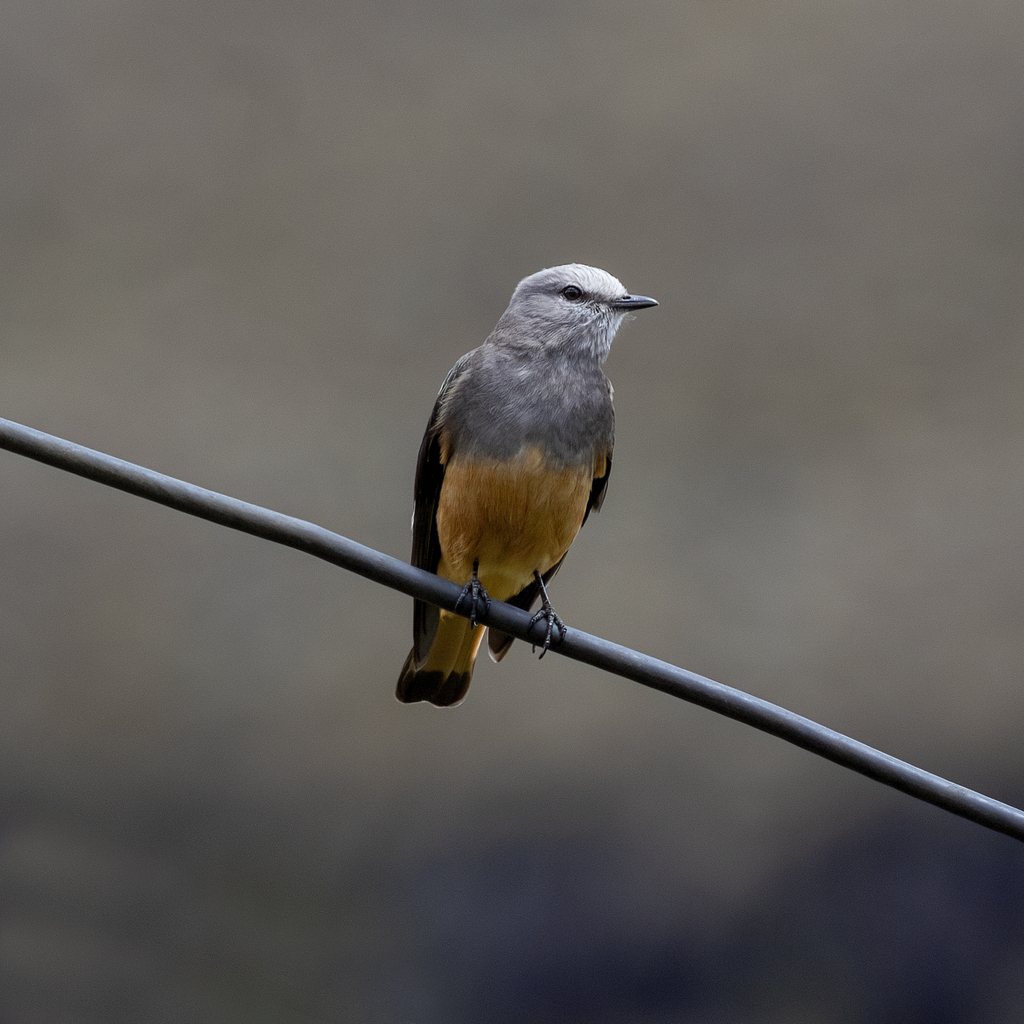
The red-rumped bush tyrant is a small flycatcher measuring 20–23 cm in length. Both sexes share identical plumage, making field identification straightforward. The nominate subspecies displays a distinctive white forecrown that transitions to a hoary gray crown, contrasting sharply with a dark grayish-brown back. The most distinctive feature is its rufous rump, which gives the species its common name. The wings are dark grayish-brown with conspicuous white patches on the tertials that are especially visible in flight. The tail is characteristically bicolored: central feathers blackish, while outer feathers are rufous with blackish tips. Underparts are white on the chin and throat with thin dusky streaks, transitioning to a gray breast that becomes rufous on the belly and undertail coverts. The subspecies C. e. orinomus differs subtly, with a grayer back, browner rump, less black on tail tips, and a paler belly. Both subspecies have a brown iris, black bill, and black legs and feet.
Range & Habitat
This species has a disjunct distribution primarily in Andean regions across Bolivia, Colombia, Ecuador, and Peru. The nominate subspecies ranges from Nariño Department in southwestern Colombia southward through Ecuador and Peru to Cochabamba Department in Bolivia. The subspecies C. e. orinomus occupies isolated populations in Colombia's Sierra Nevada de Santa Marta and the Eastern Andes of Norte de Santander and Cundinamarca. The red-rumped bush tyrant inhabits the grassy and shrubby paramo biome and Polylepis (queñoa) groves at high elevations, ranging from 2,850–4,300 m depending on region, making it a true high-altitude specialist.
Behaviour & Diet
This is a year-round resident that feeds exclusively on insects, employing a distinctive foraging technique: it typically perches atop bushes, trees, or fence posts and drops to the ground to capture prey, though it occasionally hawks insects in mid-air. The red-rumped bush tyrant is generally solitary or found in pairs and notably does not participate in mixed-species feeding flocks, a behavior unusual among high-altitude flycatchers. The species is not particularly vocal, though it produces a repertoire of vocalizations including what is believed to be its song—a rather unpatterned series of mellow mewed whistles and rich churring notes—along with various calls ranging from loud, piercing clear notes to shrill and higher-pitched calls.
Best Time & Places to See It
The red-rumped bush tyrant is a year-round resident throughout its range, so it can be encountered at any season. However, breeding season varies geographically and includes November in Peru and March and September in the Sierra Nevada de Santa Marta. The species is considered very local in Colombia, found at low densities in Ecuador, and rare in Peru, making it a challenging but rewarding target for dedicated birders. High-elevation paramo habitats and Polylepis groves offer the best opportunities for encounters, particularly in protected areas and undisturbed mountain regions.
Photography Tips
Photographing the red-rumped bush tyrant requires patience and high-altitude stamina. The species' preference for perching atop exposed bushes and fence posts can work in the photographer's favor, offering relatively open perches against mountain backdrops. The distinctive white tertial patches and rufous rump are key identification features worth capturing, particularly in flight shots where these markings are most conspicuous. Early morning light in paramo habitats provides excellent conditions for showcasing the subtle plumage contrasts. Given the species' solitary habits and tendency to remain at high elevations, a powerful telephoto lens (500mm or greater) and sturdy tripod are essential equipment for reaching this remote and elusive bird.
Sangay National Park
Cebadas, Ecuador
+320 birds+10 mammals
High in Ecuador's Andean spine, where the Western Cordillera rises to touch perpetual snow, a landscape of volcanic drama and ecological intensity unfolds across Sangay National…
VIEW NATIONAL PARKYacuri National Park
Las Juntas, Ecuador
+166 birds+1 mammals
Where the eastern slopes of the Andes descend into Ecuador's southern frontier, Yacuri National Park unfolds across nearly 1,300 square kilometers of montane cloud forest and…
VIEW NATIONAL PARKAntisana National Park
Quijos, Ecuador
+432 birds+21 mammals
Where the eastern Andean slopes descend into the Amazon basin, Antisana National Park sprawls across roughly 2,500 square kilometers of some of South America's most dramatic…
VIEW NATIONAL PARKCotopaxi National Park
Mulaló, Ecuador
+211 birds+6 mammals
High in Ecuador's volcanic corridor, where the páramo transitions into cloud forest along the slopes of Cotopaxi volcano, the national park unfolds across nearly 500 square…
VIEW NATIONAL PARKLlanganates National Park
Tena, Ecuador
+239 birds+8 mammals
Where the eastern slopes of the Andes plunge toward the Amazon basin, Llanganates National Park sprawls across nearly 3,500 square kilometers of montane wilderness, its terrain…
VIEW NATIONAL PARKCajas National Park
Cuenca, Ecuador
+190 birds+7 mammals
High in the Andes above Cuenca, where elevation ranges from 3,100 to 4,200 metres, the páramo landscape dominates—a windswept realm of cushion plants, alpine grasses, and…
VIEW NATIONAL PARKNatural Chingaza National Park
Junín, Colombia
+285 birds+6 mammals
Where the Andes rise above three thousand metres in the Cundinamarca region, high-altitude grasslands and cloud forests converge in a landscape shaped by both geology and…
VIEW NATIONAL PARKNatural Sumapaz National Park
Cubarral, Colombia
+368 birds+1 mammals
Where the Andes descend toward the Amazon basin, the high páramo grasslands of Sumapaz National Park sprawl across more than five thousand square kilometers of Meta…
VIEW NATIONAL PARKYanachaga–chemillén National Park
Palcazu, Peru
+639 birds+6 mammals
Where the eastern slopes of Peru's central cordillera plunge into cloud forest, Yanachaga–Chemillén National Park protects nearly three thousand square kilometres of montane wilderness that few…
VIEW NATIONAL PARKNo community photos yet. Log in to add the first one.
No community observations of this species yet.