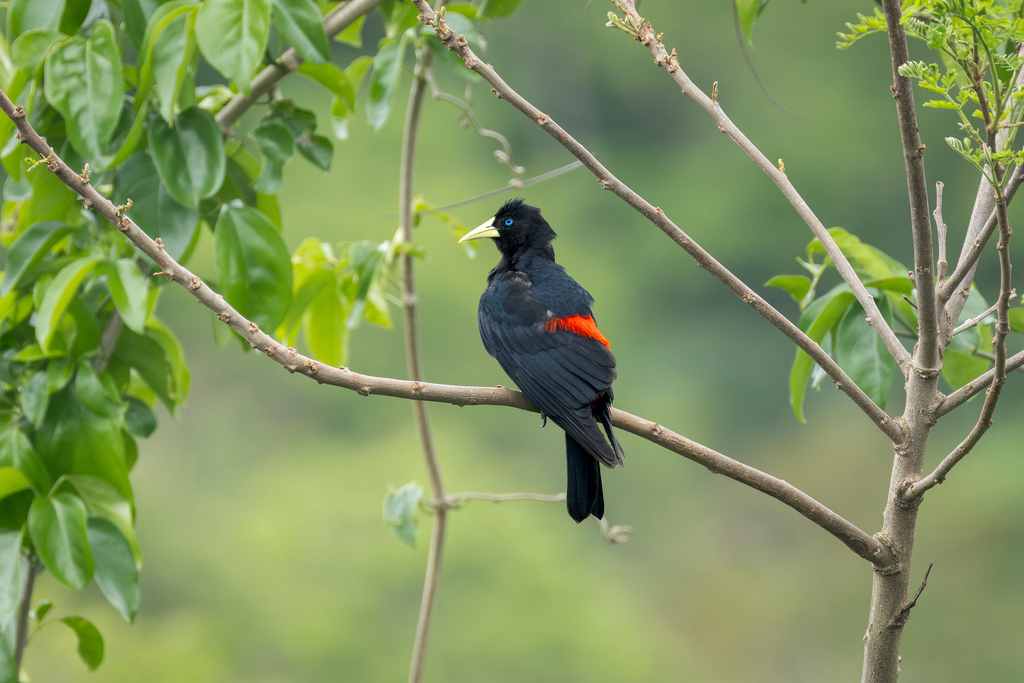
Red-rumped Cacique
Photo © Chris Kirby-Lambert
Photo © Chris Kirby-Lambert — CC BY 4.0 — Source: iNaturalist photo #606170273Identification
The red-rumped cacique is a medium-sized passerine, with males averaging 29 cm in length and females slightly smaller at 25 cm. The species is unmistakable in the field: both sexes are mostly glossy black with a bright red lower back and rump that gives the species its common name. Males display a pale blue iris, while females have a brownish-blue iris; both sexes sport an ivory-colored bill contrasting sharply with black legs and feet. Females are overall duller than males, and juveniles resemble adult females. Three subspecies are recognized, with minor variations in bill thickness and plumage gloss, though all share the distinctive red rump that makes identification straightforward for travellers.
Range & Habitat
The red-rumped cacique occurs throughout mainland South America except Chile, with a disjunct distribution across three subspecies. The northernmost populations range from southeastern Colombia through southern Venezuela and the Guianas to northeastern Brazil, with intermittent populations extending south through Ecuador, Peru, and Amazonian Brazil. A separate southern subspecies inhabits eastern Brazil from Pernambuco and northern Minas Gerais south through Paraguay into northeastern Argentina. The species favours forest edges, clearings, and gallery forests, occurring in both primary and secondary growth. Amazonian populations prefer the forest periphery and plantations, while southern populations inhabit woodland and forest stands, often breeding in small towns and suburbs. Elevations range from below 500 m in Colombia to 1,000 m in Peru and Brazil.
Behaviour & Diet
Red-rumped caciques are sedentary year-round residents that forage in flocks, sometimes numbering more than 80 individuals in the non-breeding season. They feed on insects, arthropods, small vertebrates, fruits, and nectar, foraging primarily in trees but also exploiting vines and epiphytes. These birds are highly social breeders, nesting in colonies typically of 20 to 30 nests in Amazonia, though southern populations may form colonies of 85 to 100 nests. Females construct distinctive long, purse-like woven nests hung from tree branches or palm fronds, laying clutches of two whitish eggs marked with reddish brown. Incubation lasts 17 to 18 days, with fledging occurring 23 to 28 days after hatching. Breeding seasons vary regionally, spanning September to May in Suriname and August to January in Argentina.
Best Time & Places to See It
For the best viewing opportunities, travellers should visit the Amazon Basin during the breeding season (August to May depending on region), when colonies are most active and conspicuous. The northern subspecies is accessible in the Guianas, Venezuela, and northeastern Brazil, while the southern subspecies can be found in central and southeastern Brazil, Paraguay, and northeastern Argentina. Forest edges and clearings, particularly around isolated trees that host nesting colonies, offer the most reliable sightings. Early morning hours are optimal for observing foraging flocks and hearing the species' characteristic loud, complex vocalizations that help locate colonies in dense vegetation.
Photography Tips
The bright red rump and glossy black plumage create excellent contrast for photography, particularly in dappled forest light. Position yourself near fruiting trees or flowering vines where foraging flocks congregate. During breeding season, colonies offer abundant opportunities for action shots—focus on females entering nests or parents provisioning nestlings. The pale blue iris of males and the distinctive bill colouration warrant close-up attention. Early morning light accentuates the glossy black plumage and makes the red rump pop; avoid harsh midday shadows in the forest canopy. For flight shots, watch for birds commuting between foraging and roosting sites, particularly at dawn and dusk.
Tijuca National Park
Brazil
+317 birds+13 mammals
Where the Atlantic forest rises steeply from Rio de Janeiro's urban edge, Tijuca National Park encompasses a landscape of dramatic granite peaks, cascading waterfalls, and closed-canopy…
VIEW NATIONAL PARKYasuní National Park
Aguarico, Ecuador
+601 birds+43 mammals
Where the western Amazon basin converges with Ecuador's Orellana Province, lowland rainforest reaches toward the horizon in an unbroken canopy of staggering botanical density. Yasuní National…
VIEW NATIONAL PARKNatural Sierra de Chiribiquete National Park
Solano, Colombia
+359 birds+27 mammals
Massive table-top mountains rise abruptly from the lowland rainforest of southeastern Colombia, their sheer sandstone cliffs and isolated summits creating some of the most dramatic topography…
VIEW NATIONAL PARKNatural Sierra de la Macarena National Park
Vista Hermosa, Colombia
+566 birds+15 mammals
Across nearly 20,000 square kilometres of Colombia's Meta Department, the terrain rises from lowland savanna into Andean foothills through a mosaic of gallery forests, palm-fringed wetlands,…
VIEW NATIONAL PARKAmacayacu National Park
Leticia, Colombia
+567 birds+25 mammals
Where the Rio Amazonas curves through the tri-border region where Colombia, Peru, and Brazil converge, Amacayacu National Park sprawls across more than 5,250 square kilometres of…
VIEW NATIONAL PARKSuperagui National Park
Brazil
+246 birds+2 mammals
Where the Atlantic rainforest meets the subtropical coast of Paraná, Superagui National Park sprawls across more than 1,000 square kilometres of one of Brazil's most biodiverse…
VIEW NATIONAL PARKSaint-Hilaire/Lange National Park
Brazil
+225 birds
Subtropical Atlantic forests rise and fall across the plateaus of inland Paraná, where Saint-Hilaire/Lange National Park protects nearly 578 square kilometres of Brazil's most biodiverse woodland…
VIEW NATIONAL PARKSerra da Bocaina National Park
Brazil
+441 birds+5 mammals
Where the escarpment of the Serra da Bocaina rises sharply from the Atlantic coastal plain, tropical rainforest cloaks steep mountainsides that climb toward peaks exceeding 2,000…
VIEW NATIONAL PARKViruá National Park
Brazil
+389 birds+6 mammals
Across the northern frontier of Roraima, where the forest canopy rises from ancient Amazonian lowlands, Viruá National Park protects nearly 3,700 square kilometres of terra firme…
VIEW NATIONAL PARKIguaçu National Park
Brazil
+387 birds+17 mammals
Where the Paraná Plateau plunges toward the Atlantic watershed, six thousand square kilometers of subtropical rainforest cling to steep gorges and river valleys in this corner…
VIEW NATIONAL PARKIlha Grande National Park
Brazil
+233 birds
Across the subtropical plateaus and Atlantic forest remnants of southern Brazil, a vast protected landscape spanning nearly 4,600 square kilometers safeguards one of the continent's most…
VIEW NATIONAL PARKPau Brasil National Park
Brazil
+211 birds
Tropical Atlantic forest cloaks the rolling terrain of northeastern Bahia, where Pau Brasil National Park protects nearly 390 square kilometers of one of Brazil's most biodiverse…
VIEW NATIONAL PARKSerra dos Órgãos National Park
Brazil
+446 birds+13 mammals
Granite peaks thrust skyward through the Atlantic Forest canopy in the mountains immediately north of Rio de Janeiro, their bare rock faces rising above a landscape…
VIEW NATIONAL PARKChapada Diamantina National Park
Brazil
+346 birds+5 mammals
Where granite peaks and sandstone cliffs rise abruptly from the Brazilian interior, Chapada Diamantina National Park sprawls across 4,215 square kilometers of some of Brazil's most…
VIEW NATIONAL PARKAraucárias National Park
Brazil
+231 birds+3 mammals
Where the southern Brazilian highlands rise into cool temperate forest, Araucárias National Park protects one of the Atlantic Forest's most distinctive ecosystems across 506 square kilometres…
VIEW NATIONAL PARKAmazônia National Park
Brazil
+439 birds+6 mammals
Where the Rio Amazonas and its tributaries weave through the heart of Pará state, a vast tapestry of rainforest stretches across 23,611 square kilometers of unbroken…
VIEW NATIONAL PARKJaú National Park
Brazil
+354 birds+3 mammals
Vast floodplain forests and blackwater rivers define this remote corner of western Amazonas, where the Rio Negro and its tributaries have carved an intricate mosaic of…
VIEW NATIONAL PARKPacaás Novos National Park
Brazil
+279 birds+1 mammals
Across the border between Rondônia and Amazonas, vast tracts of humid tropical forest rise and fall in gentle undulations, carved by clear-flowing rivers that feed into…
VIEW NATIONAL PARKAnavilhanas National Park
Brazil
+468 birds+8 mammals
Across the Rio Negro in central Amazonas, an archipelago of over a thousand islands rises from the world's largest rainforest river system, creating a labyrinth of…
VIEW NATIONAL PARKCampos Gerais National Park
Brazil
+143 birds
Where rolling plateaus rise above the Atlantic forest escarpment in Paraná's interior, Campos Gerais National Park unfolds across 539 square kilometers of highland grassland and forest…
VIEW NATIONAL PARKSerra do Divisor National Park
Brazil
+448 birds+10 mammals
Where the western Amazon meets the Andes foothills, Serra do Divisor National Park sprawls across one of South America's most biodiverse and least accessible frontiers. Spanning…
VIEW NATIONAL PARKManu National Park
Manu, Peru
+892 birds+26 mammals
Across the eastern slopes of the Peruvian Andes, tropical rainforest descends into the Amazon basin with a complexity that few terrestrial ecosystems match. Manu National Park…
VIEW NATIONAL PARKBahuaja Sonene National Park
San Pedro de Putina Punco, Peru
+602 birds+8 mammals
Where the Madre de Dios and Heath rivers converge in southeastern Peru rises one of South America's most biodiverse wilderness regions: a vast protected realm of…
VIEW NATIONAL PARKTingo Maria National Park
Mariano Dámaso Beraún, Peru
+423 birds
Where the eastern slopes of the Peruvian Andes descend toward the Amazon basin, the landscape fractures into a maze of limestone ridges, humid gorges, and cloud-wrapped…
VIEW NATIONAL PARKIguazú National Park
Puerto Iguazú, Argentina
+346 birds+15 mammals
Where the Paraná Plateau plunges toward the Atlantic watershed, nearly 800 square kilometers of subtropical rainforest drape across Misiones Province in a landscape carved by millennia…
VIEW NATIONAL PARKNo community photos yet. Log in to add the first one.
No community observations of this species yet.