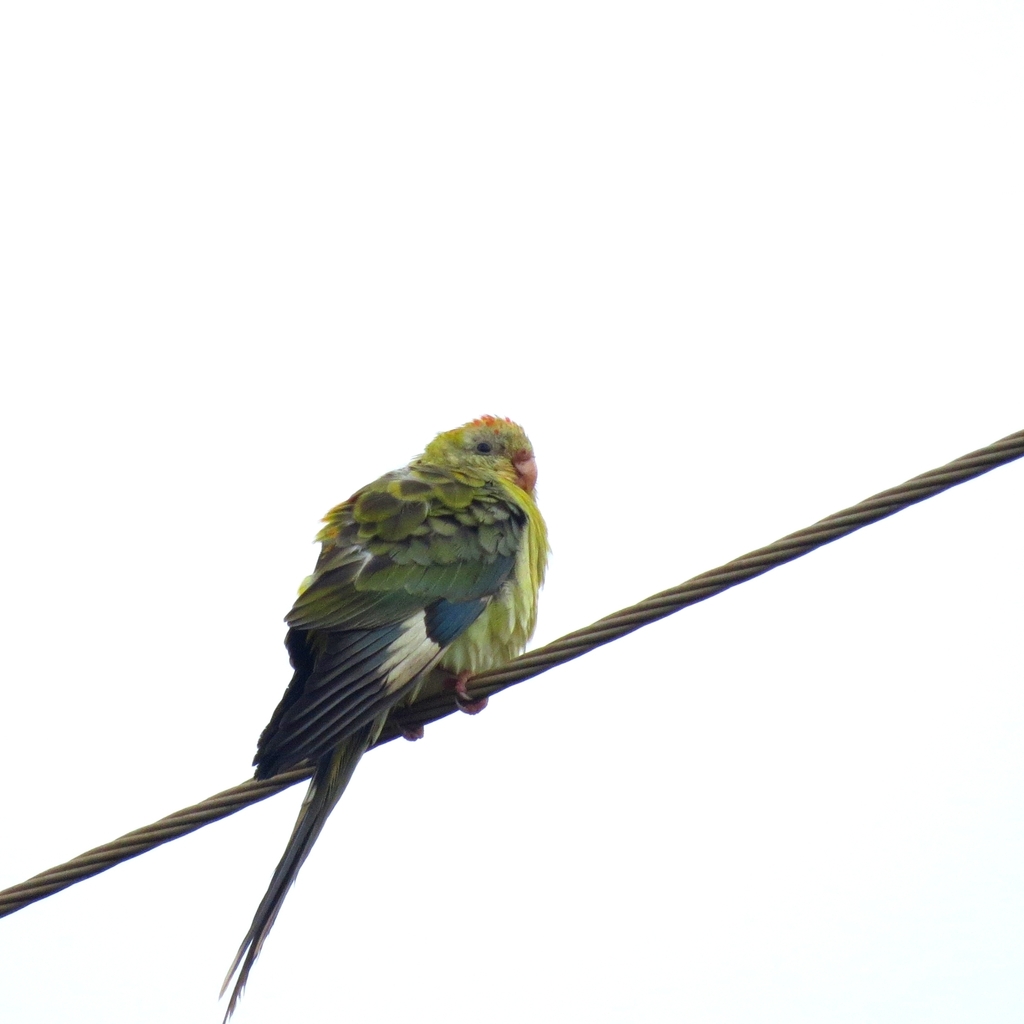
Red-rumped Parrot
Photo © Alan Estumano
Photo © Alan Estumano — CC BY 4.0 — Source: iNaturalist #263279290Identification
The red-rumped parrot is a slim, moderate-sized parrot measuring approximately 28 cm (11 in) in length. It is highly sexually dimorphic, making identification straightforward. Adult males display vibrant plumage with bright emerald-green upperparts, yellow underparts, and a distinctive brick-red lower back and rump—the feature that gives the species its common name. Males also show blue highlights on the wings and upper back, with bright yellow shoulder patches. Adult females are considerably less vibrant, with pale olive underparts and dull olive-green mantle and upper back; their lower back and rump are lime-green rather than red. Juvenile males resemble females but possess red rumps and light blue-green faces. Both sexes have grey bills (darker in males) and dark-grey flight feathers with dark blue underwing coverts visible in flight. Females of all ages display an off-white underwing bar.
Red-rumped parrots can be distinguished from the similar mulga parrot by overall colour differences, particularly the mulga's yellow band above the bill and red patch on the nape. The light brown irises of males and light grey-brown irises of females are also useful identification features.
Range & Habitat
The red-rumped parrot is endemic to south-eastern Australia, widely distributed throughout open woodland and grassy habitats in the Murray-Darling Basin and surrounding regions. Their range encompasses most of New South Wales and Victoria, as well as parts of southern Queensland and eastern South Australia, typically below 1,000 metres elevation. The nominate subspecies, P. h. haematonotus, is found throughout much of New South Wales and Victoria, while the subspecies P. h. caeruleus occurs further inland near the Queensland-South Australia border.
These parrots favour open, lightly timbered plains and deliberately avoid coastal and heavily wooded areas. They have adapted remarkably well to human-modified landscapes and are commonly found in paddocks, fields, farmland, roadside verges, parks and gardens, making them accessible to travellers throughout rural and suburban areas across their range.
Behaviour & Diet
Red-rumped parrots are non-migratory, though they undertake local movements after breeding. They are highly social, found in pairs or flocks that can occasionally number up to 100 or more birds. These parrots are notably crepuscular, being most active during dawn and dusk while avoiding activity during the hottest parts of the day. They spend considerable time foraging on the ground for a variety of seeds, and their green plumage provides such effective camouflage in ankle-length grasses that they can remain hidden until an observer is only 10–20 metres away. They maintain contact with one another using an attractive, distinctive call: chee chillip chee chillip.
Red-rumped parrots are monogamous and pair for life. They nest in tree hollows, fenceposts and stumps, laying 4–6 white eggs around 2 centimetres in size. Breeding usually occurs in spring (September–November), though inland populations may breed at any time in response to rainfall. Both sexes defend the nest hollow, with females alone responsible for incubation, which lasts approximately 20–25 days. Birds begin breeding between 12 and 18 months of age.
Best Time & Places to See It
Red-rumped parrots are most active during dawn and dusk, making these the optimal times for observation and photography. Early morning and late afternoon visits to suitable habitats will maximise sighting opportunities. Their non-migratory status means they are present year-round throughout their range, though local movements occur following the breeding season. During the breeding season (September–November in spring, or following rainfall in drier inland areas), birds may be observed near nesting sites.
Look for red-rumped parrots in open woodland, grassy paddocks, parks and gardens throughout south-eastern Australia, particularly in New South Wales and Victoria. Their adaptation to suburban and rural environments means they can often be found in accessible locations near towns and farmland, making them relatively easy to locate compared to forest-dwelling species. Watch for them feeding on the ground in open grassland, where their cryptic green plumage blends remarkably well with vegetation.
Photography Tips
The sexual dimorphism of red-rumped parrots offers excellent opportunities to photograph both vibrant males and subtly coloured females. The males' emerald-green and red plumage creates striking colour contrasts, while the females' softer olive-green tones provide different aesthetic appeal. Early morning and late afternoon light will enhance the males' jewel-like plumage, particularly their yellow underparts and red rumps. Ground-feeding birds allow photographers to position themselves at eye level with subjects, creating engaging compositions.
Since these parrots spend much time foraging on the ground and can remain hidden until very close approach, patience and slow movement are essential. Their effective camouflage in grassland means scanning ankle-length grass carefully will reveal hidden birds. When photographing pairs or small flocks, capture the attractive interaction between individuals and their characteristic calling behaviour. The dark flight feathers and blue underwing coverts are particularly prominent when birds take flight, offering dynamic shooting opportunities.
Bunya Mountains National Park
Australia
+149 birds+11 mammals
Where subtropical rainforest meets open eucalyptus woodland on the elevated plateau of southeastern Queensland, Bunya Mountains National Park unfolds across 483 square kilometres of some of…
VIEW NATIONAL PARKGreater Bendigo National Park
Whipstick, Australia
+202 birds+8 mammals
Across the red volcanic plains of inland Victoria, Greater Bendigo National Park sprawls across more than 1,000 square kilometres of eucalyptus woodland, open grassland, and scattered…
VIEW NATIONAL PARKChiltern-Mt Pilot National Park
Australia
+229 birds+12 mammals
Granite ridges and eucalyptus woodlands define this 869-square-kilometre park straddling the border between Victoria and New South Wales, where rugged terrain rises sharply from gentler foothill…
VIEW NATIONAL PARKIkara-Flinders Ranges National Park
Australia
+149 birds+10 mammals
Where ancient quartzite ridges rise across the semi-arid heart of South Australia, Ikara-Flinders Ranges National Park unfolds across nearly two thousand square kilometres of one of…
VIEW NATIONAL PARKKinglake National Park
Australia
+164 birds+11 mammals
Where the volcanic plains of central Victoria rise into forested ridges, Kinglake National Park encompasses roughly 844 square kilometres of diverse habitat that represents one of…
VIEW NATIONAL PARKLower Glenelg National Park
Australia
+161 birds+12 mammals
Where the Glenelg River carves through southeastern Victoria's limestone country, Lower Glenelg National Park unfolds across nearly 800 square kilometres of river gorge, eucalypt woodland, and…
VIEW NATIONAL PARKBudj Bim National Park
Australia
+137 birds+7 mammals
Across southwestern Victoria's volcanic plains, Budj Bim National Park preserves a landscape shaped by ancient lava flows and Indigenous land stewardship spanning millennia. The park's 184…
VIEW NATIONAL PARKRoyal National Park
Sydney, Australia
+296 birds+46 mammals
Where sandstone ridges plunge toward the Tasman Sea, Royal National Park unfolds across 343 square kilometres of southeastern Australian coastal wilderness. The park's defining character emerges…
VIEW NATIONAL PARKLittle Desert National Park
Australia
+200 birds+11 mammals
Across northwestern Victoria's semi-arid interior, sandstone ridges and heathland plateaus rise from red earth in a landscape sculpted by fire and drought rather than water. Little…
VIEW NATIONAL PARKBelair National Park
Adelaide, Australia
+126 birds+18 mammals
Eucalyptus woodland and native shrubland cloak the low hills of this Adelaide park, where ancient quartzite ridges rise above the plains of South Australia's densest metropolitan…
VIEW NATIONAL PARKCleland National Park
Australia
+127 birds+14 mammals
Eucalypt woodlands rise and fall across Adelaide's nearby hills, where Cleland National Park sprawls across some twenty square kilometres of native South Australian bushland. The terrain…
VIEW NATIONAL PARKOnkaparinga River National Park
Adelaide, Australia
+126 birds+16 mammals
Where the Onkaparinga River winds through the Adelaide Hills and down toward the coastal plain, a mosaic of eucalyptus woodland, riparian corridors, and open grassland creates…
VIEW NATIONAL PARKNaracoorte Caves National Park
Australia
+116 birds+12 mammals
Beneath the grassy limestone plains of southeastern South Australia lies one of the Southern Hemisphere's most significant underground landscapes. Naracoorte Caves National Park encompasses a mosaic…
VIEW NATIONAL PARKLockyer National Park
Australia
+130 birds+5 mammals
Steep ridges and weathered escarpments rise from the Brisbane Valley in southeastern Queensland, where Lockyer National Park sprawls across 267 square kilometres of eucalypt woodland and…
VIEW NATIONAL PARKSundown National Park
Australia
+211 birds+9 mammals
Granite ridges and eucalypt woodlands define this 305-square-kilometre expanse of southeastern Queensland, where the landscape descends from sandstone plateaus into open forests and grassy clearings that…
VIEW NATIONAL PARKBald Rock National Park
Australia
+122 birds+15 mammals
Granite peaks and weathered stone dominate the landscape of this 202-square-kilometre national park in inland New South Wales, where rugged tors and rocky outcrops rise dramatically…
VIEW NATIONAL PARKGirraween National Park
Australia
+193 birds+21 mammals
Granite boulders rise like the bones of the earth across these 278 square kilometres of southeastern Queensland, where the Great Dividing Range descends towards the coastal…
VIEW NATIONAL PARKMorton National Park
Australia
+253 birds+57 mammals
Across nearly 4,800 square kilometers of New South Wales's Southern Tablelands, rugged sandstone plateaus rise above sheltered valleys where cool-climate eucalypt woodland meets grassy heath and…
VIEW NATIONAL PARKBlue Mountains National Park
Australia
+220 birds+43 mammals
Dramatic sandstone cliffs rise in tiers across this mountainous plateau west of Sydney, their rust-coloured faces weathered into amphitheatres and gorges where eucalyptus forest clings to…
VIEW NATIONAL PARKKosciuszko National Park
Australia
+211 birds+52 mammals
Where the Great Dividing Range reaches its highest peaks in southeastern Australia, Kosciuszko National Park encompasses a landscape of windswept plateaus, rocky ridges, and deep river…
VIEW NATIONAL PARKMungo National Park
Australia
+135 birds+7 mammals
Across the semi-arid inland plains of New South Wales, where sparse shrubland and scattered grassland stretch beneath enormous skies, lies a landscape shaped by ancient geological…
VIEW NATIONAL PARKWarrumbungle National Park
Coonabarabran, Australia
+183 birds+22 mammals
Volcanic peaks and weathered ridges rise abruptly from the inland tablelands of central New South Wales, their exposed rock faces glowing ochre and rust in the…
VIEW NATIONAL PARKOxley Wild Rivers National Park
Australia
+202 birds+45 mammals
Where the New England Tablelands descend toward the coast, river gorges carve through temperate forests in a landscape of dramatic geological contrast. Oxley Wild Rivers National…
VIEW NATIONAL PARKGrampians National Park
Australia
+214 birds+18 mammals
Where sandstone ridges rise above the Western District of Victoria, Grampians National Park unfolds across rolling terrain sculpted by ancient geology and sustained by a temperate…
VIEW NATIONAL PARKGreat Otway National Park
Australia
+255 birds+42 mammals
Temperate rainforest and wet eucalyptus woodland cloak the ridges and gullies of Victoria's Great Otway National Park, where persistent moisture and mild year-round temperatures sustain a…
VIEW NATIONAL PARKMurray-Sunset National Park
Australia
+205 birds+2 mammals
Across the semi-arid borderlands of northwestern Victoria, where the Murray River defines the state's edge, sprawls a landscape of remarkable resilience and subtle beauty. Murray-Sunset National…
VIEW NATIONAL PARKPort Campbell National Park
Port Campbell, Australia
+170 birds+7 mammals
Dramatic sea cliffs rise from churning waters along Victoria's southwestern coast, where sandstone and limestone formations tower over a hundred metres above the Southern Ocean. Port…
VIEW NATIONAL PARKCoorong National Park
Australia
+217 birds+15 mammals
Where the Murray River meets the Southern Ocean, a chain of shallow lagoons stretches across the South Australian coast, separated from the sea by a ribbon…
VIEW NATIONAL PARKNo community photos yet. Log in to add the first one.
No community observations of this species yet.