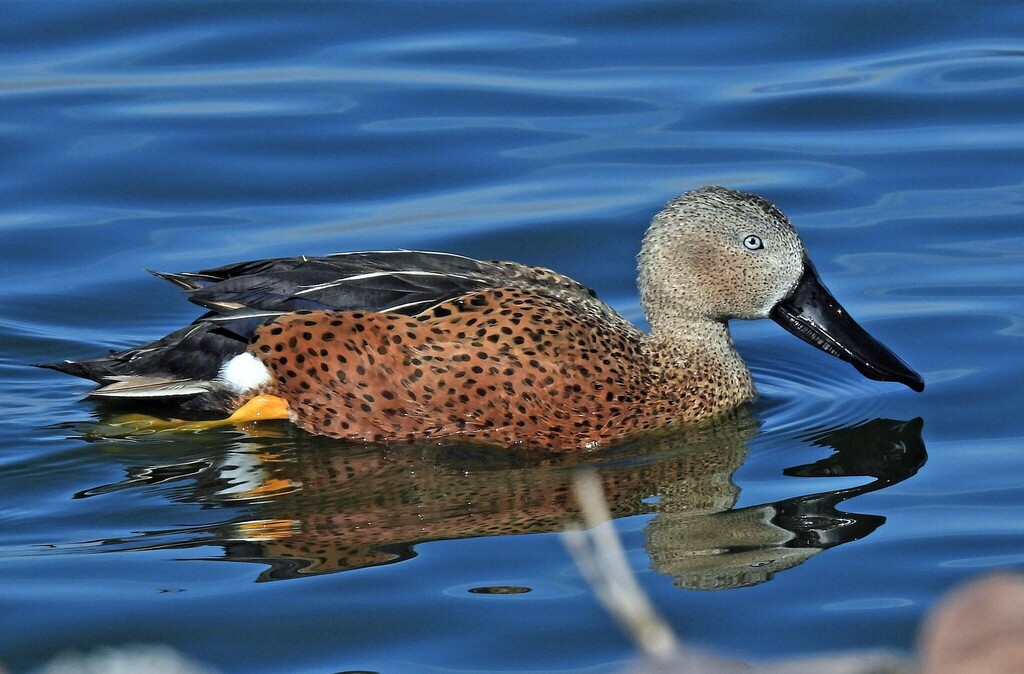
Red Shoveler
Photo © Hugo Hulsberg
Photo © Hugo Hulsberg — CC0 1.0 — Source: iNaturalist photo #295509101Identification
The red shoveler is a medium-sized dabbling duck, measuring 45–56 centimetres in length with a wingspan of 66–73 centimetres and weighing around 523–608 grams. The species is instantly recognizable by its distinctive spatula-shaped bill—the source of both its common and scientific names. Males display striking plumage ranging from deep red to paler shades of red and pink, while females are more subdued and notable for their large, dark bills. Both sexes share a green speculum (the iridescent patch on the wing) and light blue upper wing coverts, which are visible in flight.
Range & Habitat
Native to southern South America, the red shoveler breeds across a broad range extending from Tierra del Fuego northwards through Chile and most of Argentina, reaching the Falkland Islands. Smaller, isolated breeding populations exist in the southern regions of Peru, Bolivia, and Paraguay, with additional populations in the extreme south of Brazil and Uruguay. These ducks favour shallow lakes and pools with dense reed beds, as well as intertidal mangrove swamps and marshes. They are equally at home in brackish waters, including coastal lagoons, deltas, and estuaries.
Behaviour & Diet
Red shovelers are dabbling ducks adapted to filter-feeding in shallow water. Their specialized lamellate bill mechanism allows them to extract small food items from the water column with remarkable efficiency. Their diet is diverse, consisting of herbs, grasses, pond weeds, widgeon grass, algae, eelgrass, and small invertebrates. The species is partially migratory, with southernmost populations moving north during winter months to escape the harshest conditions.
Breeding pairs form on the wintering grounds following often noisy courtship displays. Females lay clutches of 7–8 eggs, with an incubation period of approximately 25–26 days. Ducklings remain dependent for 40–45 days before fledging.
Best Time & Places to See It
The red shoveler is relatively common and widespread throughout its southern South American range, making it accessible to wildlife travellers visiting Patagonia, the Falkland Islands, or wetland areas of Argentina and Chile. The species is classified as Least Concern, with a stable population and extremely large range. Breeding season offers opportunities to observe courtship behaviour and family groups, while winter months may bring northern visitors to lower-latitude wetlands in Paraguay, Bolivia, and Peru.
Photography Tips
The red shoveler's distinctive bill and colourful plumage, particularly in males, make it an rewarding photographic subject. The light blue upper wing coverts and green speculum are best captured in flight photography. Early morning visits to shallow lakes, reed-fringed pools, and coastal lagoons offer the best lighting and activity levels. Photograph during breeding season to capture males in full plumage or document family groups with ducklings, though approach carefully to avoid disturbing nesting birds concealed in dense vegetation.
Peixe National Park Lagoon
Brazil
+293 birds+4 mammals
Where the coastal plains of Rio Grande do Sul meet the Atlantic, Peixe National Park Lagoon sprawls across nearly 2,200 square kilometres of shallow waters, reed…
VIEW NATIONAL PARKChiloé National Park
Dalcahue, Chile
+122 birds+6 mammals
Temperate rainforest cloaks the Chiloé archipelago's northwestern reaches, where granite ridges thrust through dense, moisture-laden canopy and freshwater streams carve ravines toward the Pacific. Across approximately…
VIEW NATIONAL PARKTorres del Paine National Park
Torres del Paine, Chile
+143 birds+10 mammals
Where granite spires pierce the Patagonian sky, Torres del Paine commands one of South America's most dramatic landscapes. Across 4,106 square kilometres of southern Chile, jagged…
VIEW NATIONAL PARKLaja National Park Lagoon
Antuco, Chile
+123 birds+1 mammals
Where the Andes descend into the Biobío Region's temperate forests, a vast lagoon fills the caldera of the extinct Antuco volcano, cradled by steep native woodland…
VIEW NATIONAL PARKPuyehue National Park
Puyehue, Chile
+110 birds+4 mammals
Across the volcanic spine of the Los Lagos Region, where the Andes descend toward temperate rainforest, Puyehue National Park encompasses nearly 2,600 square kilometers of one…
VIEW NATIONAL PARKCerro Castillo National Park
Coyhaique, Chile
+89 birds+3 mammals
Granite peaks and windswept steppe converge across this vast Patagonian landscape, where the Andes' eastern flank drops into terrain sculpted by ice age glaciers and relentless…
VIEW NATIONAL PARKPatagonia National Park
Cochrane, Chile
+133 birds+8 mammals
Where the Andes meet the Patagonian steppe, vast grasslands and shrublands sweep across rolling terrain carved by ancient glaciation, their contours softened by distance and dramatic…
VIEW NATIONAL PARKParque Provincial Península de Magallanes
Argentina
+125 birds+4 mammals
Granite peaks and windswept steppe converge across this 415-square-kilometre peninsula jutting into the cold Atlantic waters of southern Patagonia, where the Magallanes landscape embodies the raw,…
VIEW NATIONAL PARKMonte León National Park
Argentina
+100 birds+4 mammals
Where the Patagonian steppe meets the Atlantic, Monte León National Park protects a landscape of windswept coastal cliffs, rocky outcrops, and semi-arid grassland spanning over 1,200…
VIEW NATIONAL PARKLos Glaciares National Park
Argentina
+121 birds+3 mammals
Where granite peaks and sprawling ice fields dominate the landscape, Los Glaciares National Park encompasses over ten thousand square kilometres of Patagonian wilderness in southern Argentina.…
VIEW NATIONAL PARKEl Palmar National Park
Distrito Sexto, Argentina
+244 birds+14 mammals
Across the Paraná River floodplain in northeastern Argentina, palms rise from wetland and grassland in a landscape shaped by water and time. El Palmar National Park…
VIEW NATIONAL PARKCampos del Tuyú National Park
Argentina
+169 birds+5 mammals
Subtropical forest graces the borderlands where Misiones Province meets Paraguay, a landscape shaped by the Paraná Plateau's weathered topography and the warm, humid climate of northeastern…
VIEW NATIONAL PARKPerito Moreno National Park
Argentina
+78 birds
Where the Patagonian steppe descends into a landscape carved by ancient ice, Perito Moreno National Park sprawls across nearly 1,590 square kilometres of some of South…
VIEW NATIONAL PARKEl Rey National Park
Municipio de Las Lajitas, Argentina
+317 birds+4 mammals
Where the eastern slopes of the Andes descend into northwestern Argentina's subtropical transition zone, El Rey National Park unfolds across 841 square kilometers of dramatically varied…
VIEW NATIONAL PARKNahuel Huapi National Park
Argentina
+124 birds+11 mammals
Where the Andes descend toward Patagonia, vast glacial lakes cut through a landscape of southern beech forest and granite peaks, creating one of South America's most…
VIEW NATIONAL PARKLanín National Park
Argentina
+128 birds+7 mammals
Where the volcanic spine of the Andes plunges into Patagonian steppe, Lanín National Park sprawls across nearly 4,700 square kilometers of one of Argentina's most visually…
VIEW NATIONAL PARKSierra de las Quijadas National Park
Argentina
+168 birds+5 mammals
Sandstone cliffs and deeply incised canyons define this 1,137-square-kilometre expanse in San Luis Province, where the dry Chacoan landscape of central Argentina reveals an unexpected ecological…
VIEW NATIONAL PARKLago Puelo National Park
Argentina
+109 birds+1 mammals
Where temperate forests descend to crystalline waters in the foothills of the Andes, Lago Puelo National Park sprawls across nearly 300 square kilometers of pristine wilderness…
VIEW NATIONAL PARKChaco National Park
Municipio de Presidencia de la Plaza, Argentina
+258 birds+7 mammals
Across the humid subtropical lowlands of northeastern Argentina, where the Paraná River basin feeds vast seasonal wetlands and gallery forests, Chaco National Park protects one of…
VIEW NATIONAL PARKNo community photos yet. Log in to add the first one.
No community observations of this species yet.