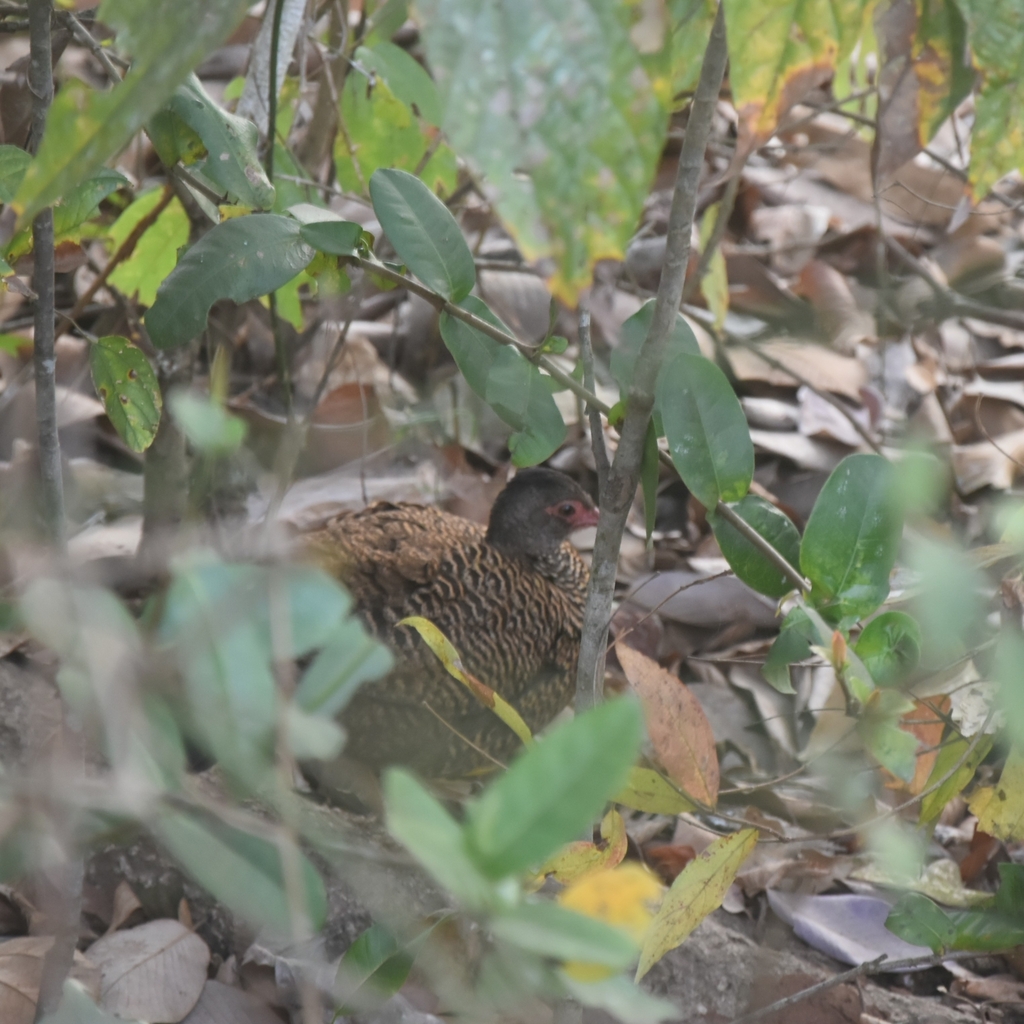
Red Spurfowl
Photo © Name
Photo © Name — CC BY 4.0 — Source: iNaturalist #150123196Identification
The red spurfowl is a large, reddish-brown partridge-like bird with a distinctive long tail and overall robust build. Males display grey on the face and neck, while both sexes feature prominent bare red skin around the eye and red legs bearing one or two spurs—the feature that gives the species its common name. The upper parts are brown with dark barring, and the underside is rufous with dark markings. Both males and females possess long crown feathers that can be erected into a crest. The Kerala subspecies (G. s. stewarti) is particularly striking, with the male displaying all-chestnut plumage including the head feathers, while females show clinal variation becoming darker towards the southern parts of their range.
Range & Habitat
The red spurfowl is endemic to India, found south of the Ganges across the subcontinent from west Nepal and northern India through to central and southern Kerala. The species occupies scrub, dry and moist-deciduous forests often in hilly country, showing a preference for areas with good undergrowth—including those formed by the invasive lantana plant. Three subspecies are recognized across this range: the nominate form in west Nepal and north-central India, the Aravalli race in southern Rajasthan, and the chestnut Kerala race in the south of the peninsula.
Behaviour & Diet
Red spurfowl are secretive despite their size, usually foraging in small parties of three to five birds. They are quite silent during the day but vocal in the mornings and evenings, producing a distinctive ker-wick...kerwick... call and harsh karr...karrr... notes. These birds forage on the ground for fallen seeds, berries, mollusks, and insects, swallowing grit to aid digestion. When walking, they sometimes hold their tail vertical like domestic fowl, and when flushed they fly only a short distance before settling. They maintain well-defined territories throughout the year and roost in trees at night.
Breeding occurs from January to June, primarily before the rains. The species is monogynous, with males playing a role in predator distraction when females have chicks nearby, though males do not incubate eggs. Females lay 3-5 eggs in a ground nest scrape.
Best Time & Places to See It
Red spurfowl are notoriously difficult to observe despite their size due to their secretive nature and preference for dense undergrowth. Your best opportunities come during early mornings and evenings when the birds are most vocal and active. Listen carefully for their distinctive calls, which often betray their presence before they are seen. Focus on forested areas with good undergrowth in hilly country across India south of the Ganges. The Kerala race may be encountered in the south of the peninsula, while the Aravalli race can be found in southern Rajasthan. Patience and a keen ear are essential when searching for this elusive species.
Photography Tips
Photographing red spurfowl presents significant challenges due to their secretive habits and brief visibility when flushed. Early morning and evening visits, when birds are most vocal, offer the best opportunities to locate them and anticipate their movements. Use the distinctive calls as your primary guide to finding birds. Once you locate a bird, approach slowly and carefully, as sudden movement will cause it to flush. A telephoto lens is essential, as the birds are wary and typically only visible for a few seconds before retreating into undergrowth. The bright red facial skin and leg coloration provide good visual targets when framing shots, and the distinctive crest and long tail offer identifying features worth capturing.
Eravikulam National Park
Devikulam, India
+192 birds+7 mammals
High in the Western Ghats of Kerala, where monsoon mists cling to slopes that rise above 2,000 metres, Eravikulam National Park preserves one of South India's…
VIEW NATIONAL PARKKanha Tiger Reserve
Kanha Kisli F.V., India
+321 birds+23 mammals
Where sal forests give way to emerald meadows and crystalline streams carve through ancient valleys, one of India's finest wilderness reserves unfolds across the Maikal Range.…
VIEW NATIONAL PARKTadoba National Park
Palasgaon Singru, India
+270 birds+20 mammals
Where sal forests meet open grasslands and rocky outcrops rise from red laterite soil, central India's landscape unfolds in raw, untamed beauty. Ancient teak woodlands and…
VIEW NATIONAL PARKBandhavgarh National Park
Garhpuri, India
+285 birds+17 mammals
Where granite ridges rise dramatically above sal and bamboo forests, one of India's most pristine tiger reserves unfolds across the Vindhyan plateau. Ancient rock formations tower…
VIEW NATIONAL PARKPeriyar National Park
Mlappara, India
+232 birds+4 mammals
Dawn breaks over mist-shrouded ridges where the Western Ghats tumble toward Kerala's spice-scented lowlands. Here, ancient tropical forests envelope a glittering artificial lake, creating a mosaic…
VIEW NATIONAL PARKPampadum Shola National Park
Vattavada, India
+258 birds+14 mammals
Where misty shola forests cling to the high plateaus of the Nilgiri Mountains, ancient evergreen remnants create a world apart. This 2,316-hectare reserve protects one of…
VIEW NATIONAL PARKBandipur National Park
Hirehalli, India
+302 birds+19 mammals
Where the Western Ghats descend into the Deccan plateau, ancient deciduous forests blanket a landscape carved by the Nugu River. Bandipur unfolds across 880 square kilometres…
VIEW NATIONAL PARKNagarahole Tiger Reserve
Nalkeri Forest, India
+323 birds+23 mammals
Where granite escarpments rise above dense deciduous forests and the Kabini River carves through pristine wilderness, one of India's most biodiverse landscapes unfolds across the Western…
VIEW NATIONAL PARKNo community photos yet. Log in to add the first one.
No community observations of this species yet.