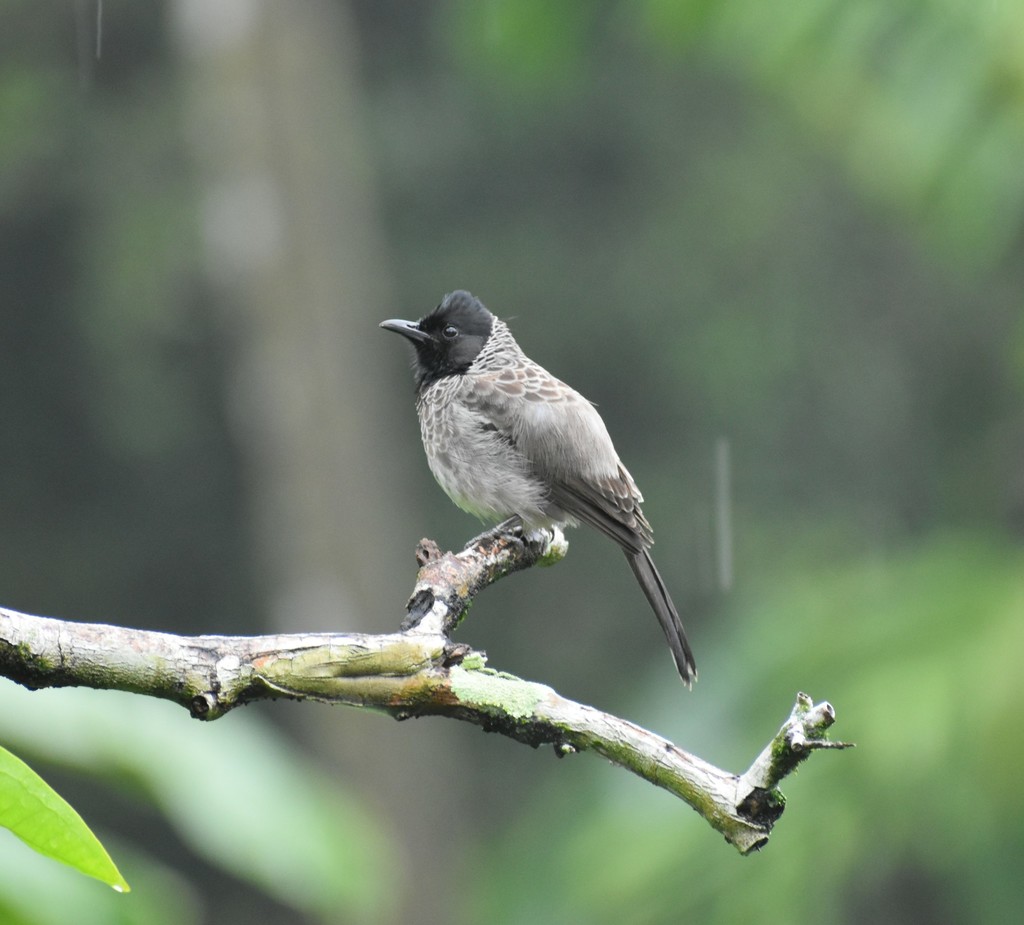
Red-vented Bulbul
Photo © Devika M B
Photo © Devika M B — CC BY 4.0 — Source: iNaturalist #98479490Identification
The red-vented bulbul is easily identified by its distinctive short crest, which gives the head a characteristically squarish appearance. The body is dark brown with a scaly pattern, while the head is darker or black. The most striking field marks are the white rump and bright red vent, which give the species its common name. The bird measures about 20 cm in length and sports a long black tail tipped with white. Sexes are similar in plumage, though young birds are noticeably duller than adults.
Subspecific variation occurs across the species' range. Himalayan races display more prominent crests and streaking on the underside, with the western Himalayan race intermedius showing a distinctive black hood extending to the mid-breast. The desert race humayuni has a paler brown mantle, while the Sri Lankan race haemorrhousus features a dark mantle with narrow pale edges. Melanistic and leucistic individuals have been occasionally recorded.
Range & Habitat
The red-vented bulbul is a resident breeder across South Asia, extending east to Burma, with eight recognized subspecies distributed from the western Himalayas and Pakistan through India, Bangladesh, Nepal, Assam, and into Burma, Thailand, southwest China, and Sri Lanka. The species typically inhabits dry scrub, open forest, plains, and cultivated lands, rarely venturing into mature forests in its native range. Vegetation type has been identified as the single most important factor determining the species' distribution.
Beyond its native range, the red-vented bulbul has established itself as an invasive species on multiple continents and islands, including Argentina, Fiji, Tonga, Samoa, parts of the Cook Islands, and the United States. It was introduced to Fiji in 1903, Tonga in 1943, and became widespread across these Pacific islands. The species is now included in the list of the world's 100 worst invasive alien species, though a successful extermination campaign in New Zealand in 1955 prevented permanent establishment there.
Behaviour & Diet
The red-vented bulbul produces a distinctive call that has been transcribed as "ginger beer," along with various sharp, single-note calls resembling "pick." The species' alarm calls are notable for being readily heeded and responded to by many other bird species, suggesting they serve as important sentinel warnings within mixed-species flocks. Young birds are noticeably duller in plumage than adults.
In introduced regions, red-vented bulbuls have become problematic due to their habit of damaging fruit crops. They prefer dry lowland habitats in their introduced range and have proven remarkably adaptable to human-modified landscapes, establishing thriving populations across multiple Pacific islands and other introduced locations.
Best Time & Places to See It
In its native South Asian range, the red-vented bulbul is best observed in dry scrub, open forests, plains, and cultivated areas rather than mature forest interiors. The species' preference for open habitats and its conspicuous behavior make it relatively easy to locate throughout its extensive range from Pakistan and northern India through the Himalayas, central and eastern India, Bangladesh, and into Southeast Asia.
For travelers outside South Asia, the species can be encountered in its established populations across Pacific islands including Fiji, Tonga, and Samoa, where it has become common. The bird's adaptability to human-modified landscapes means it is often encountered in gardens, orchards, and cultivated areas even in introduced regions.
Photography Tips
The red-vented bulbul's distinctive field marks—particularly the white rump, red vent, and prominent crest—make it visually striking for photography. The squarish head profile created by the crest is a useful identifying feature to capture. The long black tail with white tips provides excellent compositional elements and helps distinguish this species from similar bulbuls. Look for the contrast between the dark head and brown body, along with the scarlet undertail coverts that give the bird its name.
The species' preference for open habitats and cultivated areas means it is often more accessible to photographers than forest-dwelling bulbuls. The bird's responsive alarm calls and tendency to perch conspicuously while vocalizing provide good opportunities for close approach and detailed portraiture. Early morning and late afternoon light will best reveal the subtle scaly patterns on the body plumage and the vibrant red coloring of the vent.
Minneriya National Park
Sri Lanka
+158 birds+9 mammals
Across the dry zone of Sri Lanka's North Central Province spreads a landscape of shallow tanks, grassland margins, and scattered dry forest—a mosaic of water and…
VIEW NATIONAL PARKWasgamuwa National Park
Sri Lanka
+156 birds+8 mammals
Dry deciduous forest and open grassland sweep across the North Central lowlands where Wasgamuwa National Park protects one of Sri Lanka's largest remaining tracts of this…
VIEW NATIONAL PARKAngamedilla National Park
Polonnaruwa, Sri Lanka
+40 birds+2 mammals
Ancient tanks and sal forests define this water-rich sanctuary in Sri Lanka's North Central heartland, where seasonal wetlands and dry deciduous woodland create a mosaic of…
VIEW NATIONAL PARKMaduru Oya National Park
Sri Lanka
+74 birds+1 mammals
Granite ridges rise abruptly from the humid lowlands of Sri Lanka's Uva Province, their weathered slopes clothed in dry monsoon forest and scattered woodland where deciduous…
VIEW NATIONAL PARKLangtang National Park
Helambu, Nepal
+364 birds+14 mammals
Where the southern slopes of the Himalayan highlands descend toward the subtropical valleys of central Nepal, Langtang National Park sprawls across one of the subcontinent's most…
VIEW NATIONAL PARKOrang National Park
Rangagarapathar, India
+298 birds+1 mammals
Where the Brahmaputra's floodplains meet the foothills of Assam, Orang National Park unfolds across a mosaic of riverine grasslands, forests and wetlands that pulse with the…
VIEW NATIONAL PARKValmiki National Park
Ramnagar, India
+66 birds+6 mammals
Along Bihar's western frontier, where the Gandak River winds through subtropical forest and grassland, Valmiki National Park sprawls across terrain shaped by monsoon rains and seasonal…
VIEW NATIONAL PARKSagarmatha National Park
Khumjung, Nepal
+219 birds+7 mammals
Soaring peaks and deep glacial valleys define this alpine wilderness in northeastern Nepal, where the terrain rises from forested foothills into a realm of high-altitude tundra…
VIEW NATIONAL PARKKhangchendzonga National Park
Sakkyong, India
+290 birds+1 mammals
Where the eastern Himalayas surge toward their crowning peaks, Khangchendzonga National Park embraces a landscape of almost overwhelming vertical drama. Rising from subtropical river valleys into…
VIEW NATIONAL PARKEravikulam National Park
Devikulam, India
+192 birds+7 mammals
High in the Western Ghats of Kerala, where monsoon mists cling to slopes that rise above 2,000 metres, Eravikulam National Park preserves one of South India's…
VIEW NATIONAL PARKKhao Laem National Park
Sangkhla Buri District, Thailand
+197 birds
Where the Vajiralongkorn Reservoir sprawls across the forested valleys of Kanchanaburi's northern borderlands, Khao Laem National Park protects a landscape where limestone ridges rise dramatically from…
VIEW NATIONAL PARKTúria Natural Park
València, Spain
+150 birds+21 mammals
Where the Túria riverbed winds through the lowlands south of Valencia, a sprawling natural park of nearly 440 square kilometres unfolds across one of Spain's most…
VIEW NATURAL PARKKanha Tiger Reserve
Kanha Kisli F.V., India
+321 birds+23 mammals
Where sal forests give way to emerald meadows and crystalline streams carve through ancient valleys, one of India's finest wilderness reserves unfolds across the Maikal Range.…
VIEW NATIONAL PARKTadoba National Park
Palasgaon Singru, India
+270 birds+20 mammals
Where sal forests meet open grasslands and rocky outcrops rise from red laterite soil, central India's landscape unfolds in raw, untamed beauty. Ancient teak woodlands and…
VIEW NATIONAL PARKBandhavgarh National Park
Garhpuri, India
+285 birds+17 mammals
Where granite ridges rise dramatically above sal and bamboo forests, one of India's most pristine tiger reserves unfolds across the Vindhyan plateau. Ancient rock formations tower…
VIEW NATIONAL PARKPanna National Park
Badgadi Kalan, India
+271 birds+17 mammals
Where granite gorges slice through central India's Vindhyan plateau, a landscape of stark beauty unfolds across nearly six hundred square kilometers. The Ken River carves through…
VIEW NATIONAL PARKKaziranga National Park
Kohora, India
+422 birds+26 mammals
Dawn breaks over the floodplains of the Brahmaputra, where tall grasslands stretch endlessly beneath monsoon-heavy skies. This sprawling wilderness of northeastern Assam is a mosaic of…
VIEW NATIONAL PARKNanda Devi National Park
Garpak, India
+218 birds+5 mammals
Where the Himalayas surge into their most dramatic alpine amphitheater, a wilderness of raw geological power unfolds across 624 square kilometers of pristine terrain. Nanda Devi,…
VIEW NATIONAL PARKValley of Flowers National Park
Ghangaria, India
+117 birds+1 mammals
Where alpine meadows explode with color each monsoon season, the Himalayan slopes of Uttarakhand rise to create one of Earth's most extraordinary floral displays. Perched between…
VIEW NATIONAL PARKKeoladeo National Park
Shreenagar Rural, India
+326 birds+14 mammals
Where shallow wetlands shimmer beneath vast Rajasthani skies, one of Asia's finest bird sanctuaries pulses with extraordinary life. This former maharaja's hunting reserve, now spanning 29…
VIEW NATIONAL PARKPeriyar National Park
Mlappara, India
+232 birds+4 mammals
Dawn breaks over mist-shrouded ridges where the Western Ghats tumble toward Kerala's spice-scented lowlands. Here, ancient tropical forests envelope a glittering artificial lake, creating a mosaic…
VIEW NATIONAL PARKPampadum Shola National Park
Vattavada, India
+258 birds+14 mammals
Where misty shola forests cling to the high plateaus of the Nilgiri Mountains, ancient evergreen remnants create a world apart. This 2,316-hectare reserve protects one of…
VIEW NATIONAL PARKBandipur National Park
Hirehalli, India
+302 birds+19 mammals
Where the Western Ghats descend into the Deccan plateau, ancient deciduous forests blanket a landscape carved by the Nugu River. Bandipur unfolds across 880 square kilometres…
VIEW NATIONAL PARKNagarahole Tiger Reserve
Nalkeri Forest, India
+323 birds+23 mammals
Where granite escarpments rise above dense deciduous forests and the Kabini River carves through pristine wilderness, one of India's most biodiverse landscapes unfolds across the Western…
VIEW NATIONAL PARKGir National Park
Asundrali, India
+258 birds+13 mammals
Dry deciduous forests cloak the rolling hills of western Gujarat where the Gir landscape rises as a final sanctuary for one of the world's rarest felids:…
VIEW NATIONAL PARKGaoligong Mountain National Nature Reserve
Nujiang Lisu Autonomous Prefecture, China
+443 birds+13 mammals
VIEW NATURE RESERVENational Park of American Samoa
Leusoaliʻi, United States
+31 birds+1 mammals
The volcanic ridges of American Samoa rise steeply from the Pacific, their slopes cloaked in tropical rainforest that cascades down to a coast where reef systems…
VIEW NATIONAL PARKNo community photos yet. Log in to add the first one.
No community observations of this species yet.