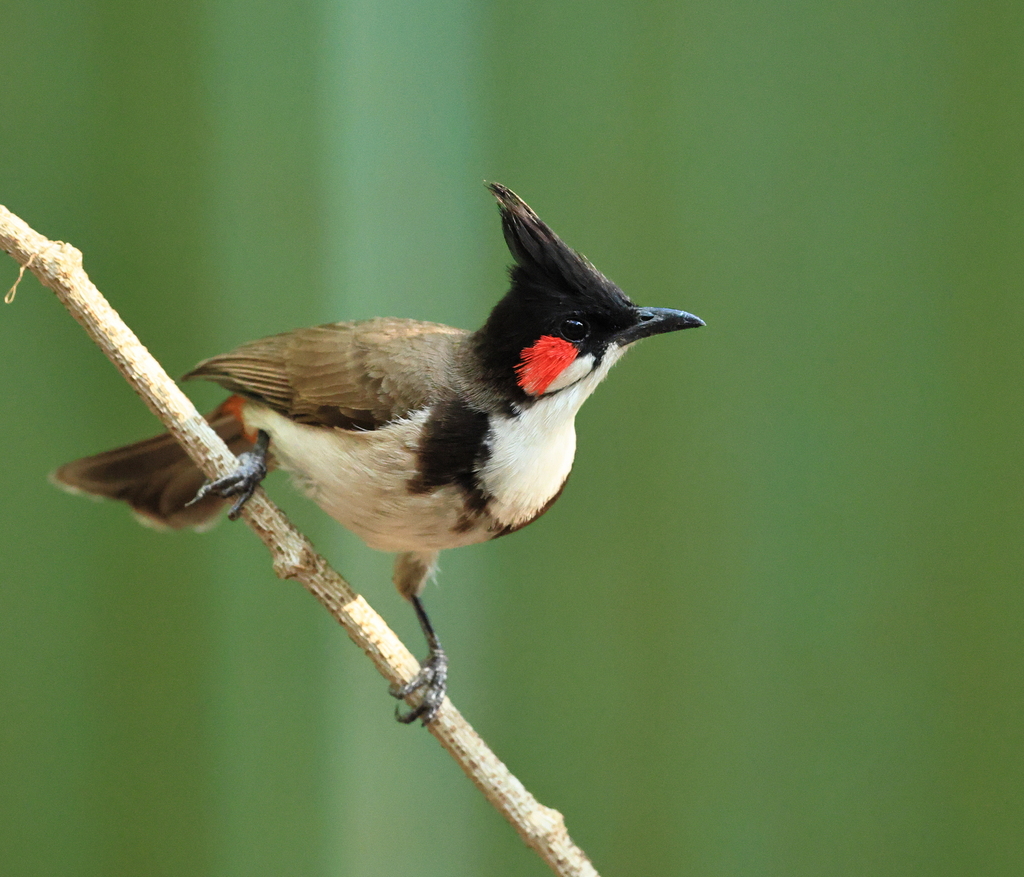
Red-whiskered Bulbul
Photo © Darren Obbard
Photo © Darren Obbard — CC BY 4.0 — Source: iNaturalist photo #630658386Identification
The red-whiskered bulbul is a compact passerine about 20 centimetres in length, instantly recognizable by its distinctive appearance. It features warm brown upperparts contrasting with whitish underparts and buff flanks. The bird's most striking features are its tall, pointed black crest, bright red face patch behind the eye, and thin black moustachial line that gives it character. A dark spur runs from the shoulder onto the breast, and the long brown tail is tipped with white, while the vent area is noticeably red. Juveniles are similar but lack the red eye patch, instead showing a rufous-orange vent. The bird is more often heard than seen, but it perches conspicuously, particularly in the mornings when calling from tree tops. Its loud, evocative call is a sharp "kink-a-joo" (variously transcribed as "pettigrew" or "pleased to meet you"), with songs consisting of scolding chatter.
Range & Habitat
Native to tropical Asia, the red-whiskered bulbul is a resident frugivore with a broad distribution across the continent, from India through to south-eastern China and south-east Asia. Nine recognized subspecies show variation across this range, from the western and central Indian populations to those in the Himalayas, Myanmar, Thailand, and the Malay Peninsula. The species inhabits lightly wooded areas, open country with bushes and shrubs, and farmland, thriving particularly in hill forests and urban gardens.
The species has become notably successful as an introduced bird worldwide, establishing populations in Australia, the United States (including Florida, Hawaii, and Los Angeles), Mauritius, and various Indian Ocean islands. In Australia, it was introduced to Sydney in 1880 and became well established across suburbs by 1920, continuing to spread slowly. It has also colonized suburban Melbourne and Adelaide, though the means of arrival there remains unclear.
Behaviour & Diet
The red-whiskered bulbul is a frugivore that feeds on fruits and small insects, playing an important ecological role as a seed disperser across its range. In introduced populations, it consumes fruits and berries from numerous exotic plants, including loquat, Lantana, Brazilian pepper, and figs. Seeds passing through their digestive systems germinate more readily, aiding the spread of both native and invasive plant species. Breeding occurs once or twice yearly, with peaks varying by location: December to May in southern India and March to October in northern India. Males perform distinctive courtship displays involving head bowing, tail spreading, and wing drooping. Cup-shaped nests are constructed on bushes, thatched walls, or small trees using fine twigs, roots, and grasses, often embellished with bark strips, paper, or plastic bags. Clutches typically contain two or three eggs. Adults will feign injury to distract predators from nests. The species can live approximately 11 years in captivity.
Best Time & Places to See It
The red-whiskered bulbul is best observed in the early morning hours when it calls conspicuously from tree tops. Hill forests and urban gardens throughout tropical Asia offer reliable viewing opportunities, particularly during the breeding season when birds are most active. In introduced ranges such as Australian suburbs or Florida, suburban gardens and parks provide good sighting chances. The bird's habit of perching openly, especially in mornings, makes it more accessible to patient observers than many other species, though listening for its distinctive call often proves more productive than visual searching.
Photography Tips
The red-whiskered bulbul's conspicuous early-morning behavior and preference for prominent perches make it an excellent photographic subject. Position yourself near flowering or fruiting trees and bushes in suitable habitat, particularly during breeding season. Early light is ideal for capturing the bird's striking plumage details—the black crest, red face patch, and contrasting underparts photograph particularly well in soft morning sun. The bird's habit of calling from exposed tree tops provides frequent opportunities for clear shots. Listen for the distinctive "kink-a-joo" call to locate individuals, and be patient as they often remain in view for extended periods. Urban garden settings in introduced ranges may offer closer approach distances than wild populations.
L’Albufera Natural Park
València, Spain
+321 birds+18 mammals
Where shallow lagoons meet Mediterranean coastal marshland, L'Albufera Nature Park unfolds as one of Spain's most vital wetland complexes. This protected landscape, designated under IUCN Category…
VIEW NATURAL PARKOrang National Park
Rangagarapathar, India
+298 birds+1 mammals
Where the Brahmaputra's floodplains meet the foothills of Assam, Orang National Park unfolds across a mosaic of riverine grasslands, forests and wetlands that pulse with the…
VIEW NATIONAL PARKEravikulam National Park
Devikulam, India
+192 birds+7 mammals
High in the Western Ghats of Kerala, where monsoon mists cling to slopes that rise above 2,000 metres, Eravikulam National Park preserves one of South India's…
VIEW NATIONAL PARKPhou Khao Khouay National Protected Area
Thaphabath District, Thailand
+113 birds
Where the Annamite Mountains descend into central Thailand's monsoon forests, Phou Khao Khouay National Protected Area sprawls across rugged limestone terrain interlaced with river valleys and…
VIEW NATIONAL PARKHat Noppharat Thara-Mu Ko Phi Phi National Park
Ao Nang, Thailand
+253 birds+9 mammals
Where limestone karsts rise dramatically from turquoise waters, Hat Noppharat Thara-Mu Ko Phi Phi National Park unfolds across a mosaic of beach, mangrove forest, and island…
VIEW NATIONAL PARKKhao Yai National Park
Prachantakham District, Thailand
+377 birds+46 mammals
Evergreen dipterocarp forest blankets the rolling terrain of this national park in eastern Thailand, where limestone hills rise abruptly from the forest floor and seasonal streams…
VIEW NATIONAL PARKKhao Laem National Park
Sangkhla Buri District, Thailand
+197 birds
Where the Vajiralongkorn Reservoir sprawls across the forested valleys of Kanchanaburi's northern borderlands, Khao Laem National Park protects a landscape where limestone ridges rise dramatically from…
VIEW NATIONAL PARKEverglades National Park
Monroe County, United States
+345 birds+22 mammals
Where freshwater marsh meets subtropical sky, the Everglades sprawls across southwestern Florida as one of North America's most expansive wetland ecosystems. Spanning over 13,000 square kilometers,…
VIEW NATIONAL PARKTúria Natural Park
València, Spain
+150 birds+21 mammals
Where the Túria riverbed winds through the lowlands south of Valencia, a sprawling natural park of nearly 440 square kilometres unfolds across one of Spain's most…
VIEW NATURAL PARKSydney Harbour National Park
Sydney, Australia
+203 birds+26 mammals
Where Sydney Harbour's sheltered waters meet the sandstone headlands of New South Wales, a mosaic of coastal heathland, eucalyptus woodland and rocky shores creates one of…
VIEW NATIONAL PARKRoyal National Park
Sydney, Australia
+296 birds+46 mammals
Where sandstone ridges plunge toward the Tasman Sea, Royal National Park unfolds across 343 square kilometres of southeastern Australian coastal wilderness. The park's defining character emerges…
VIEW NATIONAL PARKMorton National Park
Australia
+253 birds+57 mammals
Across nearly 4,800 square kilometers of New South Wales's Southern Tablelands, rugged sandstone plateaus rise above sheltered valleys where cool-climate eucalypt woodland meets grassy heath and…
VIEW NATIONAL PARKHeathcote National Park
Sydney, Australia
+119 birds+16 mammals
Sandstone ridges and eucalypt woodlands rise from the Cumberland Plain southwest of Sydney, where Heathcote National Park unfolds across 82 square kilometres of bushland shaped by…
VIEW NATIONAL PARKMount Nanling Forest Park
Ruyang Forest Farm, China
+179 birds+3 mammals
Granite ridges and weathered peaks rise through a canopy of subtropical montane forest where Ruyang Forest Farm anchors one of southern China's most biodiverse landscapes. Across…
VIEW FOREST & JUNGLEKanha Tiger Reserve
Kanha Kisli F.V., India
+321 birds+23 mammals
Where sal forests give way to emerald meadows and crystalline streams carve through ancient valleys, one of India's finest wilderness reserves unfolds across the Maikal Range.…
VIEW NATIONAL PARKBandhavgarh National Park
Garhpuri, India
+285 birds+17 mammals
Where granite ridges rise dramatically above sal and bamboo forests, one of India's most pristine tiger reserves unfolds across the Vindhyan plateau. Ancient rock formations tower…
VIEW NATIONAL PARKKaziranga National Park
Kohora, India
+422 birds+26 mammals
Dawn breaks over the floodplains of the Brahmaputra, where tall grasslands stretch endlessly beneath monsoon-heavy skies. This sprawling wilderness of northeastern Assam is a mosaic of…
VIEW NATIONAL PARKKeoladeo National Park
Shreenagar Rural, India
+326 birds+14 mammals
Where shallow wetlands shimmer beneath vast Rajasthani skies, one of Asia's finest bird sanctuaries pulses with extraordinary life. This former maharaja's hunting reserve, now spanning 29…
VIEW NATIONAL PARKPeriyar National Park
Mlappara, India
+232 birds+4 mammals
Dawn breaks over mist-shrouded ridges where the Western Ghats tumble toward Kerala's spice-scented lowlands. Here, ancient tropical forests envelope a glittering artificial lake, creating a mosaic…
VIEW NATIONAL PARKPampadum Shola National Park
Vattavada, India
+258 birds+14 mammals
Where misty shola forests cling to the high plateaus of the Nilgiri Mountains, ancient evergreen remnants create a world apart. This 2,316-hectare reserve protects one of…
VIEW NATIONAL PARKBandipur National Park
Hirehalli, India
+302 birds+19 mammals
Where the Western Ghats descend into the Deccan plateau, ancient deciduous forests blanket a landscape carved by the Nugu River. Bandipur unfolds across 880 square kilometres…
VIEW NATIONAL PARKNagarahole Tiger Reserve
Nalkeri Forest, India
+323 birds+23 mammals
Where granite escarpments rise above dense deciduous forests and the Kabini River carves through pristine wilderness, one of India's most biodiverse landscapes unfolds across the Western…
VIEW NATIONAL PARKTaman Negara National Park
Kampong Samas, Malaysia
+393 birds+48 mammals
Where ancient rainforest meets limestone peaks, one of Southeast Asia's oldest protected wilderness preserves sprawls across 4,343 square kilometers of primordial landscape. Dipterocarp giants tower overhead,…
VIEW NATIONAL PARKBlue Mountains National Park
Australia
+220 birds+43 mammals
Dramatic sandstone cliffs rise in tiers across this mountainous plateau west of Sydney, their rust-coloured faces weathered into amphitheatres and gorges where eucalyptus forest clings to…
VIEW NATIONAL PARKKu-ring-gai Chase National Park
Sydney, Australia
+216 birds+39 mammals
Where Hawkesbury sandstone cliffs plunge toward sheltered bays and creeks, Ku-ring-gai Chase National Park unfolds across rugged terrain just north of Sydney, a mosaic of eucalyptus…
VIEW NATIONAL PARKPoyang Lake National Nature Reserve
Shangrao, China
+270 birds+7 mammals
Where the Yangtze River's massive floodplain spreads across central China, Poyang Lake National Nature Reserve encompasses one of the continent's most dynamic and water-rich wetland systems.…
VIEW NATURE RESERVEXishuangbanna National Nature Reserve
Xishuangbanna Dai Autonomous Prefecture, China
+173 birds+2 mammals
Where subtropical monsoon forests meet the margins of the Yunnan plateau, Xishuangbanna National Nature Reserve sprawls across a landscape of dramatic relief—deep river valleys carved by…
VIEW NATURE RESERVEGaoligong Mountain National Nature Reserve
Nujiang Lisu Autonomous Prefecture, China
+443 birds+13 mammals
VIEW NATURE RESERVEBiscayne National Park
Miami-Dade County, United States
+263 birds+7 mammals
Coral reefs and mangrove shallows dominate this marine sanctuary where the Florida Keys meet the Atlantic, creating a mosaic of shallow seagrass meadows, patch reefs, and…
VIEW NATIONAL PARKNo community photos yet. Log in to add the first one.
No community observations of this species yet.