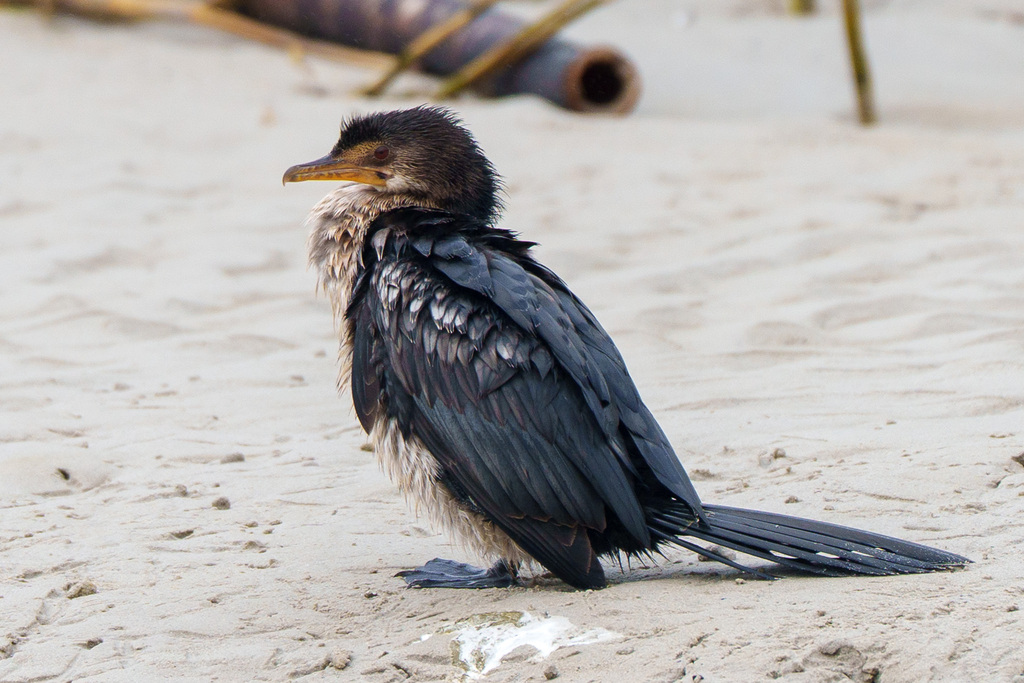
Reed Cormorant
Photo © bdhimes
Photo © bdhimes — CC0 1.0 — Source: iNaturalist photo #497393573Identification
The reed cormorant is a small cormorant measuring 50–55 cm in length with a wingspan of 80–90 cm. In breeding plumage, it is mainly black with a green gloss, and the wing coverts are distinctively silvery. Look for its longish tail, short head crest, and striking red or yellow face patch, combined with a yellow bill. The sexes are similar in appearance.
Non-breeding adults and juveniles are noticeably browner than breeding birds, with a white belly that provides useful field identification. Some southern populations retain their crest throughout the year, while others lose it seasonally, so plumage variation is an important feature to note when identifying this species.
Range & habitat
The reed cormorant is a common and widespread species throughout much of Africa south of the Sahara, as well as in Madagascar. It is resident across its range but undertakes some seasonal movements. The species is not considered to be threatened and adapts to a variety of wetland environments.
This cormorant breeds on freshwater wetlands and quiet coasts, making it accessible in diverse habitats across sub-Saharan Africa. Two subspecies are recognised: M. a. africanus, found in inland and coastal sub-Saharan Africa, and M. a. pictilis, which occurs in Madagascar, chiefly on the western side of the island.
Behaviour & diet
Reed cormorants are capable divers that can reach considerable depths, though they typically feed in shallow water. They have an interesting feeding habit of frequently bringing prey to the surface, making them relatively easy to observe while hunting. They take a wide variety of fish species, showing a preference for small, slow-moving fish with long and tapering shapes such as mormyrids, catfishes, and cichlids.
Beyond fish, the species will occasionally consume soles (which can become locally important in the diet), frogs, aquatic invertebrates, and small birds. Breeding birds lay two to four eggs in nests constructed in trees or on the ground, typically concealed from view by long grass or other vegetation.
Best time & places to see it
As a resident species with only seasonal movements, the reed cormorant can be encountered throughout the year across its African and Madagascan range. Look for this bird on freshwater wetlands—including lakes, rivers, and marshes—and along quiet coastal areas. The species' prevalence and widespread distribution mean that nature travellers exploring wetland habitats in sub-Saharan Africa or Madagascar have good chances of encountering it.
Photography tips
The reed cormorant's small size and frequent shallow-water feeding behaviour make it an excellent subject for wildlife photography. The silvery wing coverts and contrasting coloration of breeding birds provide striking photographic opportunities. Position yourself quietly near wetland margins or coastlines where the bird regularly feeds, and watch for the characteristic moment when it brings fish to the surface—an active, dynamic behaviour that captures the essence of this small cormorant's hunting prowess.
Bwindi Impenetrable National Park
Lake Mburo National Park
Mabamba Swamp
Queen Elizabeth National Park
Aberdare National Park
Abijata-Shalla Lakes National Park
Addo Elephant National Park
Agulhas National Park
Amboseli National Park
Nothing matches these filters.
No community photos yet. Log in to add the first one.
No community observations of this species yet.