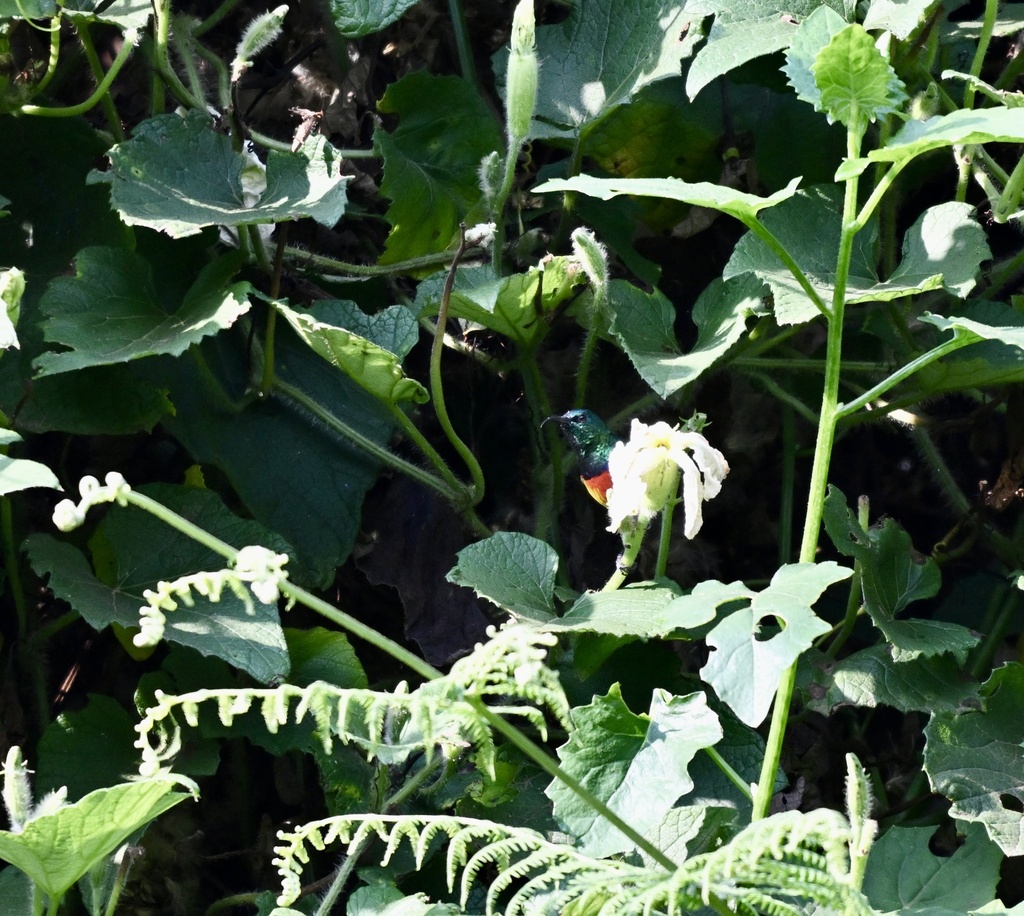
Regal Sunbird
Photo © Lukas Zangl
Photo © Lukas Zangl — CC BY 4.0 — Source: iNaturalist #305370393The regal sunbird (Cinnyris regius) is a species of bird in the family Nectariniidae. It is native to the Albertine Rift montane forests. == Description == The regal sunbird is a small species. The adult male has head and upper parts an iridescent golden-green, dark wings and tail and a boldly-marked red and yellow breast and belly. The adult female has dull olive upper parts, with yellowish, faintly streaked underparts. The male is distinctive, but the female could be confused with the female Rockefeller's sunbird (Cinnyris rockefelleri), though this has a paler throat. The female Rwenzori double-collared sunbird (Cinnyris stuhlmanni) and the female northern double-collared sunbird (Cinnyris reichenowi) are also similar, but these have greener upper parts and yellower underparts; another similar species is the variable sunbird (Cinnyris venustus), but the regal can be recognised by the upper parts being more olive and the underparts a more uniform yellowish-olive. == Distribution and habitat == The regal sunbird's range spans the entire Albertine Rift montane forests (from Uganda to Tanzania), where it occurs between 1,500 and 3,100 m (4,900 and 10,200 ft) above sea level. Its habitat includes evergreen mountain forest, mixed forest, secondary growth forest, scrubland and bamboo. == Status…
Virunga National Park
Uganda
+418 birds+13 mammals
Where the Western Rift Valley fractures the landscape of North Kivu, Virunga National Park sprawls across terrain as geologically dramatic as it is ecologically vital. Volcanic…
VIEW NATIONAL PARKBwindi Impenetrable National Park
Kanyashogi, Uganda
+603 birds+26 mammals
Steep ridges cloaked in montane forest rise from Uganda's southwestern borderlands, where the landscape grows so dense and tangled that early explorers named it impenetrable. At…
VIEW NATIONAL PARKVolcanoes National Park
Musanze District, Uganda
+152 birds+6 mammals
Where volcanic cones rise sharply above the montane forests of northern Uganda, Volcanoes National Park protects one of East Africa's most dramatic high-altitude ecosystems. The park's…
VIEW NATIONAL PARKMgahinga Gorilla National Park
Cyanika, Uganda
+429 birds+6 mammals
Where the Virunga Mountains rise steeply from the Uganda–Rwanda–Democratic Republic of Congo frontier, montane forest cloaks the volcanic slopes in a dense, moisture-laden embrace. Mgahinga Gorilla…
VIEW NATIONAL PARKLake Mburo National Park
Uganda
+505 birds+24 mammals
Rolling acacia woodland and scattered lakes define this intimate savanna preserve in southwestern Uganda, where the rift valley's geological drama shapes every water source and grassland.…
VIEW NATIONAL PARKToro-Semliki Proposed National Park
Uganda
+474 birds+5 mammals
Where the Albertine Rift's western escarpment rises above the Semliki River valley, a vast mosaic of forest, savanna and wetland converges to create one of East…
VIEW NATIONAL PARKQueen Elizabeth National Park
Uganda
+672 birds+30 mammals
Across the southwestern escarpment of Uganda, where the Western Rift Valley descends through ancient volcanic terrain, Queen Elizabeth National Park sprawls across more than 8,300 square…
VIEW NATIONAL PARKNo community photos yet. Log in to add the first one.
No community observations of this species yet.