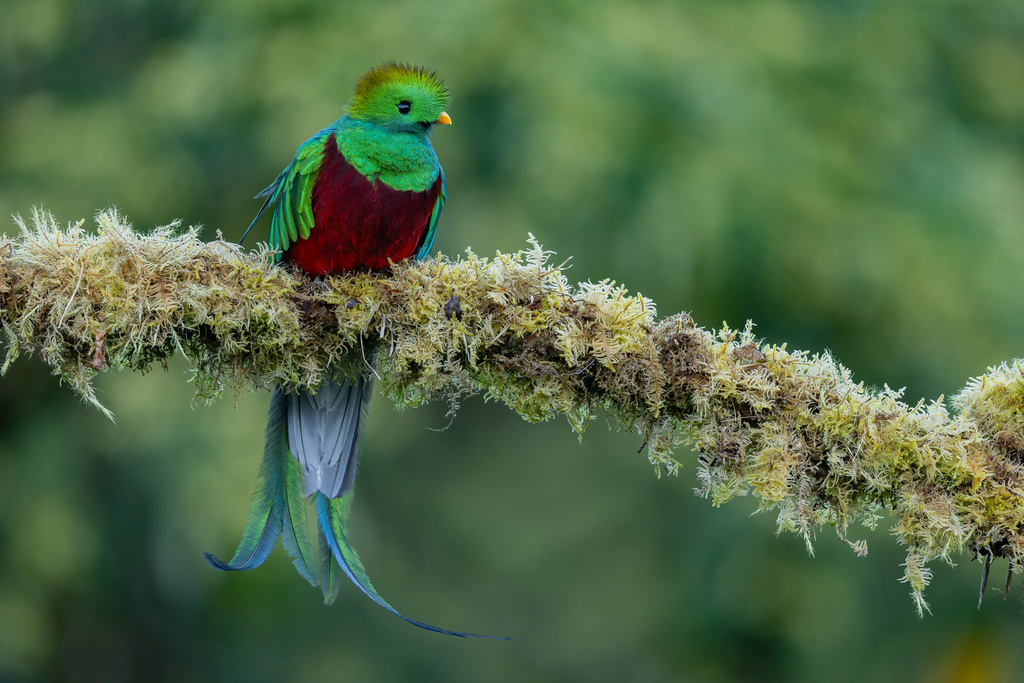
Resplendent Quetzal
Photo © Matt Felperin
Photo © Matt Felperin — CC BY 4.0 — Source: iNaturalist photo #619927072Identification
The resplendent quetzal is the largest trogon, measuring 36 to 40 cm in length. Males are unmistakable with their iridescent green plumage, red lower breast and belly, black innerwings, and distinctive white undertail. The most striking feature of breeding males is their elongated green upper tail coverts, which extend far beyond the body and shimmer with iridescence that shifts from green-gold to blue-violet depending on the light. The male sports a helmet-like crest and has a yellow bill. Females are considerably duller, with bronze-green heads, grey lower breasts and bellies, grey bills, and notably shorter tails. Despite appearing brilliantly green, the quetzal's feathers are actually brown, with iridescence created by their structure rather than pigment—an adaptation that provides camouflage within the forest canopy.
Range & Habitat
The resplendent quetzal is found in Central America and southern Mexico, ranging from the southernmost reaches of Oaxaca and Chiapas south to western Panama. Two recognized subspecies occupy different regions: P. m. mocinno inhabits southern Mexico, Guatemala, Honduras, northern El Salvador, and northwestern Nicaragua, while P. m. costaricensis is found in Costa Rica and western Panama. The species lives exclusively in tropical forests, particularly montane cloud forests at high elevations between 900 and 3,200 meters. Within these lush, moist rainforests, quetzals inhabit the canopy and subcanopy, favoring decaying trees, stumps, and abandoned woodpecker hollows in ravines and cliff faces.
Behaviour & Diet
The resplendent quetzal is mostly omnivorous, feeding primarily on fruits from laurel family plants, though it supplements its diet by occasionally hunting insects, lizards, frogs, and snails. During breeding season—typically commencing in March and extending through August, though timing varies by location—the birds are altitudinal migrants, moving from the forest slopes to the canopy. They hollow out nest holes in decaying trees or repurpose abandoned woodpecker cavities, where males and females share incubation duties, with males attending by day and females by night. A female typically lays one to three eggs, which hatch after 17 to 19 days. The quetzal's distinctive song consists of full-toned, mellow, slurred notes in plain patterns, often remarkably melodious.
Best Time & Places to See It
The breeding season from March through August offers the best opportunity to observe resplendent quetzals, particularly in their montane cloud forest habitat at elevations between 900 and 3,200 meters. Costa Rica and western Panama host P. m. costaricensis, while Guatemala, Honduras, and nearby regions support P. m. mocinno. The lush, moist conditions of these high-elevation rainforests, particularly within ravines and cliff faces where decaying trees and woodpecker cavities are abundant, concentrate populations during the nesting season.
Photography Tips
Photographing resplendent quetzals demands patience and attention to lighting, as the male's iridescent plumage shifts dramatically with angle and illumination. Position yourself to capture the interplay of light across the green-gold, blue-violet iridescent feathers and the striking red underparts. The elongated tail streamers of breeding males—measuring up to a meter in median length—are a defining feature worth emphasizing in composition. The forest's dim, dappled light can challenge exposure, so be prepared for high ISO and careful metering. Early morning in the breeding season offers the best chance of observing these birds as they move through the canopy, and their melodious, distinctive calls can help locate them within the dense forest vegetation.
Arenal Volcano National Park
Peñas Blancas, Costa Rica
+551 birds+21 mammals
Straddling the border between Alajuela and Guanacaste in northwestern Costa Rica, this national park rises dramatically around one of Central America's most active volcanic systems. The…
VIEW NATIONAL PARKChirripó National Park
Rivas, Costa Rica
+274 birds+6 mammals
Where the volcanic spine of Costa Rica's Central Cordillera reaches its apex, Chirripó National Park encompasses a landscape that shifts dramatically with elevation, from montane cloud…
VIEW NATIONAL PARKBraulio Carrillo National Park
Las Horquetas, Costa Rica
+547 birds+18 mammals
Where the Caribbean slope descends from the central volcanic cordillera toward the humid lowlands of Heredia, Braulio Carrillo National Park preserves one of Costa Rica's most…
VIEW NATIONAL PARKVolcán Poás National Park
Toro Amarillo, Costa Rica
+237 birds+4 mammals
Where volcanic slopes rise sharply from the Central Valley floor, Volcán Poás National Park protects one of Costa Rica's most active and accessible volcanic systems. The…
VIEW NATIONAL PARKBaru Volcano National Park
Cerro Punta, Panama
+402 birds+6 mammals
Where the land rises sharply toward the Caribbean's western spine, Baru Volcano National Park sprawls across roughly 220 square kilometres of southwestern Panama, anchored by the…
VIEW NATIONAL PARKLagunas de Montebello National Park
Laguna de Montebello, Mexico
+360 birds+2 mammals
Where turquoise lagoons pierce the limestone plateau of southeastern Chiapas, the Lagunas de Montebello National Park unfolds across roughly 174 square kilometers of spectral water and…
VIEW NATIONAL PARKLos Quetzales National Park
Copey, Costa Rica
+232 birds+3 mammals
Cloud forest sweeps across the upper slopes of the Central Valley watershed, where elevation and persistent moisture forge an ecosystem unlike any other in Costa Rica.…
VIEW NATIONAL PARKTapantí Macizo de la Muerte National Park
Orosi, Costa Rica
+503 birds+18 mammals
Where montane cloud forest rises steeply from the Orosi Valley, Tapantí Macizo de la Muerte National Park enfolds a landscape of perpetual moisture and emerald complexity.…
VIEW NATIONAL PARKLa Amistad International Park
Crorina, Costa Rica
+532 birds+20 mammals
Where the Caribbean slopes of Costa Rica's Talamanca Mountains rise steeply inland from Limón, the boundary between two nations dissolves into an unbroken expanse of rainforest.…
VIEW NATIONAL PARKVolcán Tenorio National Park
Guatuso, Costa Rica
+480 birds+12 mammals
Where volcanic slopes rise through Costa Rica's northwestern borderlands, Volcán Tenorio National Park sprawls across terrain shaped by ancient lava flows and mineral-rich springs. The park's…
VIEW NATIONAL PARKNo community photos yet. Log in to add the first one.
No community observations of this species yet.