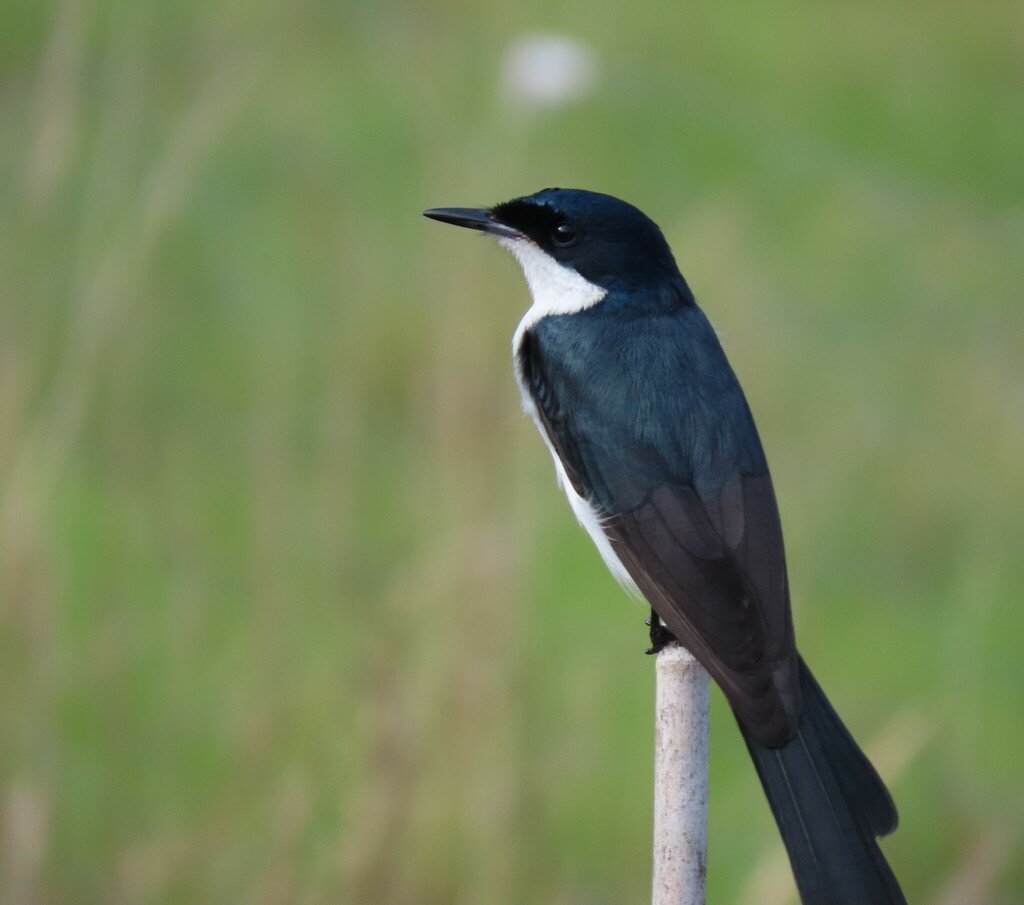
Restless Flycatcher
Photo © pimelea
Photo © pimelea — CC BY 4.0 — Source: iNaturalist #189927921Identification
The restless flycatcher is a small to medium-sized passerine approximately 20 cm (8 inches) in length. It features a glossy dark blue crest, grey-blue back, and white underparts. While superficially similar to the willie wagtail, it can be distinguished by its lack of a black throat, more slender body shape, absence of a white eyebrow stripe, and its distinctive crest. The bird's common names—razor grinder, scissors grinder, dishlicker, and dishwasher—all derive from its highly distinctive and characteristic call.
Range & Habitat
The restless flycatcher is found throughout eastern, south-eastern, and south-western Australia, ranging from Cairns in Far North Queensland west into Central Queensland, throughout most of New South Wales and Victoria, into southern South Australia, and south-western Western Australia. During winter, many populations from the south and south-east migrate northward. The species favours open and wooded forests, particularly river red gum areas near water, as well as inland and coastal scrubs and some semi-urban environments.
Behaviour & Diet
This flycatcher feeds primarily on insects and other invertebrates including spiders and centipedes, typically hunting alone or in pairs. Its characteristic foraging technique involves hovering with its head and tail pointed downward to pluck insects from foliage, preferring to hunt from the mid-canopy and rarely descending to the ground. During breeding season, restless flycatchers construct distinctive cup-shaped nests from shredded bark and grasses bound together with spider webbing, often decorated with lichen, bark strips, or spider egg sacs. Nests are typically positioned in the fork of well-foliaged trees near or overhanging water, sometimes reaching heights of twenty metres or more. Clutches typically consist of three eggs with a light grey to white glossy appearance and brown or dark spots concentrated at the larger end.
Best Time & Places to See It
The restless flycatcher is resident throughout its range, though populations shift northward during winter months. The species is most readily observed in suitable habitat—particularly river red gum forests and wooded scrubland with proximity to water—across eastern and southern Australia. Spring and early summer are optimal periods for observing breeding behaviour and hearing the species' distinctive vocalizations.
Photography Tips
Photograph restless flycatchers in well-lit forest clearings or river red gum habitat where they actively forage. The bird's characteristic hovering posture with downward-angled head and tail provides excellent photographic opportunities. Early morning light best reveals the glossy blue-black crest and grey-blue back plumage. Patience and a telephoto lens are essential, as the species prefers the mid-canopy and remains active but wary. Positioning yourself near water sources and listening for the distinctive call will aid in locating subjects for photography.
Barrington Tops National Park
Ben Boyd National Park
Blue Mountains National Park
Boodjamulla National Park
Bouddi National Park
Bribie Island National Park
Budj Bim National Park
Bunya Mountains National Park
Cania Gorge National Park
Nothing matches these filters.
No community photos yet. Log in to add the first one.
No community observations of this species yet.