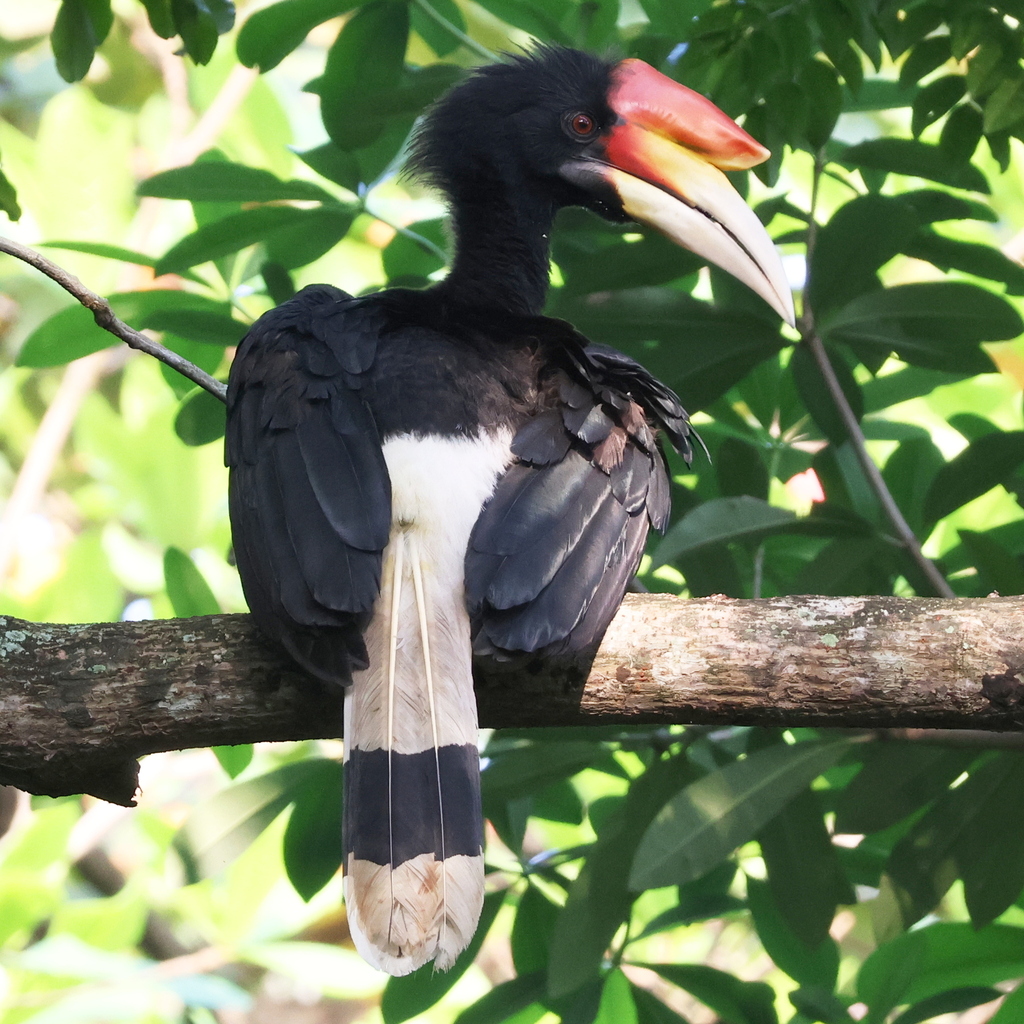
Rhinoceros Hornbill
Photo © Huey
Photo © Huey — CC BY 4.0 — Source: iNaturalist #324105387Identification
The rhinoceros hornbill is a large arboreal hornbill measuring 80 to 90 centimetres in length, with males weighing between 2,465 and 2,960 grams and females between 2,040 and 2,330 grams. Its most striking feature is its enormous bill and casque—a helmet-like structure on the head—both coloured bright orange and red, a hue derived from preen oil that the bird rubs onto these structures from glands above its tail. The plumage is predominantly black, contrasting sharply with white legs, vent, and a white tail marked by a black band. Sexual dimorphism is evident in the eyes: males display red eyes with black rims, while females have white eyes with red rims, making it possible to distinguish the sexes in the field.
Range & Habitat
The rhinoceros hornbill is found across Southeast Asia, inhabiting lowland and montane tropical and subtropical forests, including mountain rain forests up to 1,400 metres elevation. Its range extends from southern Thailand through the Malay Peninsula and to the islands of Singapore, Borneo, Sumatra, and Java. The species is notably the national bird of Malaysia and the state bird of Sarawak, where it receives legal protection as a totally protected animal under the 1998 Wild Life Protection Ordinance.
Behaviour & Diet
The rhinoceros hornbill's diet is dominated by fruit, though it will opportunistically consume insects, small reptiles, rodents, and smaller birds when available. These birds are cavity nesters, making their nests inside tree trunks. Their breeding behaviour is remarkable for the extraordinary partnership between male and female: once eggs are laid, the pair seal the cavity entrance with mud mixed with food and feces, leaving only a tiny aperture through which the male feeds the incubating female and later the chicks. The female remains inside throughout incubation and early chick-rearing, depending entirely on her mate for sustenance. When chicks are fully feathered and ready to fledge, the parents chip away the dried mud to release them. Interestingly, rhinoceros hornbills have been recorded interbreeding successfully with great hornbills.
Best Time & Places to See It
The rhinoceros hornbill inhabits primary and mature secondary forests where large trees suitable for nesting cavities remain available. Borneo, Sumatra, the Malay Peninsula, and Java represent key locations for encountering this species. As a forest specialist dependent on large trees, sightings are most likely in protected rainforest areas and national parks within its range. The species' cultural significance in Sarawak underscores the region's importance for both conservation and birdwatching.
Photography Tips
The rhinoceros hornbill's striking orange-red bill and casque, contrasting black plumage, and distinctive white tail make it visually distinctive and rewarding to photograph. Its large size and arboreal habits mean it may be visible at considerable distances in the forest canopy. Early morning light will best illuminate the brilliant colours of the bill and casque. Patience is essential, as these are forest birds that may be heard before they are seen. The sexual differences in eye coloration provide an additional identification challenge for photographers attempting to determine the bird's sex in photographs.
Bako National Park
Kuching, Malaysia
+210 birds+17 mammals
Weathered sandstone cliffs rise dramatically from the South China Sea, their ochre faces sculpted by millennia of wind and tide into a landscape of extraordinary geological…
VIEW NATIONAL PARKTaman Negara National Park
Kampong Samas, Malaysia
+393 birds+48 mammals
Where ancient rainforest meets limestone peaks, one of Southeast Asia's oldest protected wilderness preserves sprawls across 4,343 square kilometers of primordial landscape. Dipterocarp giants tower overhead,…
VIEW NATIONAL PARKTaman Negara Bukit Lambir National Park
Miri, Malaysia
+153 birds+7 mammals
Rainforest cascades down sandstone ridges where crystal streams carve through ancient geology, creating a landscape of profound biological richness in Sarawak's interior. This 68-square-kilometre sanctuary protects…
VIEW NATIONAL PARKGunung Mulu National Park
Long Seridan, Malaysia
+280 birds+39 mammals
Where granite monoliths pierce the rainforest canopy of Sarawak, an ancient limestone karst landscape reveals one of Southeast Asia's most biodiverse strongholds. Soaring peaks cloaked in…
VIEW NATIONAL PARKTaman Nasional Baluran
Situbondo, Indonesia
+189 birds+9 mammals
Across the northeastern tip of East Java, where monsoon winds sweep down from the Bali Strait, a landscape of contrasts unfolds within 374 square kilometres of…
VIEW NATIONAL PARKTaman Nasional Meru Betiri
Jember, Indonesia
+93 birds+1 mammals
Across East Java's southeastern coast, where the Indian Ocean meets a landscape of volcanic soils and monsoon-fed forests, sprawls a national park that epitomizes the ecological…
VIEW NATIONAL PARKWay Kambas National Park
Lampung Timur, Indonesia
+237 birds+20 mammals
Across the low swamplands of eastern Lampung, where freshwater wetlands merge into tidal mangrove forests along the Sunda Strait, sprawls one of Sumatra's most vital sanctuaries.…
VIEW NATIONAL PARKNo community photos yet. Log in to add the first one.
No community observations of this species yet.