Ridgway’s Rail
Photo © Amber M. King
Photo © Amber M. King — CC BY 4.0 — Source: iNaturalist #305001627Identification
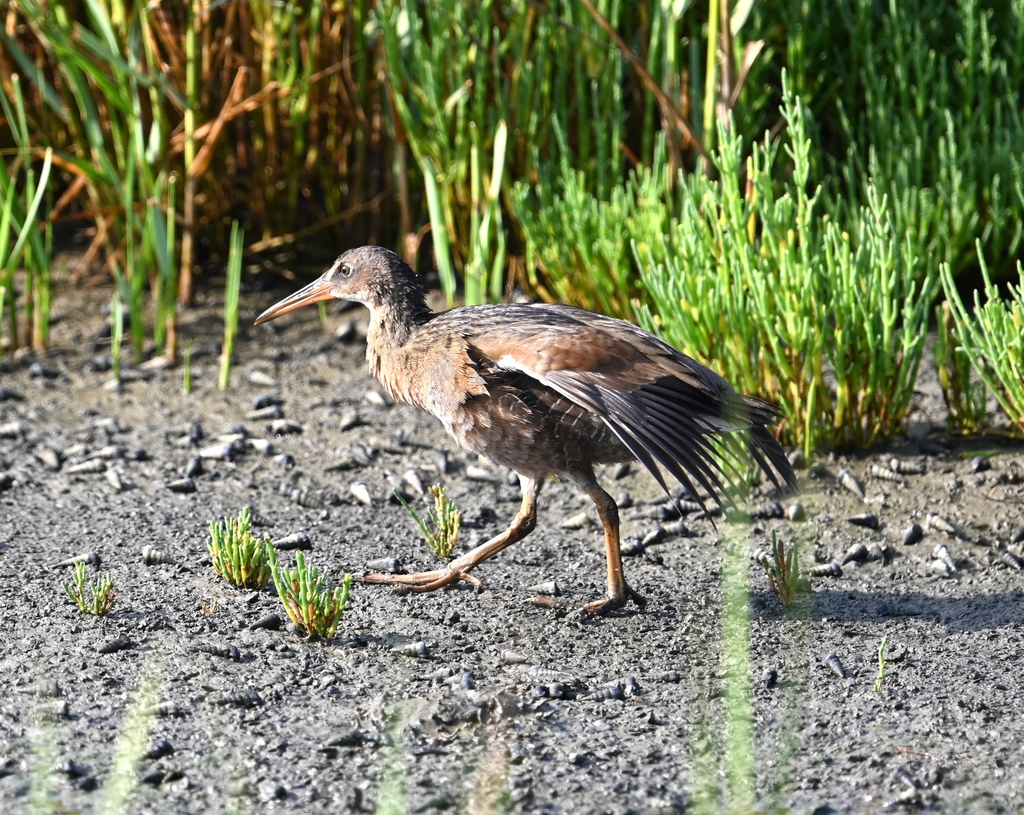
Ridgway's rail is a large, stocky rail measuring 32–41 cm in length, with males about 20% larger than females. Its most distinctive features are a long, downward-curving bill and predominantly cinnamon-brown plumage that darkens toward the back. Adults display a pale chestnut breast contrasted by a conspicuous whitish rump patch, and grayish-brown flanks. Adult coloration is variable, with several color morphs occurring across its range. Hatchlings are covered entirely in black downy feathers. This species is closely related to the clapper rail and was until recently considered a subspecies.
Range & Habitat
Ridgway's rail is found principally along the Pacific coast of North America from the San Francisco Bay Area to southern Baja California, with populations also occurring in regions of the Gulf of California. The largest known population, approximately 1,100 individuals, resides in San Francisco Bay, though historically the species occupied more than 90% of that area. The rail inhabits brackish tidal marshes dominated by pickleweed and cordgrass, or emergent wetland with these plants plus bulrush. It forages along the ecotone between mudflat and higher vegetated zones, selecting areas with taller plant material nearby for protection during high tides.
Behaviour & Diet
Ridgway's rail is most active during nocturnal and crepuscular hours and rarely flies. The species is highly opportunistic in its feeding habits, probing and scavenging while walking to retrieve mussels, clams, arthropods, snails, worms, and small fish. It also consumes minnows, small crabs, crayfish, aquatic insects, seeds, slugs, and occasionally small birds. During high tides, it may prey upon mice and scavenge dead fish. Breeding occurs from mid-March through August, with peak activity in late June. Nests are built low, sometimes among plant roots, and females lay clutches of four to fourteen purple-spotted buff eggs, averaging 7.6 per clutch. Both parents share incubation duties over an 18–29 day period.
Best Time & Places to See It
Ridgway's rail is resident year-round in coastal wetlands but is best observed during breeding season from March through August, when birds are more active and densities are higher. In the San Francisco Bay Area, prime locations include the Napa Sonoma Marsh, Bothin Marsh in Mill Valley, Gallinas Creek in San Rafael, Arrowhead Marsh and Damon Marsh in Oakland, the Palo Alto baylands, Charleston Slough in Mountain View, Seal Slough in San Mateo, and Belmont Slough. Juveniles disperse into freshwater wetlands from late August through October, expanding viewing opportunities. The species has been observed foraging in relatively disturbed areas, suggesting that even small marsh remnants may harbor populations.
Photography Tips
Photographing Ridgway's rail requires patience and early morning or evening light when the bird is most active. Position yourself near the ecotone between mudflats and marsh vegetation where rails forage for food. Use a telephoto lens to maintain distance and avoid flushing the bird, as this species rarely flies. The pale chestnut breast and whitish rump patch are key identifying features that photograph well when the bird is backlit by low sun. Focus on capturing the distinctive downward-curving bill and posture as the rail walks while probing the substrate. During breeding season, listen for vocalizations to locate birds in dense marsh vegetation where visual observation may be difficult.
Don Edwards San Francisco Bay National Wildlife Refuge
El Vizcaíno
Farallon National Wildlife Refuge
Havasu National Wildlife Refuge
Imperial National Wildlife Refuge
Salton Sea National Wildlife Refuge
Nothing matches these filters.
No community photos yet. Log in to add the first one.
No community observations of this species yet.