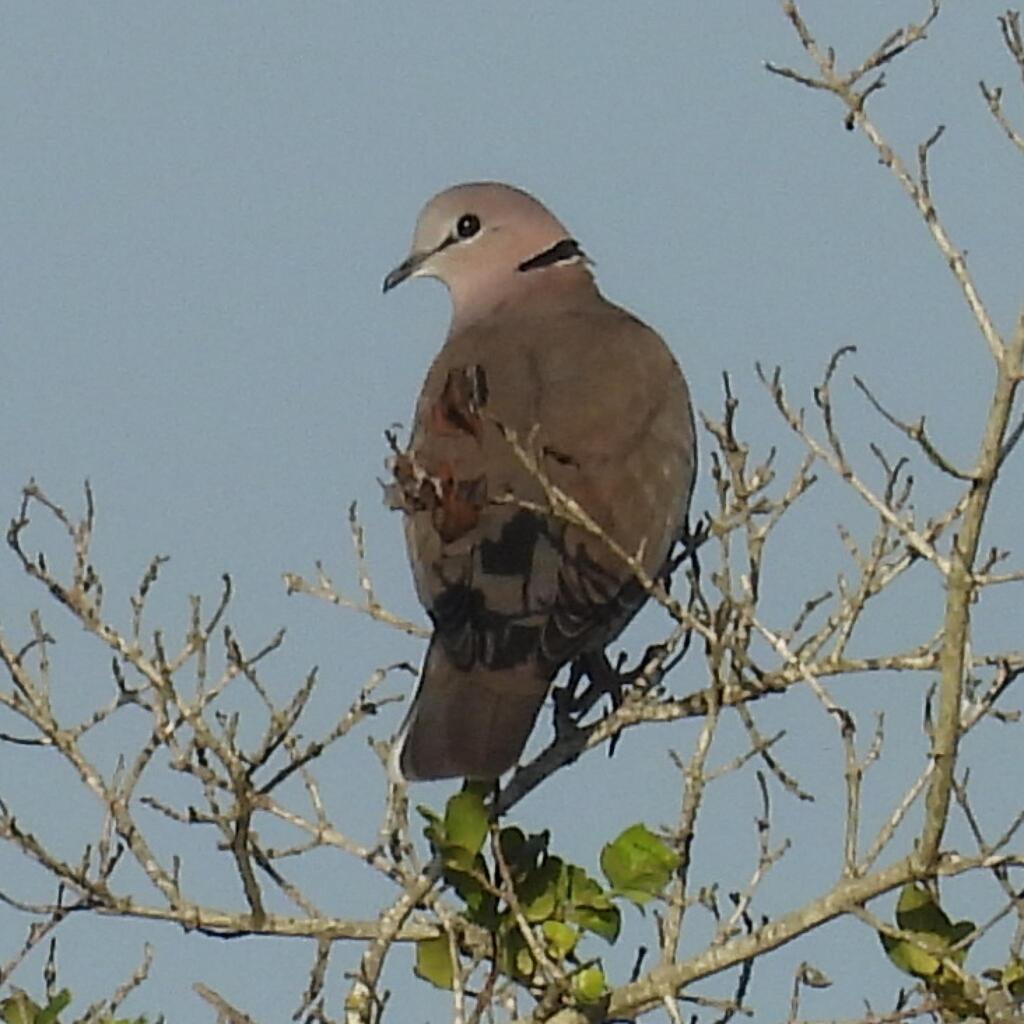
Ring-necked Dove
Photo © Henry de Lange
Photo © Henry de Lange — CC BY 4.0 — Source: iNaturalist #278707640Identification
The ring-necked dove is a medium-sized dove measuring 25–26.5 cm in length and weighing 92–188 g. Its most distinctive feature is the semi-collar of black feathers on the lower nape, which gives the species its common name. The plumage is predominantly grey and brown on the upperparts, with lavender shades on the nape, while the underparts are paler with pinkish-lavender tints. The lower belly and undertail coverts are white. The tail feathers are slate grey with conspicuous white tips and fringes, a pattern that becomes particularly noticeable during the bird's distinctive display flight. The eyes are almost black, the bill is black, and the feet are dark purple. Males and females look identical, though males are slightly larger. Immature birds are duller overall, lacking the distinctive semi-collar and showing buff edges to their upper plumage and wing coverts.
Individual plumage variation is high, with some birds appearing light and others almost sooty. This variation reflects adaptation to different regional environments across the species' range, with birds from arid regions tending toward paler, greyer tones.
Range & Habitat
The ring-necked dove is widespread and often abundant throughout East and southern Africa. It occupies a diverse range of open habitats including semi-desert scrub, Boscia and Acacia savannah, various woodland types, farmlands, open plantations, and alien acacia thickets. In southern Africa, it is commonly observed in fynbos regions, miombo and mopane woodlands, and grasslands ranging from moist to dry conditions. The species has benefited from human settlement, particularly where trees have been planted in groves around farm homesteads. Closed forests, extensive waterless areas such as the Namib's dune fields, and gravel plains are unsuitable habitats. The species seldom occurs above 2,000 metres elevation. Seasonal movements are most noticeable in tropical areas, while nomadic movements occur in arid regions with limited resources.
Behaviour & Diet
Ring-necked doves are mostly sedentary birds with a penetrating, rhythmic three-syllabled crooning call that is a familiar sound throughout the year within their range. They are usually found alone or in pairs while foraging, but congregate in large flocks—sometimes comprising hundreds of birds—around roosts and sources of food and water. These flocks are notably noisy, both from the various calls made throughout the day and often into moonlit nights, as well as from the loud clatter of wings during take-off. Their loud, harsh song is repeated ten to forty times and is sometimes interpreted as "how's father?" or "work harder." They roost in treetops at night and forage on the ground by day, with peak foraging times in early morning and late afternoon. They drink mainly in the morning and depend entirely on surface water, congregating at waterholes particularly in dry regions.
Ring-necked doves feed mainly on seeds of grasses, cereal grains, lupins, milkweeds, alien acacias, and pines, supplemented with broken fruit and berries from oaks, gums, currants, and Lantana. Occasionally they consume insects including earthworms, termites, and weevils, and recorded food items also include small sedge bulbs, succulent leaves, aloe nectar, and sugary aphid secretions. They are vulnerable to predation by lanner falcons at exposed waterholes and black sparrowhawks in plantations, as well as by reptiles, wildcats, jackals, genets, herons, storks, eagles, and barn owls.
Best Time & Places to See It
Ring-necked doves can be observed year-round throughout their range, as they are mostly sedentary birds with breeding activity occurring across seasons. Their loud, distinctive calls make them relatively easy to locate even if not immediately visible. Look for them in open grasslands, savannah woodlands, and cultivated areas, particularly around water sources. Early morning and late afternoon are the best times to observe them actively foraging on the ground. At waterholes, particularly in drier regions, they may be found congregating in large flocks, especially during the morning drinking period.
Photography Tips
The ring-necked dove's most photogenic feature is its distinctive display flight, in which males flutter steeply upward before spiraling down with wings and tail spread—a spectacular moment to capture. The white tail tips against the slate grey feathers create strong contrast and are particularly striking during flight. Ground-level photography while the birds forage can yield natural behavioural shots, particularly during peak foraging times at dawn and dusk when light is favourable. Large flocks at waterholes offer opportunities for flock photography and can showcase the birds' social behaviour. Patience at a waterhole, especially in arid regions, can reward with numerous close-range shots as birds drink and bathe. The bird's characteristic head-bobbing gait while walking is a distinctive behaviour worth attempting to capture, and the inflated throat during the male's bowing display provides dramatic close-up opportunities.
Bwindi Impenetrable National Park
Mabamba Swamp
Murchison Falls National Park
Queen Elizabeth National Park
Aberdare National Park
Abijata-Shalla Lakes National Park
Addo Elephant National Park
Agulhas National Park
Amboseli National Park
Nothing matches these filters.
No community photos yet. Log in to add the first one.
No community observations of this species yet.