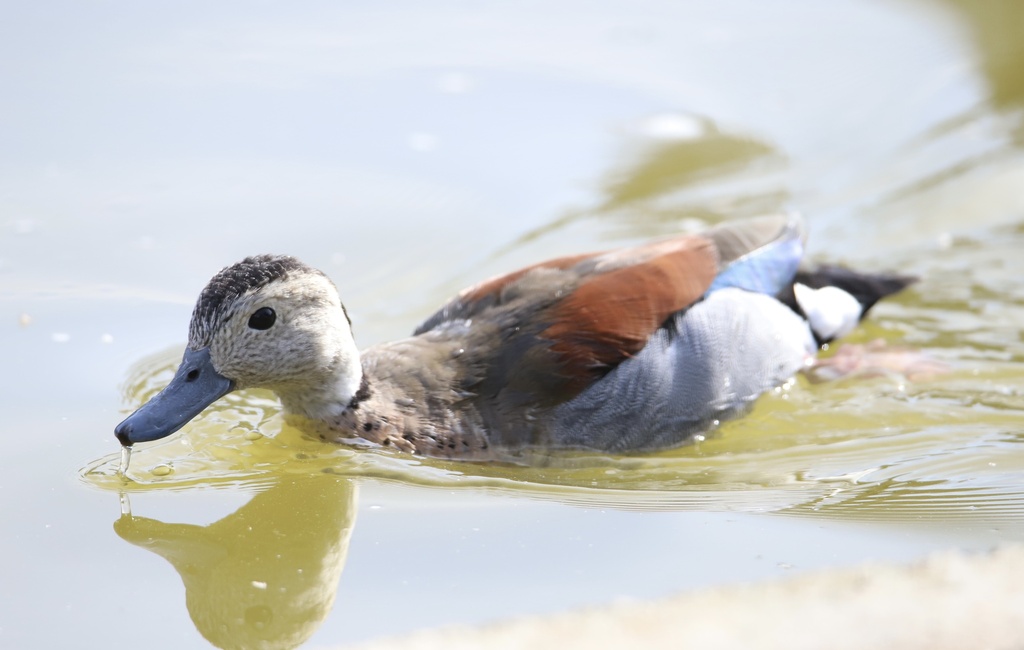
Ringed Teal
Photo © Aitor
Photo © Aitor — CC BY 4.0 — Source: iNaturalist photo #232416531Identification
The ringed teal is a small duck, measuring 35–38 cm in length with a 70 cm wingspan, making it a compact and delicate waterfowl. Males are particularly striking, displaying a rich chestnut back contrasting with pale grey flanks and a salmon-coloured breast speckled in black. A distinctive black band runs from the top of the head down to the nape, giving the species its characteristic appearance. Females are more subdued, with an olive-brownish back, a head blotched and striated in white, and pencilled barring on a pale chest and belly. Both sexes share several identifying features: a dark tail, a contrasting pale rump, a distinctive white patch on the wing, a grey bill, and pink legs and feet. Remarkably, both males and females retain similar plumage throughout the year, lacking the eclipse plumage typical of many duck species.
One of the ringed teal's most unusual features is the possession of webbed toes with long, pointed claws that enable these ducks to perch on tree branches—an adaptation that hints at their forest wetland lifestyle. In the field, listen for their distinctive vocalizations: females produce a cat-like mee-oowing call, while males make a lingering peewoo sound.
Range & Habitat
The ringed teal is native to south-central South America, with breeding populations found in northern Argentina, southern and central Bolivia, southern Brazil, Paraguay, and Uruguay. After the breeding season, the species is resident or disperses only short distances, making it a relatively sedentary duck with limited seasonal migration.
These ducks favour tropical, swampy forests and marshy clearings in well-wooded lowlands, along with secluded pools and small streams. Their preference for forested wetlands and tree cavities distinguishes them from many other duck species and makes them particularly dependent on intact woodland habitats.
Behaviour & Diet
Ringed teals are highly social ducks that form strong pair bonds, typically lasting a single breeding season, though lifetime partnerships can occur. Courtship displays are elaborate, involving extensive preening, flashing of the iridescent green speculum, and swimming in figure-eight patterns around the female while calling. Once bonded, the male actively defends the female against rivals and predators throughout the season.
As predominantly aquatic dabblers rather than divers, ringed teals feed on aquatic plants, invertebrates, and seeds found near the water's surface. They typically feed by dabbling and up-ending—submerging their heads and upper bodies with their tails in the air—rather than making prolonged deep dives. Both male and female participate in nest defence and chick-rearing, with the male often showing particular investment in protecting separated or slower chicks. This cooperative breeding behaviour is remarkably efficient; bonded pairs can produce two clutches in a single breeding season, potentially raising up to 24 offspring annually.
Best Time & Places to See It
The breeding season represents the best time to observe ringed teals, when pairs are actively courting and nesting throughout their south-central South American range. Look for them in northern Argentina, southern and central Bolivia, southern Brazil, Paraguay, and Uruguay, focusing on tropical swampy forests, marshy clearings in well-wooded lowlands, and secluded pools surrounded by vegetation.
Since ringed teals breed in tree cavities and occasionally in large stick nests built by monk parakeets, scanning suitable forest wetlands with binoculars can reward patient observers. The species' preference for undisturbed, well-wooded habitats means that remote or protected wetland areas offer the highest probability of encounters.
Photography Tips
The ringed teal's small size and preference for densely vegetated wetlands present challenges for photographers. The contrasting plumage of males—particularly the chestnut back, black head markings, and pale flanks—makes them more photogenic than females, but both sexes showcase the beautiful white wing patch in flight. Early morning light enhances the iridescent green speculum that males flash during courtship displays.
Position yourself near known nesting or roosting sites with minimal disturbance to the birds. The distinctive white rump patch is especially visible when birds are swimming away, and the pale wing patch becomes prominent as ducks take flight. Patience and a telephoto lens are essential for capturing the elegant pair-bonding behaviours that make this species remarkable.
Marjal Pego-Oliva Natural Park
Molinell, Spain
+219 birds+2 mammals
Where the Valencian littoral flattens into wetland and reed-bed, Marjal Pego-Oliva straddles the boundary between the Mediterranean and its inland margins, a mosaic of shallow lagoons,…
VIEW NATURAL PARKL’Albufera Natural Park
València, Spain
+321 birds+18 mammals
Where shallow lagoons meet Mediterranean coastal marshland, L'Albufera Nature Park unfolds as one of Spain's most vital wetland complexes. This protected landscape, designated under IUCN Category…
VIEW NATURAL PARKPeixe National Park Lagoon
Brazil
+293 birds+4 mammals
Where the coastal plains of Rio Grande do Sul meet the Atlantic, Peixe National Park Lagoon sprawls across nearly 2,200 square kilometres of shallow waters, reed…
VIEW NATIONAL PARKIguaçu National Park
Brazil
+387 birds+17 mammals
Where the Paraná Plateau plunges toward the Atlantic watershed, six thousand square kilometers of subtropical rainforest cling to steep gorges and river valleys in this corner…
VIEW NATIONAL PARKEl Palmar National Park
Distrito Sexto, Argentina
+244 birds+14 mammals
Across the Paraná River floodplain in northeastern Argentina, palms rise from wetland and grassland in a landscape shaped by water and time. El Palmar National Park…
VIEW NATIONAL PARKCampos del Tuyú National Park
Argentina
+169 birds+5 mammals
Subtropical forest graces the borderlands where Misiones Province meets Paraguay, a landscape shaped by the Paraná Plateau's weathered topography and the warm, humid climate of northeastern…
VIEW NATIONAL PARKEl Rey National Park
Municipio de Las Lajitas, Argentina
+317 birds+4 mammals
Where the eastern slopes of the Andes descend into northwestern Argentina's subtropical transition zone, El Rey National Park unfolds across 841 square kilometers of dramatically varied…
VIEW NATIONAL PARKParque Provincial Pampa del Indio
Laguna Limpia, Argentina
+231 birds+4 mammals
Across the flat horizons of Chaco Province, where the Paraná River system spills into vast wetlands and grasslands, Parque Provincial Pampa del Indio protects one of…
VIEW NATURE RESERVEChaco National Park
Municipio de Presidencia de la Plaza, Argentina
+258 birds+7 mammals
Across the humid subtropical lowlands of northeastern Argentina, where the Paraná River basin feeds vast seasonal wetlands and gallery forests, Chaco National Park protects one of…
VIEW NATIONAL PARKNo community photos yet. Log in to add the first one.
No community observations of this species yet.