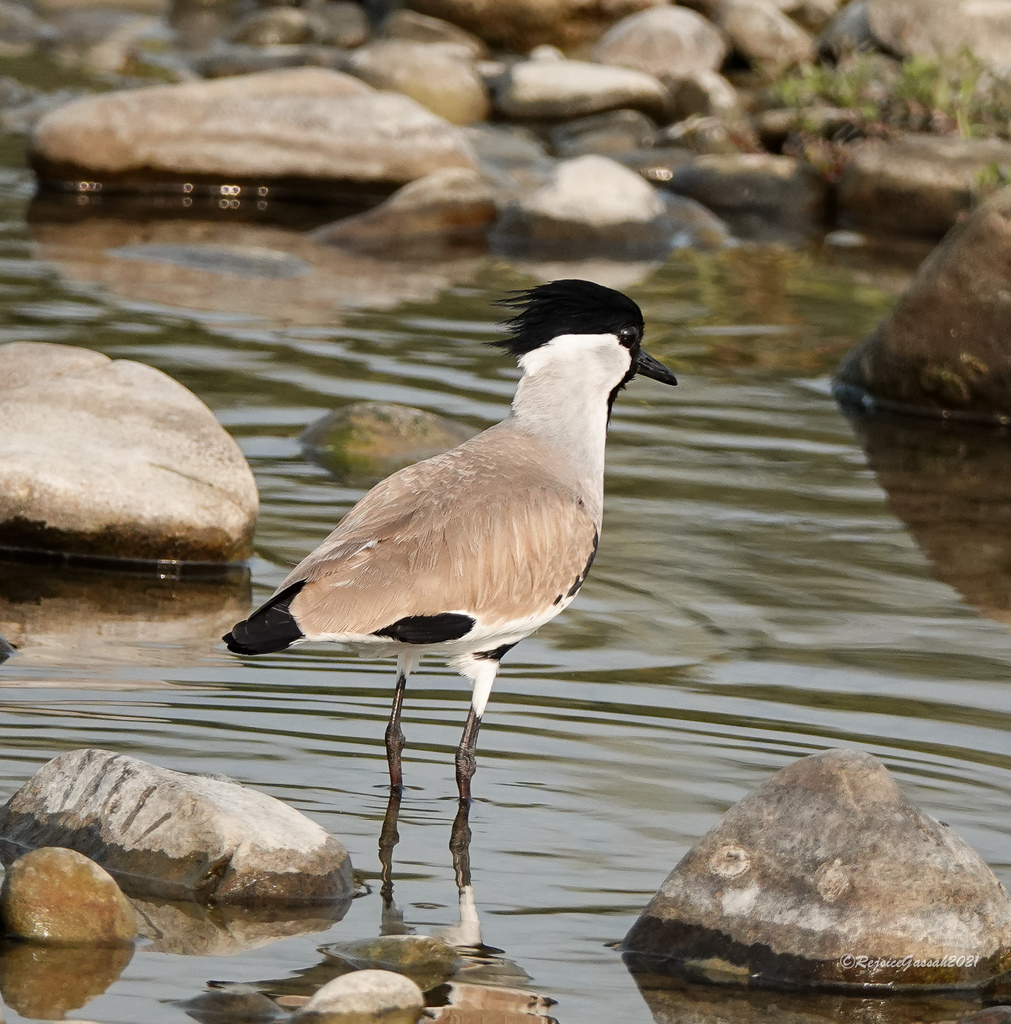
River Lapwing
Photo © Rejoice Gassah
Photo © Rejoice Gassah — CC BY 4.0 — Source: iNaturalist #78429767Identification
The river lapwing is a striking plover measuring 29–32 cm in length, immediately recognisable by its bold head markings. Adults display a distinctive black crest, crown, face and central throat, contrasted sharply against grey-white neck sides and nape. The breast is grey-brown, while the underparts are white with a characteristic black belly patch. The back is brown with a white rump and black tail. In flight, this species is particularly eye-catching, revealing black primaries, white under wings and upper wing secondaries, and brown upper wing coverts. Males are slightly larger than females but otherwise similarly plumaged. Younger birds show brown tips to the black head feathers, a sandier brown back, and pale fringes to the upperpart and wing covert feathers. The bird's sharp call is a distinctive tip-tip or did-did-did sound.
Range & Habitat
The river lapwing breeds from the Indian subcontinent eastwards to Southeast Asia, with its range encompassing much of northern and northeastern India and extending through Southeast Asia to Vietnam. The species appears to be entirely sedentary, remaining within its breeding range year-round without undertaking long-distance migrations.
Behaviour & Diet
This lapwing is not gregarious, preferring solitary or small group associations rather than forming large flocks. During breeding season, which runs from March to June, males perform striking ground displays that include stooping, spinning, stretching and crest-raising movements designed to attract mates. The river lapwing nests on shingle and sand banks, laying just two eggs in a simple ground scrape with minimal nest construction. Its diet comprises insects, worms, crustaceans and molluscs, which it forages for in nearby wet grassland and farmland habitats adjacent to its riverside nesting sites.
Best Time & Places to See It
The breeding season from March to June offers the best opportunity to observe river lapwings, when they are engaged in courtship displays and nesting activities on riverine shingle and sand banks. Birdwatchers should focus on suitable riverine habitats throughout the bird's range in northern and northeastern India and Southeast Asia, particularly areas with nearby wet grassland and farmland. Since the species is sedentary, it can potentially be found year-round within these regions, though breeding season activity makes sightings most predictable and rewarding.
Photography Tips
The river lapwing's bold black and white head markings and striking flight plumage offer excellent photographic subjects. Its ground-based breeding displays provide opportunities to capture dynamic behaviour shots during the March to June season. Patience will be rewarded when photographing this non-gregarious species, as it doesn't gather in large groups. Early morning light will best showcase the contrast between the bird's black markings and white underparts, while in-flight photography should focus on capturing the distinctive white under wings and upper wing secondaries against the darker primaries and brown coverts.
Langtang National Park
Helambu, Nepal
+364 birds+14 mammals
Where the southern slopes of the Himalayan highlands descend toward the subtropical valleys of central Nepal, Langtang National Park sprawls across one of the subcontinent's most…
VIEW NATIONAL PARKOrang National Park
Rangagarapathar, India
+298 birds+1 mammals
Where the Brahmaputra's floodplains meet the foothills of Assam, Orang National Park unfolds across a mosaic of riverine grasslands, forests and wetlands that pulse with the…
VIEW NATIONAL PARKRanthambhore National Park
Sawai Madhopur, India
+294 birds+20 mammals
Granite ridges and ravines carved through the Aravalli Range frame this protected landscape in eastern Rajasthan, where deciduous forest mingles with open scrubland and seasonal water…
VIEW NATIONAL PARKMu Ko Similan National Park
Lam Kaen, Thailand
+82 birds+1 mammals
Granite islands rise from the Andaman Sea in a scattered archipelago where limestone cliffs meet turquoise shallows, their steep faces weathered into caves and overhangs that…
VIEW NATIONAL PARKKanha Tiger Reserve
Kanha Kisli F.V., India
+321 birds+23 mammals
Where sal forests give way to emerald meadows and crystalline streams carve through ancient valleys, one of India's finest wilderness reserves unfolds across the Maikal Range.…
VIEW NATIONAL PARKBandhavgarh National Park
Garhpuri, India
+285 birds+17 mammals
Where granite ridges rise dramatically above sal and bamboo forests, one of India's most pristine tiger reserves unfolds across the Vindhyan plateau. Ancient rock formations tower…
VIEW NATIONAL PARKPanna National Park
Badgadi Kalan, India
+271 birds+17 mammals
Where granite gorges slice through central India's Vindhyan plateau, a landscape of stark beauty unfolds across nearly six hundred square kilometers. The Ken River carves through…
VIEW NATIONAL PARKKaziranga National Park
Kohora, India
+422 birds+26 mammals
Dawn breaks over the floodplains of the Brahmaputra, where tall grasslands stretch endlessly beneath monsoon-heavy skies. This sprawling wilderness of northeastern Assam is a mosaic of…
VIEW NATIONAL PARKKeoladeo National Park
Shreenagar Rural, India
+326 birds+14 mammals
Where shallow wetlands shimmer beneath vast Rajasthani skies, one of Asia's finest bird sanctuaries pulses with extraordinary life. This former maharaja's hunting reserve, now spanning 29…
VIEW NATIONAL PARKGaoligong Mountain National Nature Reserve
Nujiang Lisu Autonomous Prefecture, China
+443 birds+13 mammals
VIEW NATURE RESERVENo community photos yet. Log in to add the first one.
No community observations of this species yet.