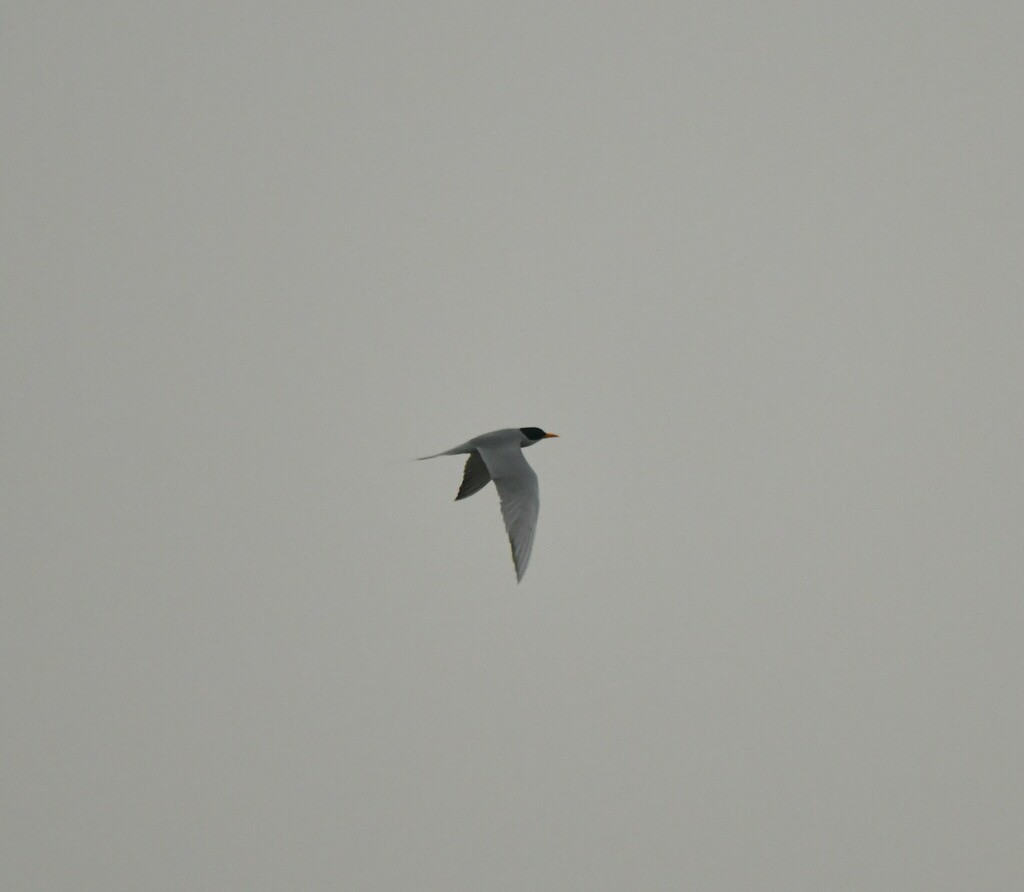
River Tern
Photo © Surabhi Srivastava
Photo © Surabhi Srivastava — CC BY 4.0 — Source: iNaturalist #144518294Identification
The River Tern is a medium-large tern, measuring 38–46 cm long with an 80–85 cm wingspan, making it distinctly larger than other typical terns in the genus Sterna. It features dark grey upperparts contrasting with white or very pale grey underparts, a characteristic forked tail with long flexible streamers, and long pointed wings with pale grey primaries. The bill is notably stout for a tern—bright yellow in summer but duller yellow with a dusky tip in winter—and the legs are bright red.
In breeding plumage, the River Tern displays a striking black cap that is more extensive than in other Sterna terns, extending well below the eye. During winter, this cap becomes greyish white, flecked and streaked with black, with a dark mask through the eye, and the two longest outer tail feathers are shed, making the bird conspicuously shorter-tailed. Juveniles have a brown head, brown-marked grey upperparts, grey-sided breast, and white underparts, with a yellowish bill tipped in dark.
Range & Habitat
This species is a resident breeder along inland rivers from Pakistan east through the Indian subcontinent to Myanmar, Thailand, and Cambodia, where it remains uncommon. Unlike most typical terns, the River Tern is almost exclusively found on freshwater and rarely ventures even to tidal creeks—a preference so strong that it is entirely absent from Sri Lanka despite being widespread in Kerala and Tamil Nadu in southernmost India.
The River Tern typically inhabits lowland riverine freshwater environments from 0–600 m altitude, though it has exceptionally been recorded at 2,706 m altitude in the Upper Indus valley in the western Himalaya. The species also uses freshwater reservoirs extensively, and this habitat flexibility has permitted local population increases in some areas, bucking the general trend of decline across much of its range.
Behaviour & Diet
The River Tern breeds from March to May, nesting in colonies in less accessible areas such as sandbanks in rivers. It nests in a simple ground scrape, often on bare rock or sand, laying three greenish-grey to buff eggs that are blotched and streaked with brown. Like other Sterna terns, it feeds by plunge-diving for fish, crustaceans, tadpoles, and aquatic insects in rivers, lakes, and tanks.
The species faces mounting conservation pressures across much of its range. Its populations are decreasing due to commercial development of rivers, human disturbance, and pollution of freshwater habitats. It is particularly endangered in the eastern portions of its range, notably in the far south of China where only one breeding site remains, and in Cambodia, Laos, and Thailand. The species has been recorded as a vagrant in Afghanistan and Iran.
Best Time & Places to See It
The breeding season from March to May offers the best opportunity to observe River Terns, particularly at their colonial nesting sites on accessible sandbanks and riverine areas. Look for them along inland rivers and freshwater reservoirs throughout Pakistan and the Indian subcontinent, particularly in Kerala, Tamil Nadu, and across the major river systems. Their preference for freshwater habitats means they are reliably found far from coastal areas.
Photography Tips
Photograph the River Tern during breeding season when its distinctive black cap and bright yellow bill are most vibrant. The bird's plunge-diving feeding behaviour provides dynamic photographic opportunities—position yourself along riverbanks and freshwater lakes where you can capture the characteristic dive sequence. The bright red legs and pale grey primaries are striking field marks worth highlighting in images. Note that winter plumage is considerably less striking, with a reduced tail and greyish cap, so breeding season visits will yield the most visually rewarding photographs.
Orang National Park
Rangagarapathar, India
+298 birds+1 mammals
Where the Brahmaputra's floodplains meet the foothills of Assam, Orang National Park unfolds across a mosaic of riverine grasslands, forests and wetlands that pulse with the…
VIEW NATIONAL PARKRanthambhore National Park
Sawai Madhopur, India
+294 birds+20 mammals
Granite ridges and ravines carved through the Aravalli Range frame this protected landscape in eastern Rajasthan, where deciduous forest mingles with open scrubland and seasonal water…
VIEW NATIONAL PARKEravikulam National Park
Devikulam, India
+192 birds+7 mammals
High in the Western Ghats of Kerala, where monsoon mists cling to slopes that rise above 2,000 metres, Eravikulam National Park preserves one of South India's…
VIEW NATIONAL PARKKanha Tiger Reserve
Kanha Kisli F.V., India
+321 birds+23 mammals
Where sal forests give way to emerald meadows and crystalline streams carve through ancient valleys, one of India's finest wilderness reserves unfolds across the Maikal Range.…
VIEW NATIONAL PARKTadoba National Park
Palasgaon Singru, India
+270 birds+20 mammals
Where sal forests meet open grasslands and rocky outcrops rise from red laterite soil, central India's landscape unfolds in raw, untamed beauty. Ancient teak woodlands and…
VIEW NATIONAL PARKBandhavgarh National Park
Garhpuri, India
+285 birds+17 mammals
Where granite ridges rise dramatically above sal and bamboo forests, one of India's most pristine tiger reserves unfolds across the Vindhyan plateau. Ancient rock formations tower…
VIEW NATIONAL PARKPanna National Park
Badgadi Kalan, India
+271 birds+17 mammals
Where granite gorges slice through central India's Vindhyan plateau, a landscape of stark beauty unfolds across nearly six hundred square kilometers. The Ken River carves through…
VIEW NATIONAL PARKKaziranga National Park
Kohora, India
+422 birds+26 mammals
Dawn breaks over the floodplains of the Brahmaputra, where tall grasslands stretch endlessly beneath monsoon-heavy skies. This sprawling wilderness of northeastern Assam is a mosaic of…
VIEW NATIONAL PARKKeoladeo National Park
Shreenagar Rural, India
+326 birds+14 mammals
Where shallow wetlands shimmer beneath vast Rajasthani skies, one of Asia's finest bird sanctuaries pulses with extraordinary life. This former maharaja's hunting reserve, now spanning 29…
VIEW NATIONAL PARKPeriyar National Park
Mlappara, India
+232 birds+4 mammals
Dawn breaks over mist-shrouded ridges where the Western Ghats tumble toward Kerala's spice-scented lowlands. Here, ancient tropical forests envelope a glittering artificial lake, creating a mosaic…
VIEW NATIONAL PARKPampadum Shola National Park
Vattavada, India
+258 birds+14 mammals
Where misty shola forests cling to the high plateaus of the Nilgiri Mountains, ancient evergreen remnants create a world apart. This 2,316-hectare reserve protects one of…
VIEW NATIONAL PARKBandipur National Park
Hirehalli, India
+302 birds+19 mammals
Where the Western Ghats descend into the Deccan plateau, ancient deciduous forests blanket a landscape carved by the Nugu River. Bandipur unfolds across 880 square kilometres…
VIEW NATIONAL PARKNagarahole Tiger Reserve
Nalkeri Forest, India
+323 birds+23 mammals
Where granite escarpments rise above dense deciduous forests and the Kabini River carves through pristine wilderness, one of India's most biodiverse landscapes unfolds across the Western…
VIEW NATIONAL PARKGir National Park
Asundrali, India
+258 birds+13 mammals
Dry deciduous forests cloak the rolling hills of western Gujarat where the Gir landscape rises as a final sanctuary for one of the world's rarest felids:…
VIEW NATIONAL PARKNo community photos yet. Log in to add the first one.
No community observations of this species yet.