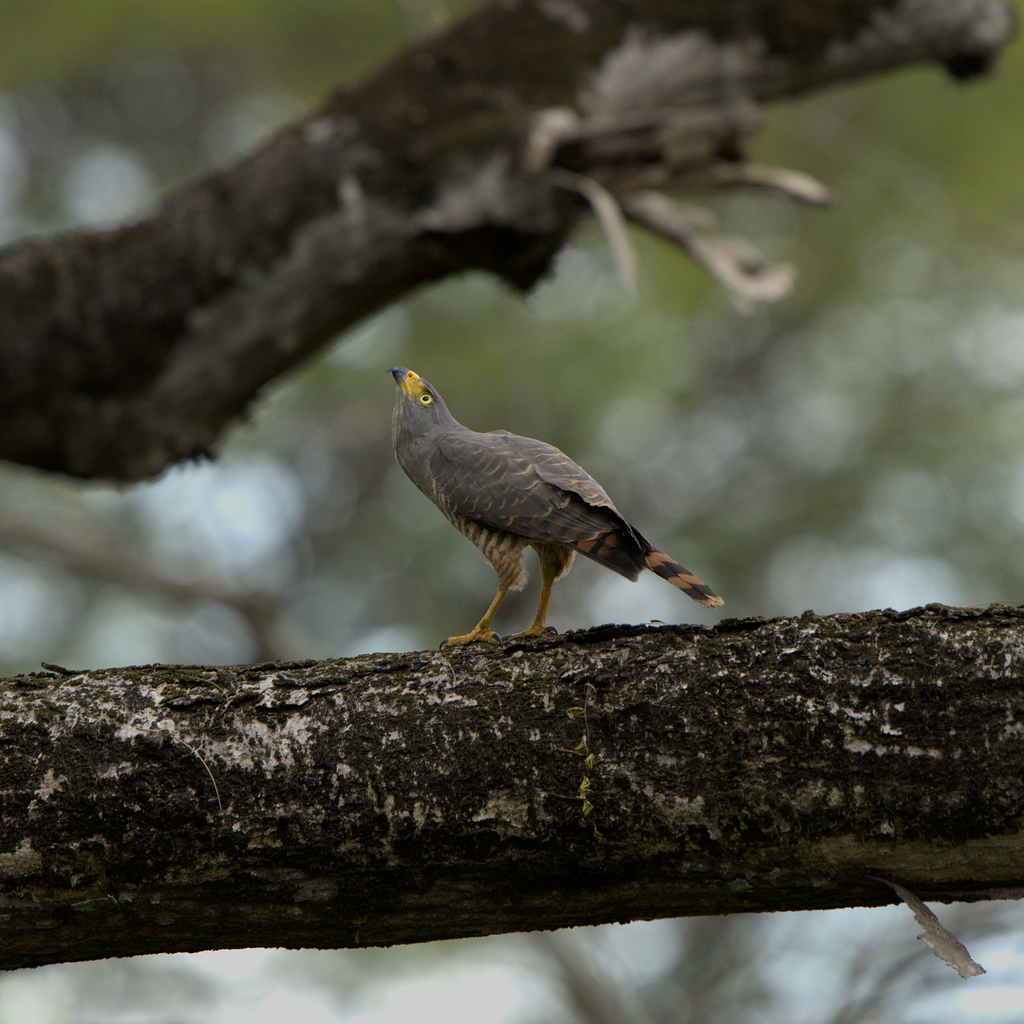
Roadside Hawk
Photo © Anthony Batista
Photo © Anthony Batista — CC BY 4.0 — Source: iNaturalist #104150522Identification
The Roadside Hawk is a small raptor measuring 31–41 cm in length and weighing 250–300 g, making it the smallest hawk in the widespread genus Buteo. Males are approximately 20% smaller than females, though otherwise the sexes are similar. Depending on the subspecies, the bird is mainly brown or grey, with the lower breast and underparts characteristically barred brown and white. The tail displays four or five grey bars. A distinctive touch of rufous (light reddish-brown) is often visible on the wings, particularly in flight. The bird's relatively large beak—reflected in its scientific name magnirostris—is a notable feature, and adult eyes are whitish or yellow. In flight, the Roadside Hawk's relatively long tail combined with disproportionately short wings are distinctive identifying features.
Range & Habitat
The Roadside Hawk is common throughout its range, which extends from Mexico through Central America to most of South America east of the Andes Cordillera, reaching from the northern Caribbean coast south to northeastern Argentina. Occasional vagrants are found in Texas. With the possible exception of dense rainforests, this species is well adapted to most ecosystems in its range. It is notably an urban bird and is possibly the most common or most conspicuous hawk species seen in various cities throughout its distribution.
Behaviour & Diet
The Roadside Hawk is a highly vocal species known for its very high-pitched piercing squeak. It is often the most common raptor in its range, and becomes notably aggressive when nesting, with records of attacks on humans passing near the nest. The bird frequently soars but does not hover. It hunts primarily using the "still hunting" method, patiently waiting from a perch before dropping or gliding down to capture prey—a technique that is generally successful, though success rates vary depending on habitat.
The diet consists mainly of insects, squamates, and small mammals, including young common marmosets and similar small monkeys, which are hunted quite regularly. Small birds are taken far less frequently. Mixed-species feeding flocks encountered in open cerrado habitat show little wariness, watching the hawk only to ensure it does not come too close, treating it barely more as a threat than the diminutive American Kestrel.
Best Time & Places to See It
The Roadside Hawk's abundance and conspicuousness make it one of the most readily observed raptors throughout its range. Urban and semi-open habitats offer the best opportunities for sightings. The species is found across diverse environments from Mexico to Argentina, making it accessible to travellers throughout Central and South America. Its vocal nature and tendency to perch openly while hunting increase the likelihood of encounters.
Photography Tips
Photograph this species from a distance during nesting season, as it can be aggressive near the nest. The distinctive long tail and short wings are best captured in flight shots. Look for the bird perched openly while hunting, which provides excellent opportunities for portraiture showing the barred underparts, large beak, and eye colour. The rufous tones on the wings are particularly visible in flight photography taken against open sky. Early morning and late afternoon light will enhance the subtle plumage variations between subspecies.
Amacayacu National Park
Amazônia National Park
Anavilhanas National Park
Antisana National Park
Araucárias National Park
Arenal Volcano National Park
Bahuaja Sonene National Park
Barbilla National Park
Baritú National Park
Nothing matches these filters.
No community photos yet. Log in to add the first one.
No community observations of this species yet.