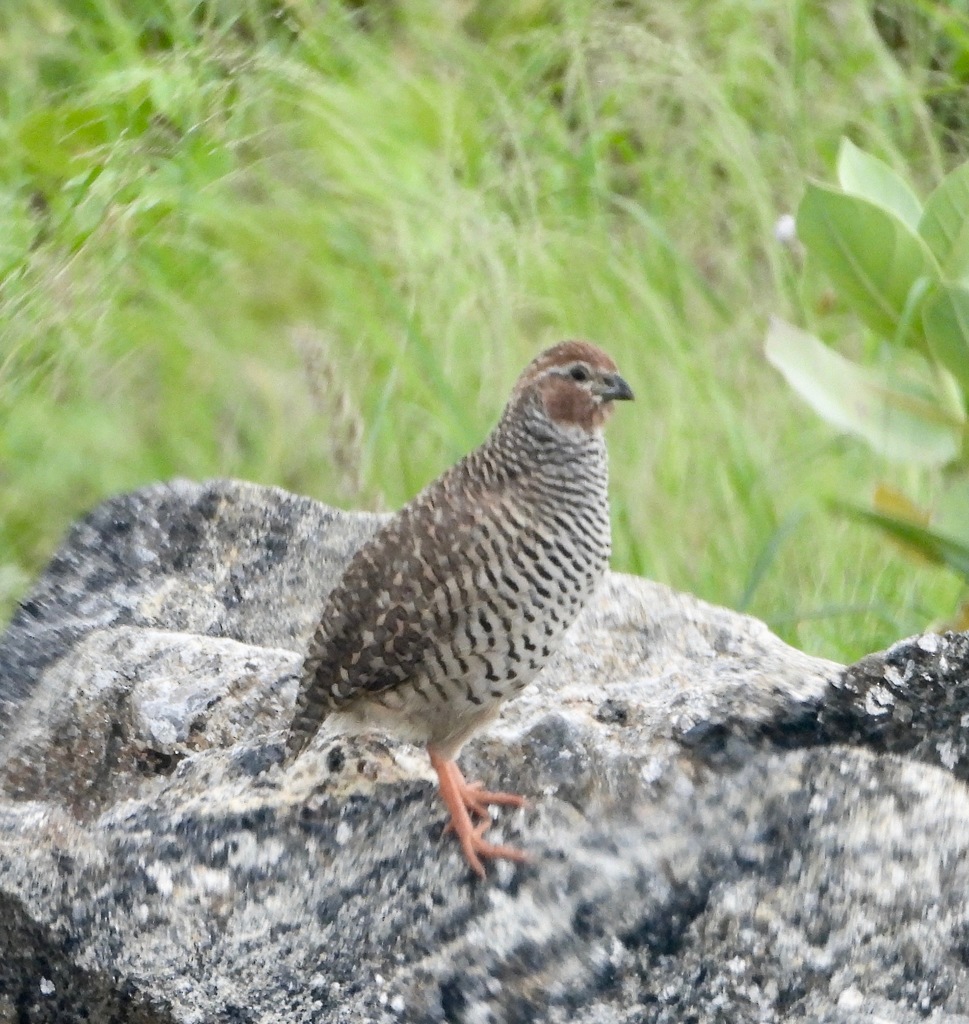
Rock Bush Quail
Photo © desertnaturalist
Photo © desertnaturalist — CC BY 4.0 — Source: iNaturalist #31733873The rock bush quail (Perdicula argoondah) is a species of quail found in parts of peninsular India. It is a common species with a wide range and the IUCN has rated it as being of "least concern". == Taxonomy and systematics == There are three recognised subspecies: P. a. argoondah found from Madhya Pradesh southwards to Tamil Nadu P. a. meinertzhageni found in northwestern India P. a. salimalii found in South India in parts of Karnataka. == Description == The rock bush quail is very similar to and overlaps in range with the jungle bush quail (Perdicula asiatica). These birds are found in small coveys and are often detected only when they suddenly burst out into flight en masse from under vegetation. It is 6.7–7.25 in (17.0–18.4 cm) in length and weighs 2.25–3 oz (64–85 g). It is some shade of brown barred and mottled with darker colour. A diagnostic feature is that the outermost primary feather is longer than the innermost, and the inner web of the primaries is barred or speckled with buff. The voice is a trill followed by a series of piping notes which start quiet and grow louder. == Distribution and habitat == The rock…
Ranthambhore National Park
Sawai Madhopur, India
+294 birds+20 mammals
Granite ridges and ravines carved through the Aravalli Range frame this protected landscape in eastern Rajasthan, where deciduous forest mingles with open scrubland and seasonal water…
VIEW NATIONAL PARKTadoba National Park
Palasgaon Singru, India
+270 birds+20 mammals
Where sal forests meet open grasslands and rocky outcrops rise from red laterite soil, central India's landscape unfolds in raw, untamed beauty. Ancient teak woodlands and…
VIEW NATIONAL PARKGir National Park
Asundrali, India
+258 birds+13 mammals
Dry deciduous forests cloak the rolling hills of western Gujarat where the Gir landscape rises as a final sanctuary for one of the world's rarest felids:…
VIEW NATIONAL PARKNo community photos yet. Log in to add the first one.
No community observations of this species yet.