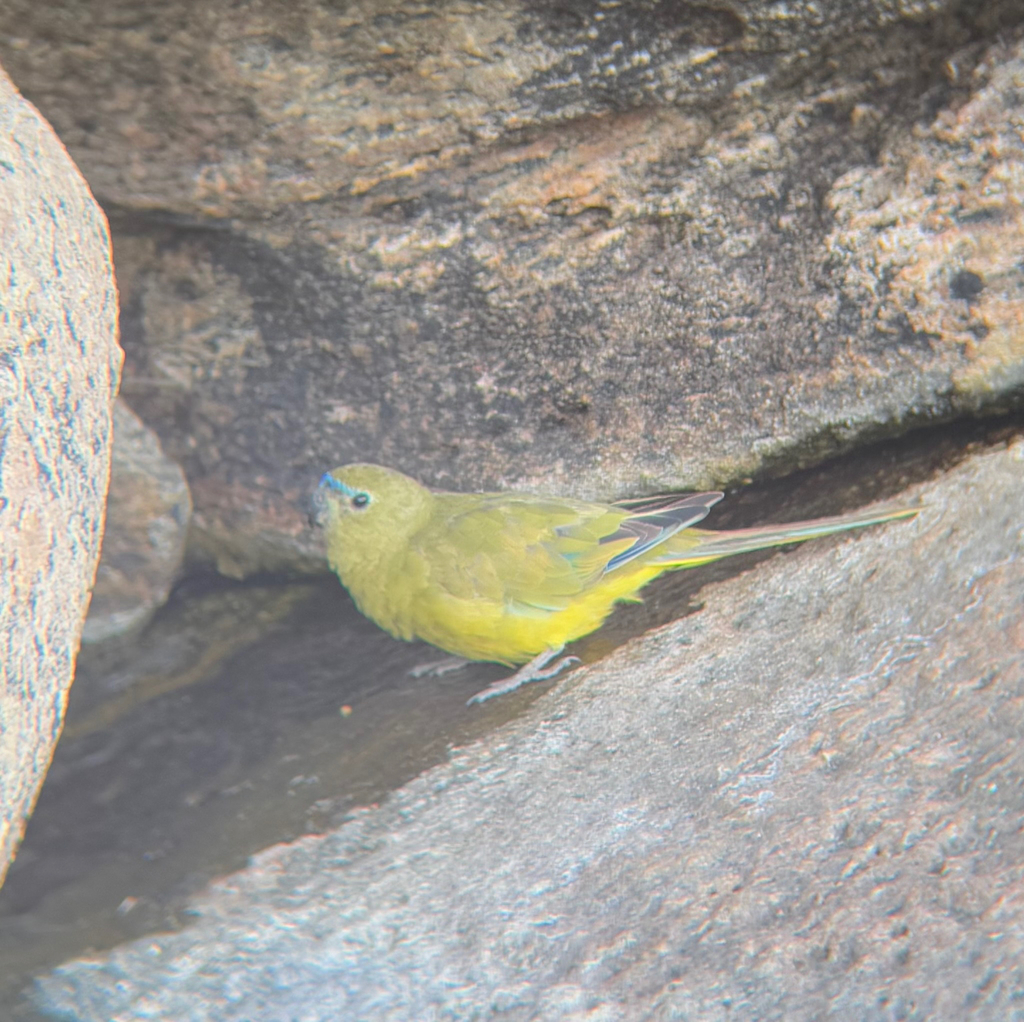
Rock Parrot
Photo © Caleb Catto
Photo © Caleb Catto — CC BY 4.0 — Source: iNaturalist #302368711Identification
The rock parrot is a small, delicately built parrot measuring 22–24 cm in length and weighing just 50–60 g. It is characterized by predominantly olive-brown upperparts and yellowish underparts. The most distinctive feature is its head pattern: a dark blue band crosses the upper forehead between the eyes, bordered by a thin light blue line above and a thicker light blue band below. The forecheeks and lores are also light blue. Males and females are similar, though females tend to have a duller frontal band and less extensive blue on the face. The wings display a striking two-toned blue leading edge when folded, and the tail is turquoise edged with yellow.
Juveniles are duller and darker overall, with indistinct or absent blue frontal bands and yellowish or orange bills that turn brown by ten weeks of age. In Western Australia, the rock parrot can be confused with the elegant parrot, and in South Australia with the blue-winged parrot, though both of these species have brighter plumage and different facial markings.
Range & Habitat
The rock parrot is endemic to Australia, found from Lake Alexandrina in southeastern South Australia westwards across coastal South and Western Australia to Shark Bay. Unlike other grass parrots, it is highly specialized for rocky and maritime environments, preferring rocky islands and coastal dune areas. It nests in burrows or rocky crevices, mostly on offshore islands such as Rottnest Island near Fremantle, rather than in trees.
This species has evolved from tree-nesting ancestors to exploit burrow-nesting niches, likely as an adaptation to avoid tree-dwelling mammalian predators. Historically, it was common on cliff faces and inaccessible rocky outcrops on offshore islands at the time of European colonisation.
Behaviour & Diet
Rock parrots are seed-eaters, with seeds of grasses and succulent plants forming the bulk of their diet. They are highly vocal birds; notably, the female's call is far louder and more shrill than the male's.
The species has experienced population decline due to predation by feral mammals, though it remains classified as least-concern by the International Union for Conservation of Nature. Their specialized burrow-nesting behaviour and dependence on offshore islands and coastal rocky habitats make them particularly vulnerable to environmental changes and introduced predators in their limited range.
Best Time & Places to See It
Rottnest Island near Fremantle, Western Australia, is one of the most reliable locations to encounter rock parrots, where they nest in rocky crevices and burrows. Other offshore islands and rocky coastal areas from Lake Alexandrina in South Australia westward to Shark Bay in Western Australia may also harbour populations.
Coastal dune areas and rocky shorelines along this range offer opportunities for sightings, particularly in areas with suitable burrow-nesting habitat and minimal feral mammal activity.
Photography Tips
The rock parrot's small size and preference for rocky, often windswept offshore island habitats present challenges for photographers. A telephoto lens is essential, as these birds are typically wary and difficult to approach closely. Early morning and late afternoon light can beautifully highlight the distinctive blue facial markings and two-toned wing edges when folded.
Patience is key—spend time observing likely burrows and rocky crevices, particularly during breeding season when birds are more active. Photographing birds in flight or entering burrows requires fast shutter speeds and good tracking ability. The contrast between the olive-brown plumage and bright blue facial patches and wing edges makes for striking images when properly lit.
Coffin Bay National Park
Coorong National Park
Fitzgerald River National Park
Flinders Chase National Park
Innes National Park
Lincoln National Park
Nambung National Park
Nothing matches these filters.
No community photos yet. Log in to add the first one.
No community observations of this species yet.