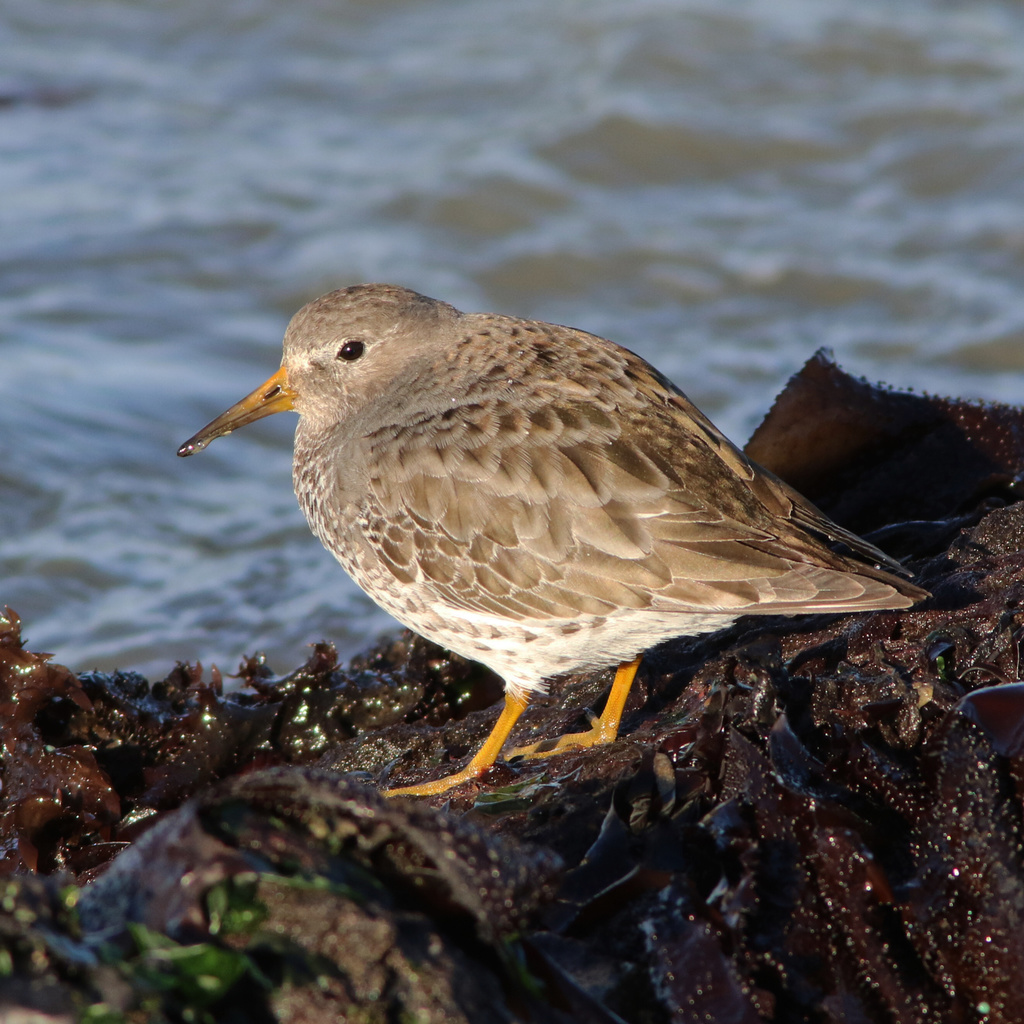
Rock Sandpiper
Photo © Cricket Raspet
Photo © Cricket Raspet — CC BY 4.0 — Source: iNaturalist #38353776Identification
The rock sandpiper is a small, hardy shorebird with distinctly stocky proportions. Adults display short yellow legs and a medium-length thin dark bill. The upperparts are dark with a subtle purplish gloss, contrasting with mainly white underparts. A grey smear across the breast and a black rump are characteristic features. The nominate subspecies from the Pribilof Islands shows a bold black belly patch in breeding plumage, making it particularly striking. The other three subspecies more closely resemble the rock sandpiper's close relative, the purple sandpiper, though all share this species' rugged appearance suited to harsh coastal environments.
Range & Habitat
Rock sandpipers breed across arctic and subarctic regions of Alaska and far eastern Russia, including the Chukchi Peninsula, Kamchatka Peninsula, Pribilof Islands, Aleutian Islands, Kuril Islands, and Commander Islands. Four recognised subspecies occupy different breeding ranges, from western Alaska to the Kamchatka Peninsula. During winter, they migrate south to rocky, ice-free Pacific coasts, with subspecies leap-frogging each other so that more northerly breeders winter farther south than more southerly breeders.
Breeding habitat consists of northern tundra on Arctic Pacific coasts, typically in drier and more desolate areas with limited vegetation such as lichen, moss, and sparse grasses. During the non-breeding season, these birds inhabit rocky Pacific coasts where they can form rather large wintering flocks and endure harsh conditions by relying on high prey quality.
Behaviour & Diet
Rock sandpipers are monogamous breeders, with pair bonds usually lasting several years. They nest on the ground, either elevated on rocks or in lower damp locations. The male makes several scrapes, and the female selects one in which to lay four eggs. Both parents share incubation duties, demonstrating collaborative breeding behaviour.
These birds forage primarily on rocky coasts, mainly eating insects, mollusks, and marine worms, with some plant material supplementing their diet. Their primary prey during the non-breeding season includes the bivalve Macoma balthica. Rock sandpipers often feed up to their breast in water and frequently swim. They typically roost on rocks near their feeding grounds just above the high tide spray, remaining closely tied to rocky coastal habitats throughout their lifecycle.
Best Time & Places to See It
Rock sandpipers can be encountered on rocky Pacific coasts during winter months when they form larger flocks at their southern non-breeding grounds. The Aleutian Islands, Pribilof Islands, and coastal Alaska are reliable locations for observing this species, though viewing opportunities depend on access to remote arctic and subarctic regions. Winter represents the most accessible season for most observers, as wintering populations gather on ice-free rocky coasts.
Photography Tips
Photographing rock sandpipers presents the challenge of capturing a small, dark shorebird in its rocky coastal habitat. Focus on capturing the distinctive features—the short yellow legs, dark upperparts with purplish gloss, and white underparts with grey breast smearing. Winter plumage is generally more accessible for photography than breeding plumage. Photograph birds as they forage in shallow water or roost on rocks near the tide line, where their behaviour is most predictable. The harsh coastal lighting typical of arctic and subarctic regions can be dramatic and rewarding for wildlife photography.
Gulf Islands National Park Reserve
Southern Gulf Islands Electoral Area, Canada
+268 birds+26 mammals
Scattered across the Salish Sea in British Columbia's southwestern corner, this national park reserve stitches together a fragmented archipelago of forested islands and rocky outcrops where…
VIEW NATIONAL PARKGlacier Bay National Park
Unorganized Borough, United States
+221 birds+15 mammals
Tidewater glaciers calving into fjords of impossible blue, where temperate rainforest rises steeply from the water's edge and alpine peaks pierce the clouds—this is the ecological…
VIEW NATIONAL PARKRedwood National Park
Humboldt County, United States
+343 birds+43 mammals
Where the Pacific fog rolls deep into northern California's coastal valleys, some of the tallest trees on Earth rise from a landscape shaped by tectonic forces…
VIEW NATIONAL PARKGwaii Haanas National Park Reserve and Haida Heritage Site
Area E (Moresby Island), Canada
+98 birds+8 mammals
Where temperate rainforest meets the Pacific's edge, the islands of southern Haida Gwaii rise as one of North America's most pristine coastal wilderness areas. Spanning approximately…
VIEW NATIONAL PARKSt. Paul Island
Saint Paul, United States
+255 birds+8 mammals
Windswept tundra rolls across this remote Pribilof island, where volcanic basalt cliffs plunge into the Bering Sea and fog rolls in thick enough to erase the…
VIEW PROTECTED LANDSCAPELake Clark National Park
United States
+158 birds+11 mammals
Where subarctic tundra meets volcanic terrain and pristine waterways, Lake Clark National Park unfolds across southwestern Alaska as a landscape carved by ice age glaciers and…
VIEW NATIONAL PARKKodiak National Wildlife Refuge
United States
+221 birds+22 mammals
Where temperate rainforest meets subarctic coast, Kodiak National Wildlife Refuge sprawls across Alaska's largest island, a sanctuary defined by steep valleys carved by tidewater glaciers and…
VIEW WILDLIFE SANCTUARYAlaska Maritime National Wildlife Refuge
Alaska, United States
+391 birds+58 mammals
Where the North Pacific collides with Alaska's rugged coastline, a sprawling archipelago of islands, rocky outcrops, and coastal headlands forms one of North America's most remote…
VIEW WILDLIFE SANCTUARYYukon Delta National Wildlife Refuge
Bethel, United States
+156 birds+12 mammals
Across the Yukon Delta sprawls one of North America's most expansive coastal wetland sanctuaries, where the boreal subarctic climate strips down existence to essentials. This vast…
VIEW WILDLIFE SANCTUARYIzembek National Wildlife Refuge
Cold Bay, United States
+138 birds+9 mammals
Where the Aleutian archipelago reaches westward into the Bering Sea, subarctic tundra and shallow coastal waters converge to create one of Alaska's most ecologically vital wildlife…
VIEW WILDLIFE SANCTUARYBecharof National Wildlife Refuge
United States
+146 birds+2 mammals
Across southwestern Alaska's windswept lowlands, where the Bristol Bay watershed spills into vast tidal flats and sedge marshes, lies one of North America's most pristine subarctic…
VIEW WILDLIFE SANCTUARYFarallon National Wildlife Refuge
San Francisco, United States
+384 birds+16 mammals
Windswept granite peaks rising abruptly from the Pacific, the Farallon Islands form a wildlife sanctuary of extraordinary seabird abundance and ecological significance just twenty-seven miles west…
VIEW WILDLIFE SANCTUARYNo community photos yet. Log in to add the first one.
No community observations of this species yet.