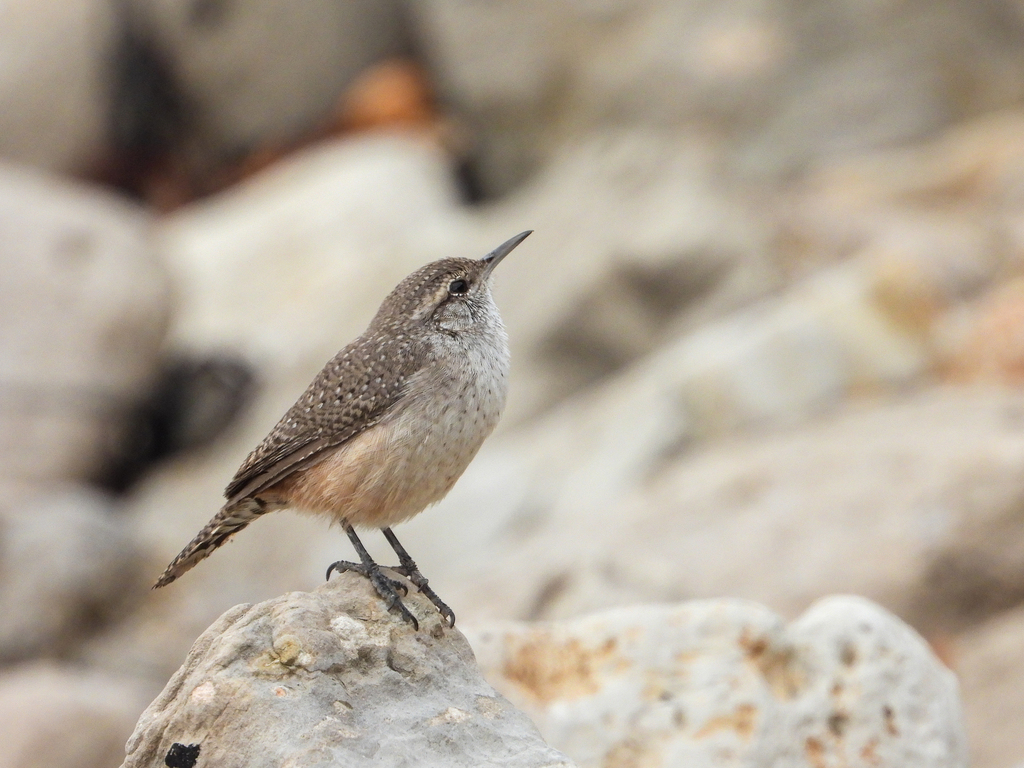
Rock Wren
Photo © James M. Maley
Photo © James M. Maley — CC BY 4.0 — Source: iNaturalist photo #155700682Identification
The rock wren is a small songbird measuring 12.5–15 cm in length with a wingspan of 22–24 cm. It features grey-brown upperparts with small black and white spots, pale grey underparts, and a distinctive light brown rump. Look for a light grey line extending through the eye, a long sharp bill, and a speckled light grey throat. The long barred tail and zebra-striped undertail coverts are additional field marks. Juvenile plumage is similar to adults but with slightly more vibrant buff coloring and fluffier feathers.
Rock wrens can be confused with canyon wrens, which share their rocky habitats. However, canyon wrens have solid white throats and brighter, less muddled overall coloring, making them distinguishable with careful observation.
Range & Habitat
Rock wrens are native to the rocky areas of western North America, with eight subspecies distributed across the region. They are permanent residents in southern parts of their range, including California, western Washington, northern Nevada, Arizona, New Mexico, inland Mexico, Baja California, and Central America (Guatemala, Nicaragua, Costa Rica, and Panama). During breeding season, their range extends northward to southern British Columbia, Wyoming, Montana, Idaho, and Utah. They occasionally appear as vagrants in the eastern United States.
Rock wrens favor rocky open habitats such as exposed rock faces, canyons, cliffs, and eroded sandbanks. They prefer areas with steep features, shrubby vegetation for foraging, and crevices suitable for nesting. Though tolerant of altitudes from 60 m to 3,600 m above sea level, they are most common below 2,000 m. They are rare in urban areas, preferring wild rocky terrain.
Behaviour & Diet
Rock wrens are serially monogamous, forming pairs during the nesting season. They are noted for their variable song and distinctive song patterns, which serve to defend their territories. A remarkable habit is their construction of "pavements"—arrangements of flat rocks around their nests that help keep nestlings dry. Nesting typically begins in March in rocky crevices, with first broods laid from late April through June and possible second broods in late June.
Rock wrens are largely terrestrial foragers that rarely fly. Their diet shifts seasonally: during spring and summer they feed primarily on insects, especially weevils, while in autumn and winter they shift to grain. They are classified as least-concern, though their population has declined by 13% between 2010 and 2020.
Best Time & Places to See It
The breeding season from March through June offers the best opportunity to observe rock wrens at nests and hear their territorial songs. Visit rocky canyons, cliff faces, and exposed rock formations throughout their western North American range. Permanent resident populations in California, Arizona, New Mexico, and Mexico provide year-round viewing opportunities. The southwestern United States offers reliable sightings in appropriate habitat.
Photography Tips
Rock wrens are small and often remain on the ground or among rocks, making them challenging subjects. Use a telephoto lens (at least 300–400 mm) to capture distant subjects without disturbing them. Early morning light helps illuminate their subtle grey-brown plumage and distinctive markings. Photograph them near nesting sites in March and April when they are more active and visible. Their habit of staying terrestrial means you may need to position yourself low to the ground for better angles. Patient stalking of rocky habitats will reward you with close approaches to foraging birds.
Arches National Park
Badlands National Park
Bear River Migratory Bird Refuge
Big Bend National Park
Bitter Lake National Wildlife Refuge
Black Canyon of the Gunnison National Park
Bosque del Apache National Wildlife Refuge
Bryce Canyon National Park
Cabeza Prieta National Wildlife Refuge
Nothing matches these filters.
No community photos yet. Log in to add the first one.
No community observations of this species yet.