Footsteps Birdhide
Footsteps Eco-Lodge·Nyatang Faraba·The Gambia
Little Bee-eater · Yellow-crowned Gonolek+7
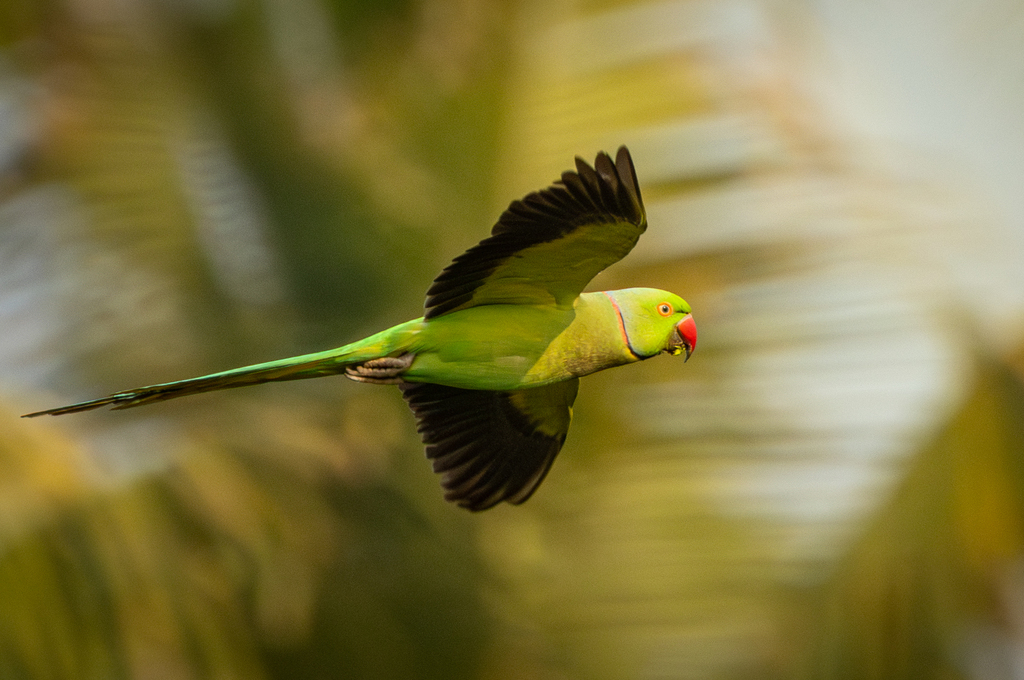
Rose-ringed parakeets are medium-sized parrots, measuring 37–43 cm in length, with distinctive green plumage, a bright red beak, and a blue tail. The most striking feature is their unmistakable neck ring: adult males display a striking pink and black ring, while females and immature birds show either no rings or faint grey shadow-like markings. Their size varies geographically, with Asian subspecies considerably larger and heavier than African birds. They are highly vocal and produce an unmistakable squawking call that often announces their presence before they come into view.
The species has a disjunct native range across tropical northern Africa—in a belt between approximately 4° to 17° N latitude across the Sudanian savannas—and throughout the Indian subcontinent and Sri Lanka, from the Indus River valley in Pakistan to the Irrawaddy River valley in Myanmar. Since the late 20th century, escaped and deliberately released captive birds have established thriving populations across much of Europe, including Germany, France, Belgium, the Netherlands, Italy, and the UK, as well as in Australia, much of the United States, and other Western countries. Remarkably, they now breed further north than any other parrot species, demonstrating exceptional adaptability to cooler climates.
Rose-ringed parakeets are non-migratory herbivores that typically feed on buds, nectar, fruit, vegetables, nuts, berries, seeds, and grains. In their native range, wild flocks forage several miles from roosting sites to feed in farmlands and orchards, sometimes causing extensive damage to crops. Their diet varies regionally: in India they favour cereal grains and pigeon peas, while in Egypt they feed on mulberries, dates, and cultivated crops like sunflowers and corn. Feral populations regularly visit gardens and other human-modified habitats, readily taking food from bird feeders.
In their native African and Asian ranges, rose-ringed parakeets occur year-round as non-migratory residents. In Europe and other introduced regions, they are increasingly established, with particularly large populations in Germany, France, Belgium, the Netherlands, Italy, and the UK. Early morning hours are often best for observation, when birds are most active and vocal. They are adaptable to disturbed habitats and urban environments, making them relatively easy to locate in parks, gardens, and agricultural areas near human settlements.
The rose-ringed parakeet's bright green plumage, red beak, and distinctive blue tail make them visually striking subjects. Males with their prominent pink and black neck rings are particularly photogenic. Their habit of visiting gardens and bird feeders in many regions offers excellent opportunities for approach photography. Early morning light brings out the vivid colours of their plumage. Their noisy, gregarious behaviour means they often occur in flocks, providing opportunities to capture multiple individuals in dynamic flight or feeding sequences. Patient observation of regular feeding sites will reward photographers with predictable opportunities.
Nothing matches these filters.
Nothing matches these filters.
No community photos yet. Log in to add the first one.
No community observations of this species yet.
We'd love to hear from you. We'll reply as soon as possible.
Found an error? Have a suggestion? We read every message.
A compact view of how this species lives, moves and responds to its environment.
Select a card to explore the details.
Please confirm the photo rights and credit terms first.
I'm the author of this photo or hold the rights to it, and I keep full ownership. I grant Wild Atlas Guide a free, non-exclusive licence to display it on the site and in Wild Atlas Guide's own channels, including social media, always credited to me by my display name or the Instagram handle I choose to provide. I confirm it does not reveal a sensitive wildlife location or a recognisable person without their permission. I can withdraw future social use for this photo or ask for it to be removed at any time.
Please accept the photo rights and credit terms to continue.
Uploading…
We use cookies to measure traffic and improve Wild Atlas Guide. You decide. Privacy policy