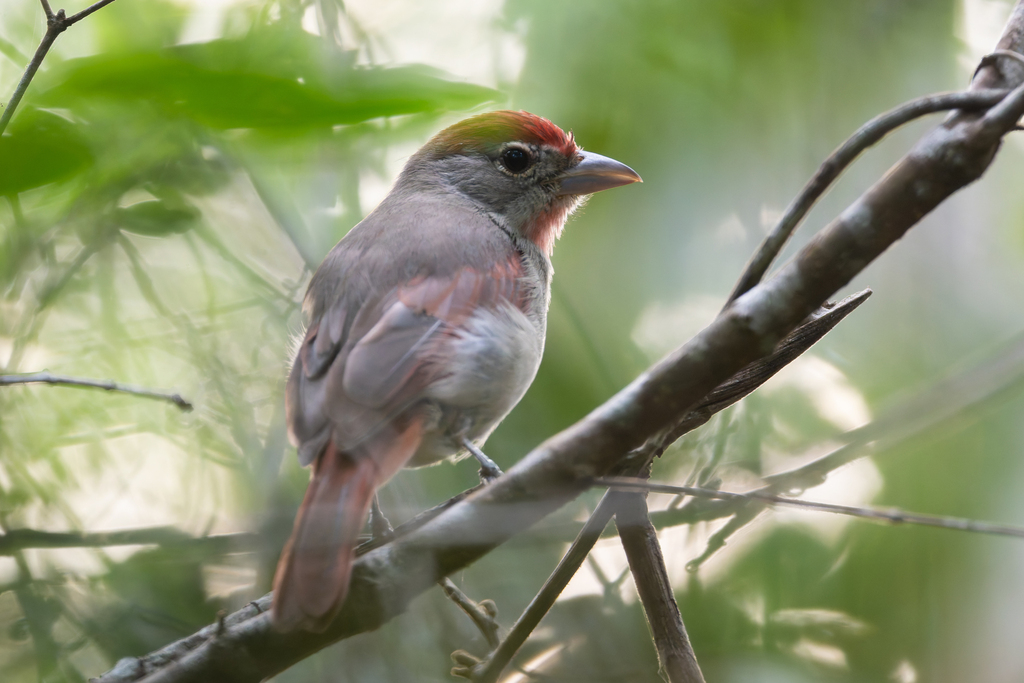
Rose-throated Tanager
Photo © Adam Jackson
Photo © Adam Jackson — CC0 1.0 — Source: iNaturalist photo #443067329Identification
The rose-throated tanager is a medium-sized songbird measuring 16 cm (6.3 in) long and weighing 21 to 30 g. Males are instantly recognizable by their striking deep rose crown and throat contrasting sharply with gray plumage on the body; the folded wings and tail appear crimson. Females are similarly patterned but feature a yellow crown and throat instead, with yellowish-olive upper parts and pale gray to whitish underparts, while their wings and tail are yellowish. The species belongs to the cardinal family (Cardinalidae), though it was originally classified as a tanager until molecular studies prompted its reclassification around 2008. Three subspecies are recognized: the nominate form and P. r. tincta vary in overall paleness, while the darker P. r. cozumelae is restricted to island populations.
Range & Habitat
Endemic to the Yucatán Peninsula in Central America, the rose-throated tanager occurs across Belize, Guatemala, and Mexico, with three subspecies occupying distinct regions. The nominate subspecies inhabits the drier northern portion of Mexico's Yucatán Peninsula, while P. r. tincta is found in the more humid southern peninsula, extending into northern Guatemala and Belize. The island subspecies P. r. cozumelae is confined to Mujeres and Cozumel. The species primarily frequents the edges of semi-humid and humid mature forest and the undergrowth of scrubby woodland, though it occasionally ventures into areas with scattered trees and open scrub, ranging from sea level to 250 m elevation.
Behaviour & Diet
This active forager moves throughout multiple forest levels—undergrowth, saplings, mid-story, and canopy—often joining mixed-species foraging flocks in the upper reaches. The species has also been documented following army ant swarms, a behavior common among many tropical forest birds. Its specific dietary preferences remain undocumented in scientific literature. The rose-throated tanager produces a rich, warbled song described as 'whee chee cheer-el-chee cheer-el-cheu chee-el-chu...' and communicates with a nasal 'rreh' call and a distinctive mewing 'myaaa' sound. Breeding phenology has not yet been scientifically published.
Best Time & Places to See It
Birdwatchers seeking rose-throated tanagers should focus on the semi-humid and humid forest edges and scrubby woodlands throughout the Yucatán Peninsula. The species is present year-round within its range, though specific seasonal abundance patterns are not well documented. Forest edges and mixed-species feeding flocks offer the best viewing opportunities, particularly in the canopy where the birds often forage. Visitors to Belize, Guatemala, and the Yucatán region of Mexico should listen for the distinctive rich warble to locate these birds.
Photography Tips
The rose-throated tanager's vibrant plumage—particularly the male's contrasting rose throat and crown against gray body and crimson wings—makes it a rewarding photographic subject. Position yourself at forest edges and mid-story levels where birds frequently forage, and watch for mixed-species flocks in the canopy. Early morning often provides better lighting in dense forest. The nasal 'rreh' and mewing 'myaaa' calls can help locate birds; once heard, remain patient and quiet to capture the moment when males reveal their striking coloration. The species' conservation status is stable, meaning populations remain accessible for ethical wildlife photography throughout the Yucatán Peninsula.
Sian Ka’an
Chunyaxché, Mexico
+350 birds+16 mammals
Where the Yucatán Peninsula dissolves into wetland and mangrove, a vast mosaic of forest, lagoon, and coastal margin creates one of Mexico's most biodiverse strongholds. Across…
VIEW BIOSPHERE RESERVETikal National Park
Tikal, Guatemala
+399 birds+16 mammals
Dense rainforest canopy rises above the limestone plateau of Petén, where archaeological wonder and ecological richness merge seamlessly across one of Central America's most biodiverse landscapes.…
VIEW NATIONAL PARKLaguna del Tigre National Park
Petén, Guatemala
+399 birds+29 mammals
Where the Petén lowlands dissolve into wetland and forest, Laguna del Tigre National Park protects one of Guatemala's most ecologically vital landscapes. This sprawling reserve encompasses…
VIEW NATIONAL PARKNo community photos yet. Log in to add the first one.
No community observations of this species yet.