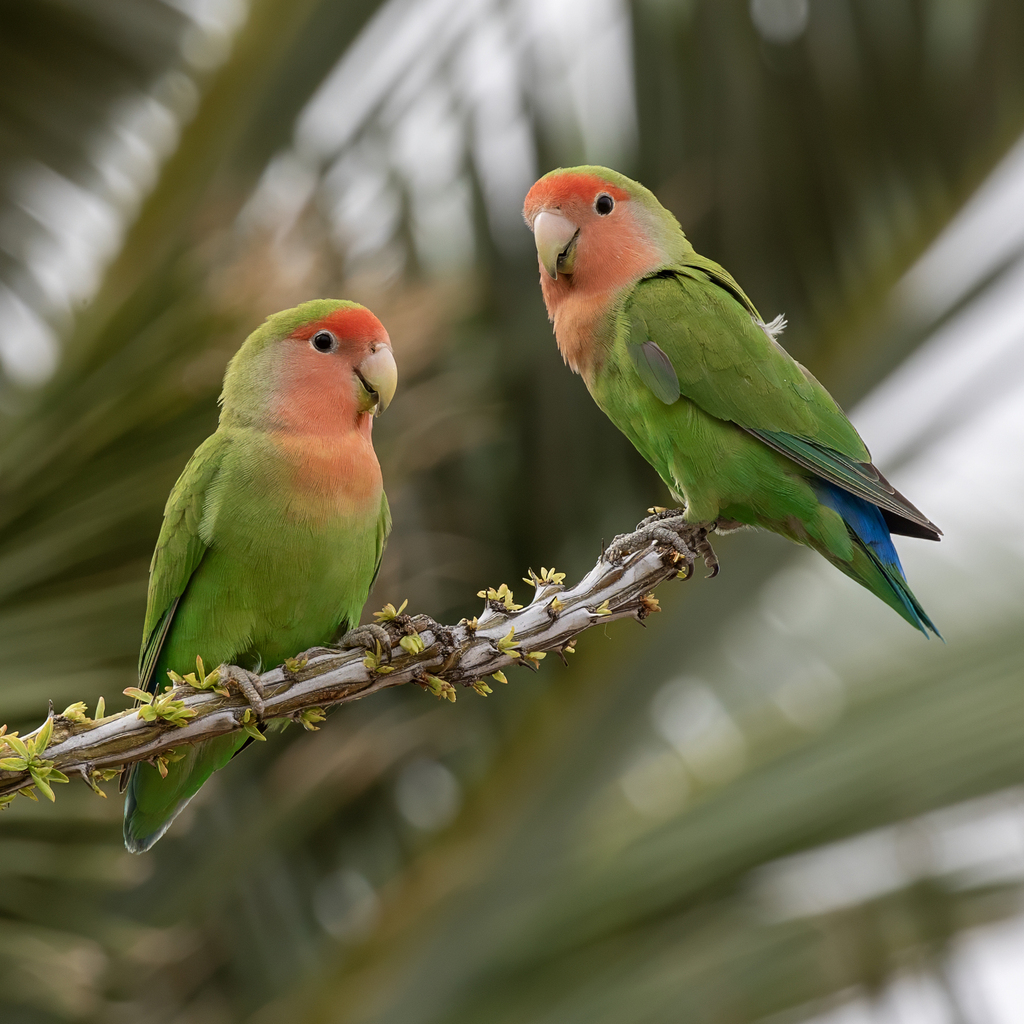
Rosy-faced Lovebird
Photo © Dan Vickers
Photo © Dan Vickers — CC BY 4.0 — Source: iNaturalist photo #462791295Identification
The rosy-faced lovebird is a fairly small parrot, measuring 17–18 cm long with distinctive plumage that makes it unmistakable in the field. Wild birds are mostly green with a striking blue rump, while the face and throat are pink—darkest on the forehead and above the eye. The bill is horn-coloured, the iris is brown, and the legs and feet are grey. Plumage is identical in males and females, making them monomorphic. Juvenile birds are paler, with a greenish fore crown and crown, and a brownish base to the beak. Coloration can vary between populations; for instance, the pink facial markings are lighter in the nominate subspecies than in the Angolan subspecies.
Range & Habitat
The rosy-faced lovebird is native to southwest Africa, with its range extending from southwest Angola across most of Namibia to the lower Orange River valley in northwest South Africa. The species inhabits dry, open country including broad-leaved woodland, semi-desert, and mountainous areas, living at altitudes up to 1,600 metres. These birds are dependent on the presence of water sources and gather around pools to drink. Two subspecies are recognised: one found in Namibia, Botswana, and South Africa, and another in Angola.
Behaviour & Diet
Rosy-faced lovebirds are loud and constant chirpers that are highly social, often congregating in small groups in the wild and sometimes gathering in flocks of hundreds when food is plentiful. They eat throughout the day, with a diet consisting mainly of seeds and berries, though they can occasionally become agricultural pests by feeding on crops such as millet. These birds also take frequent baths. They are renowned for their distinctive sleep position: sitting side-by-side with their faces turned towards each other. Females display remarkable behaviour by tearing raw materials into long strips and "twisty-tie" wrapping them onto their backs before flying substantial distances to construct nests. Nests are typically built in rock crevices, within the communal nests of sociable weavers, or in man-made structures such as house roofs. A clutch of 4–6 dull white eggs is laid between February and April, with incubation lasting about 23 days and fledging occurring after 43 days.
Best Time & Places to See It
For travellers and photographers seeking rosy-faced lovebirds in their native range, southwest Africa is the destination. The species is found throughout Namibia, in Botswana, and in northwest South Africa. Breeding season occurs between February and April, which may be a productive time for observation and photography. These birds can be found in semi-desert and woodland habitats, and they reliably gather around water sources, making pools and waterholes promising locations for encounters.
Photography Tips
The combination of green plumage, blue rump, and distinctive pink facial markings provides excellent photographic opportunities. The birds' social behaviour—particularly their iconic sleep position with faces turned towards each other—offers compelling behavioural shots. Water sources and pools are reliable locations for photography, as these lovebirds are dependent on water and gather predictably at drinking sites. Their small size (around 17–18 cm) means telephoto lenses will be useful for detailed portraits. Early morning and late afternoon, when birds are most active, provide the best lighting conditions for capturing their vibrant colours.
L’Albufera Natural Park
València, Spain
+321 birds+18 mammals
Where shallow lagoons meet Mediterranean coastal marshland, L'Albufera Nature Park unfolds as one of Spain's most vital wetland complexes. This protected landscape, designated under IUCN Category…
VIEW NATURAL PARKKruger National Park
Ba-Phalaborwa Local Municipality, South Africa
+540 birds+91 mammals
Across the low-lying savanna of northeastern South Africa unfolds one of Africa's largest and most ecologically intact protected areas, where acacia woodlands merge into mopane scrub…
VIEW NATIONAL PARKAugrabies Falls National Park
Kai !Garib Local Municipality, South Africa
+176 birds+20 mammals
Where the Orange River cuts a dramatic scar through the Northern Cape's arid interior, Augrabies Falls National Park sprawls across nearly 1,200 square kilometers of raw,…
VIEW NATIONAL PARKCamargue Regional Nature Park
Saintes-Maries-de-la-Mer, France
+378 birds+48 mammals
Where the Rhône Delta sprawls into the Mediterranean, a landscape of stark and haunting beauty emerges—vast salt marshes punctuated by shallow lagoons, reed beds, and scrubland…
VIEW NATURAL PARKEstrecho Natural Park
Pedro Valiente, Spain
+281 birds+20 mammals
Where Mediterranean pine forests meet wind-sculpted coastal cliffs, one of Europe's most dynamic ecological crossroads unfolds across the Strait of Gibraltar. Spanning 686 square kilometers of…
VIEW NATURAL PARKDorob National Park
Henties Bay, Namibia
+230 birds+13 mammals
Where the Skeleton Coast meets the Namib Desert's inland reaches, Dorob National Park sprawls across 34,021 square kilometres of one of southern Africa's most austere and…
VIEW NATIONAL PARKNamib-Naukluft National Park
Namibia
+217 birds+33 mammals
Across nearly 94,000 square kilometers of southwestern Namibia, a landscape of extremes unfolds where towering sand dunes meet rugged mountain ranges, and ancient riverbeds carve through…
VIEW NATIONAL PARKEtosha National Park
Namibia
+356 birds+58 mammals
Across northern Namibia's stark semi-arid plateau, a vast shallow depression transforms seasonally into one of Africa's most dramatic wildlife theaters. Etosha National Park, encompassing more than…
VIEW NATIONAL PARKNamibRand Nature Reserve
Hammerstein, Namibia
+107 birds+12 mammals
Where rust-coloured dunes surrender to sculpted granite outcrops and vast plains stretch toward an endless horizon, one of southern Africa's most pristine wilderness areas unfolds. The…
VIEW NATURE RESERVEWaterberg Plateau National Park
Okambukonde, Namibia
+198 birds+27 mammals
Where ancient sandstone cliffs rise 200 metres above the surrounding bushveld, a fortress of geology creates one of southern Africa's most compelling ecosystems. The plateau's steep…
VIEW NATIONAL PARKHaleakalā National Park
Maui County, United States
+66 birds+4 mammals
Ascending from sea level to over 10,000 feet across a mere thirty miles, Haleakalā National Park commands one of the Pacific's most dramatic elevation gradients, where…
VIEW NATIONAL PARKNo community photos yet. Log in to add the first one.
No community observations of this species yet.