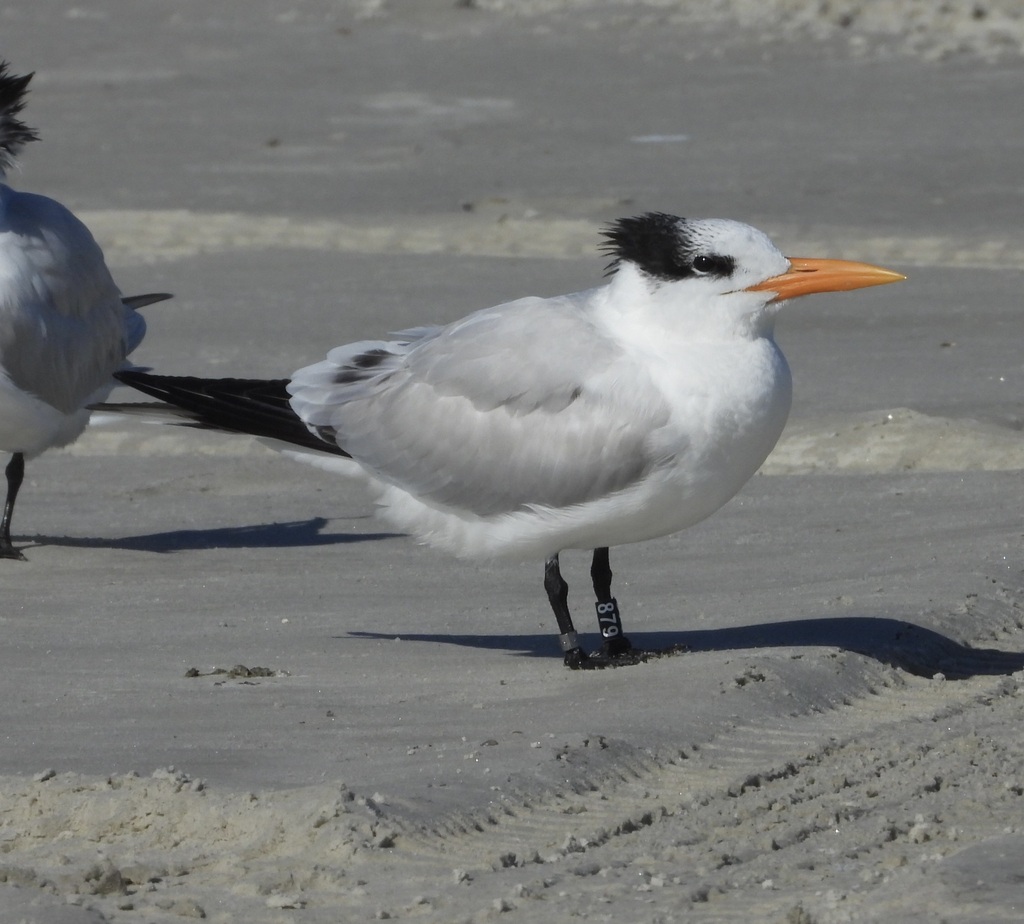
Royal Tern
Photo © Laura Gaudette
Photo © Laura Gaudette — CC BY 4.0 — Source: iNaturalist photo #607697865Identification
The royal tern is a large tern, second only to the Caspian tern among terns in the Americas. Adults have an average wingspan of 130 cm (51 inches), with bill-to-tail length ranging from 45–50 cm (18–20 inches) and weight of 350–500 g (12–18 ounces). The species is unmistakable in breeding plumage, with a stout orange-red bill, pale silvery-gray upperparts, white underparts, and an entirely black crown featuring a shaggy, erectable crest on the nape during spring courtship and the breeding season. From early summer into late winter, the black plumage gradually recedes, becoming patchy and then fully white on the forehead and upper crown while retaining black only on the nape. Juvenile birds resemble non-breeding adults but display darker gray to blackish marks on the wings and a yellower bill. The royal tern's calls are usually short, clear shrills that may sound like "kree" or "tsirr," along with a longer, rolling, more melodious plover-like whistle.
Range & Habitat
The royal tern is endemic to the Americas, though vagrants have been identified in Europe. The species is found on both coasts of the Americas. In the northeast, the breeding season (April to July) finds birds primarily from Texas to Virginia, with scattered records as far north as Long Island, New York, and south to French Guiana and several Caribbean islands. A separate southeastern population nests from southeastern Brazil south to Chubut Province in Argentina, with birds there either resident or dispersing into Brazil. Wintering ranges extend from North Carolina south to Panama and the Guianas throughout the Caribbean in the east, while western populations winter from California south to Peru.
Behaviour & Diet
The royal tern is primarily a piscivore, typically feeding on small fish such as anchovies, weakfish, and croakers, though it also occasionally consumes insects, shrimp, crabs, and hatchling sea turtles. The bird feeds in secluded bodies of water including estuaries, mangroves, and lagoons, and less frequently in open water within about 100 meters of shore. Hunting is conducted by plunge-diving from heights near 9 meters, usually alone or in groups of two or three, though large groups gather when pursuing schools of fish. When hunting small crabs or flying fish near the surface, the royal tern employs short shallow dives rather than its typical plunge-dive technique, remaining concealed from prey.
Best Time & Places to See It
The breeding season from April to July offers the best opportunity to observe royal terns at their nesting sites on island beaches and isolated beaches throughout their American range. Eastern breeders can be found from Texas and Virginia south through the Caribbean to French Guiana, while southeastern populations inhabit Brazil through Argentina. For wintering birds, the period from early summer into late winter provides viewing opportunities across the species' extensive range from North Carolina and California south through the Caribbean, Central America, and coastal South America to Peru and Argentina.
Photography Tips
Photographers seeking the royal tern should focus on coastal and estuarine habitats during the breeding season to capture birds in their striking full black cap plumage. The bird's dramatic plunge-diving behavior from heights near 9 meters provides excellent action photography opportunities, particularly when hunting in small groups or larger feeding aggregations. Early morning light over estuaries, mangroves, and lagoons will illuminate the bird's pale silvery-gray upperparts and white underparts effectively. The species' distinctive orange-red bill and shaggy nape crest are key field marks worth highlighting in photographs.
Tijuca National Park
Brazil
+317 birds+13 mammals
Where the Atlantic forest rises steeply from Rio de Janeiro's urban edge, Tijuca National Park encompasses a landscape of dramatic granite peaks, cascading waterfalls, and closed-canopy…
VIEW NATIONAL PARKCorcovado National Park
Puerto Jiménez, Costa Rica
+444 birds+48 mammals
Where the Osa Peninsula juts into the Pacific, rainforest descends almost to the tide line, and Corcovado National Park protects one of Central America's most intact…
VIEW NATIONAL PARKManuel Antonio National Park
Quepos, Costa Rica
+426 birds+22 mammals
Where tropical rainforest descends steeply to a rocky Pacific coastline, Manuel Antonio National Park distills Central American biodiversity into one of Costa Rica's most compressed and…
VIEW NATIONAL PARKArenal Volcano National Park
Peñas Blancas, Costa Rica
+551 birds+21 mammals
Straddling the border between Alajuela and Guanacaste in northwestern Costa Rica, this national park rises dramatically around one of Central America's most active volcanic systems. The…
VIEW NATIONAL PARKTortuguero National Park
Roxana, Costa Rica
+420 birds+23 mammals
Canals and lagoons thread through a labyrinth of lowland rainforest where the Caribbean coast of Costa Rica meets the wetland frontier. This is terrain shaped by…
VIEW NATIONAL PARKPiedras Blancas National Park
Golfito, Costa Rica
+386 birds+24 mammals
Where the Golfo Dulce meets the southwestern Pacific coast of Costa Rica, Piedras Blancas National Park protects a dramatic transition zone where lowland rainforest descends toward…
VIEW NATIONAL PARKSanta Rosa National Park
Santa Elena, Costa Rica
+359 birds+30 mammals
Where Pacific-facing slopes descend from volcanic uplands toward the Guanacaste lowlands, Santa Rosa National Park unfolds across a mosaic of tropical dry forest, gallery woodland, and…
VIEW NATIONAL PARKEverglades National Park
Monroe County, United States
+345 birds+22 mammals
Where freshwater marsh meets subtropical sky, the Everglades sprawls across southwestern Florida as one of North America's most expansive wetland ecosystems. Spanning over 13,000 square kilometers,…
VIEW NATIONAL PARKRedwood National Park
Humboldt County, United States
+343 birds+43 mammals
Where the Pacific fog rolls deep into northern California's coastal valleys, some of the tallest trees on Earth rise from a landscape shaped by tectonic forces…
VIEW NATIONAL PARKNatural Utría National Park
Alto Baudó (Pie de Pató), Colombia
+372 birds+11 mammals
Where the Chocó's coastal mountains plunge toward the Pacific, Utría National Park preserves one of Colombia's most biodiverse and least-visited wilderness expanses. Sprawling across 1,287 square…
VIEW NATIONAL PARKMorrocoy National Park
Municipio Silva
+290 birds
Where the Caribbean coast of northwestern Venezuela meets protected coastal waters, a mosaic of mangrove forests, sandy beaches, and coral reef systems defines Morrocoy National Park.…
VIEW NATIONAL PARKParque Nacional de Galápagos
Santo Tomás, Ecuador
+139 birds+23 mammals
Volcanic peaks and weathered lava fields dominate this remote archipelago in the Pacific, where the interplay of cold ocean currents and tropical latitude creates an ecological…
VIEW ISLAND & ARCHIPELAGONatural Bahía Portete Kaurrele National Park
Colombia
+80 birds
Where the Caribbean coast of La Guajira rises to meet arid scrubland and seasonal wetlands, Natural Bahía Portete Kaurrele National Park spans 251 square kilometres of…
VIEW NATIONAL PARKNatural Uramba Bahía Málaga National Park
Buenaventura, Colombia
+308 birds+15 mammals
Where the Pacific coastal rainforest descends to mangrove estuaries and rocky headlands, Uramba Bahía Málaga National Park unfolds across nearly 1,000 square kilometres of Colombia's Valle…
VIEW NATIONAL PARKItatiaia National Park
Brazil
+519 birds+12 mammals
Where granite peaks pierce the Atlantic rainforest canopy in southeastern Brazil, Itatiaia National Park rises as one of the country's oldest and most ecologically vital protected…
VIEW NATIONAL PARKPeixe National Park Lagoon
Brazil
+293 birds+4 mammals
Where the coastal plains of Rio Grande do Sul meet the Atlantic, Peixe National Park Lagoon sprawls across nearly 2,200 square kilometres of shallow waters, reed…
VIEW NATIONAL PARKSuperagui National Park
Brazil
+246 birds+2 mammals
Where the Atlantic rainforest meets the subtropical coast of Paraná, Superagui National Park sprawls across more than 1,000 square kilometres of one of Brazil's most biodiverse…
VIEW NATIONAL PARKSerra da Bocaina National Park
Brazil
+441 birds+5 mammals
Where the escarpment of the Serra da Bocaina rises sharply from the Atlantic coastal plain, tropical rainforest cloaks steep mountainsides that climb toward peaks exceeding 2,000…
VIEW NATIONAL PARKCoiba National Park
Montijo, Panama
+260 birds+10 mammals
An archipelago of volcanic and sedimentary islands rises from the Pacific waters off Panama's southwestern coast, its densest rainforest canopy unbroken for millennia. Coiba National Park…
VIEW NATIONAL PARKSarigua National Park
Parita, Panama
+56 birds+1 mammals
Across the Parita lowlands of Herrera Province, mangrove forests and tidal mudflats define a landscape shaped entirely by water—where brackish estuaries meet the Pacific and the…
VIEW NATIONAL PARKSoberanía National Park
Cristóbal, Panama
+495 birds+34 mammals
Rainforest and riverine woodland blanket the rolling terrain of this 714-square-kilometre national park in Colón Province, where the Caribbean watershed feeds a maze of streams and…
VIEW NATIONAL PARKChagres National Park
Caimitillo, Panama
+486 birds+19 mammals
Where the Chagres River carves through the humid tropics of central Panama, a vast montane and lowland forest sprawls across more than 2,300 square kilometers, anchoring…
VIEW NATIONAL PARKDarién National Park
Tucutí, Panama
+534 birds+13 mammals
Where the spine of Central America crumbles into wetland and rainforest, Darién National Park sprawls across more than 20,000 square kilometres of some of the tropics'…
VIEW NATIONAL PARKPortobelo National Park
Portobelo, Panama
+366 birds+9 mammals
Where the Caribbean's turquoise waters meet the Darién's verdant shore, Portobelo National Park sprawls across 570 square kilometers of coastal forest, mangrove wetland, and coral-fringed islands…
VIEW NATIONAL PARKMarino Golfo de Chiriquí National Park
Boca Chica, Panama
+82 birds+2 mammals
Where mangrove forests meet tropical Pacific waters, Marino Golfo de Chiriquí National Park spans 463 square kilometers of one of Central America's most biodiverse coastal systems.…
VIEW NATIONAL PARKArrecifes de Cozumel National Park
San Miguel de Cozumel, Mexico
+112 birds+4 mammals
Beneath the turquoise shallows of the western Caribbean, Arrecifes de Cozumel National Park protects a sprawling marine realm across 484 square kilometres off the Quintana Roo…
VIEW NATIONAL PARKSian Ka’an
Chunyaxché, Mexico
+350 birds+16 mammals
Where the Yucatán Peninsula dissolves into wetland and mangrove, a vast mosaic of forest, lagoon, and coastal margin creates one of Mexico's most biodiverse strongholds. Across…
VIEW BIOSPHERE RESERVEEl Vizcaíno
Laguna San Ignacio, Mexico
+317 birds+29 mammals
Where the Baja California peninsula thins into a tapestry of salt lagoons and coastal desert, one of Mexico's most biodiverse reserves sprawls across half a million…
VIEW BIOSPHERE RESERVEParque Nacional Isla Isabel
Santiago Ixcuintla, Mexico
+107 birds+2 mammals
A volcanic island sanctuary rises from the Pacific waters off Nayarit's coast, where three dormant cones define a landscape of sharp ridges, coastal cliffs, and sheltered…
VIEW NATIONAL PARKParque Nacional Arrecife Alacranes
Chicxulub, Mexico
+93 birds
Coral formations rise from turquoise shallows off the Yucatán Peninsula, their limestone skeletons built over millennia into a living archipelago where the Caribbean meets the Gulf…
VIEW NATIONAL PARKTikal National Park
Tikal, Guatemala
+399 birds+16 mammals
Dense rainforest canopy rises above the limestone plateau of Petén, where archaeological wonder and ecological richness merge seamlessly across one of Central America's most biodiverse landscapes.…
VIEW NATIONAL PARKLaguna del Tigre National Park
Petén, Guatemala
+399 birds+29 mammals
Where the Petén lowlands dissolve into wetland and forest, Laguna del Tigre National Park protects one of Guatemala's most ecologically vital landscapes. This sprawling reserve encompasses…
VIEW NATIONAL PARKBiscayne National Park
Miami-Dade County, United States
+263 birds+7 mammals
Coral reefs and mangrove shallows dominate this marine sanctuary where the Florida Keys meet the Atlantic, creating a mosaic of shallow seagrass meadows, patch reefs, and…
VIEW NATIONAL PARKChannel Islands National Park
Santa Barbara County, United States
+330 birds+15 mammals
A chain of eight volcanic islands rises from the cold Pacific waters off the California coast, their rugged sea cliffs and windswept terrain shaped by millions…
VIEW NATIONAL PARKDry Tortugas National Park
Monroe County, United States
+211 birds+1 mammals
Seventy miles west of Key West, where the Gulf of Mexico surrenders to the Atlantic, lies a constellation of low coral keys that rise barely above…
VIEW NATIONAL PARKVirgin Islands National Park
Cruz Bay, United States
+119 birds+3 mammals
Coral reef and mangrove ecosystems define the tropical maritime landscape of this national park, where St. John's mountainous spine rises sharply from turquoise bays fringed with…
VIEW NATIONAL PARKJ.N. “Ding” Darling National Wildlife Refuge
Sanibel, United States
+277 birds+6 mammals
Mangrove channels and coastal marshlands dominate this 6,400-acre sanctuary on Florida's Gulf coast, where brackish waterways weave between dense stands of red, black, and white mangrove…
VIEW WILDLIFE SANCTUARYMerritt Island National Wildlife Refuge
Brevard County, United States
+341 birds+19 mammals
Brackish marshes and palmetto scrub define this wildlife sanctuary spanning the coastal lowlands of central Florida, where the Atlantic tide meets freshwater systems in a dynamic…
VIEW WILDLIFE SANCTUARYChincoteague National Wildlife Refuge
Chincoteague, United States
+362 birds+16 mammals
Across the barrier islands and salt marshes of Virginia's Eastern Shore, where Atlantic tides sculpt an intricate mosaic of sandy spits and tidal flats, lies one…
VIEW WILDLIFE SANCTUARYLaguna Atascosa National Wildlife Refuge
Cameron County, United States
+365 birds+19 mammals
Where coastal prairie meets shallow lagoon along the southernmost tip of Texas, Laguna Atascosa National Wildlife Sanctuary sprawls across a landscape sculpted by salt spray and…
VIEW WILDLIFE SANCTUARYSanta Ana National Wildlife Refuge
Hidalgo County, United States
+349 birds+12 mammals
Where the Rio Grande delta meets the semi-arid scrublands of South Texas, Santa Ana National Wildlife Sanctuary preserves a rare mosaic of wetland and thornforest habitat…
VIEW WILDLIFE SANCTUARYLower Rio Grande Valley National Wildlife Refuge
Starbase, United States
+311 birds+11 mammals
Where the Rio Grande delta spreads across the coastal plain of South Texas, a sanctuary of subtropical wetlands and riparian corridors creates a landscape that pulses…
VIEW WILDLIFE SANCTUARYDon Edwards San Francisco Bay National Wildlife Refuge
Fremont, United States
+286 birds+20 mammals
Where the San Francisco Bay's shallow margins dissolve into tidal salt marshes and mudflats, this wildlife sanctuary preserves one of California's most ecologically vital estuarine systems.…
VIEW WILDLIFE SANCTUARYBombay Hook National Wildlife Refuge
Kent County, United States
+323 birds+15 mammals
Tidal marshes and brackish shallows define this sanctuary on Delaware's Atlantic coast, where the meeting of freshwater and salt creates some of the Mid-Atlantic's most dynamic…
VIEW WILDLIFE SANCTUARYBlackwater National Wildlife Refuge
Fishing Creek, United States
+293 birds+15 mammals
Tidal marshes and brackish waterways define this wildlife sanctuary where the Chesapeake Bay's influence reshapes the landscape with every rise and fall of the water. Shallow…
VIEW WILDLIFE SANCTUARYAlligator River National Wildlife Refuge
Dare County, United States
+288 birds+17 mammals
Where the coastal plain of North Carolina meets the Albemarle Peninsula, a sprawling mosaic of freshwater marshes, pocosins, and swamp forest creates one of the Atlantic…
VIEW WILDLIFE SANCTUARYPea Island National Wildlife Refuge
Dare County, United States
+356 birds+15 mammals
Where the Outer Banks taper toward the Atlantic, a sliver of barrier island creates a microcosm of coastal ecology. Pea Island National Wildlife Sanctuary spans over…
VIEW WILDLIFE SANCTUARYPelican Island National Wildlife Refuge
Windsor, United States
+265 birds+4 mammals
Where Florida's Indian River widens into a brackish estuary, a small island sanctuary commands the attention of waterbirds across the Atlantic Flyway. Pelican Island National Wildlife…
VIEW WILDLIFE SANCTUARYSt. Marks National Wildlife Refuge
Saint Marks, United States
+324 birds+16 mammals
Where the Apalachee Bay begins to define the Florida coastline, salt marshes and freshwater impoundments merge into one of the southeastern United States' most productive wildlife…
VIEW WILDLIFE SANCTUARYGreat White Heron National Wildlife Refuge
Monroe County, United States
+118 birds+3 mammals
Shallow mangrove bays and salt-marsh flats sprawl across Monroe County's coastal sanctuary, where brackish water meets the Florida Keys' distinctive transition zone between temperate and subtropical…
VIEW WILDLIFE SANCTUARYCedar Keys National Wildlife Refuge
Levy County, United States
+268 birds+8 mammals
Where the Florida Gulf Coast transitions from mainland to archipelago, Cedar Keys National Wildlife Sanctuary protects a mosaic of salt marshes, shallow estuaries, and maritime hammocks…
VIEW WILDLIFE SANCTUARYChassahowitzka National Wildlife Refuge
Homosassa, United States
+299 birds+14 mammals
Where the Gulf of Mexico's coastal marshes dissolve into brackish tidal flats and mangrove thickets, the Chassahowitzka National Wildlife Sanctuary near Homosassa represents one of Florida's…
VIEW WILDLIFE SANCTUARYCarara National Park
Tárcoles, Costa Rica
+397 birds+19 mammals
Where the Pacific coastal plain meets transitional forest, Carara National Park straddles one of Central America's most dynamic ecological boundaries. The park's landscape encompasses lowland deciduous…
VIEW NATIONAL PARKPalo Verde National Park
Bagaces, Costa Rica
+318 birds+24 mammals
Dry forest spreads across Palo Verde's low-lying terrain in northwestern Guanacaste, where seasonal rivers and lagoons etch through deciduous woodland that sheds its canopy each winter.…
VIEW NATIONAL PARKCahuita National Park
Talamanca, Costa Rica
+359 birds+15 mammals
Where the Caribbean shoreline dissolves into mangrove creeks and coral gardens, Cahuita's mosaic of habitats unfolds across the Limón coast. The park's signature feature—a living coral…
VIEW NATIONAL PARKTapantí Macizo de la Muerte National Park
Orosi, Costa Rica
+503 birds+18 mammals
Where montane cloud forest rises steeply from the Orosi Valley, Tapantí Macizo de la Muerte National Park enfolds a landscape of perpetual moisture and emerald complexity.…
VIEW NATIONAL PARKLa Amistad International Park
Crorina, Costa Rica
+532 birds+20 mammals
Where the Caribbean slopes of Costa Rica's Talamanca Mountains rise steeply inland from Limón, the boundary between two nations dissolves into an unbroken expanse of rainforest.…
VIEW NATIONAL PARKMarino Ballena National Park
Bahía Ballena, Costa Rica
+336 birds+8 mammals
Where mangrove forests meet coral-fringed shorelines along Costa Rica's southern Pacific coast, Marino Ballena National Park encompasses a marine and terrestrial mosaic that ranks among Central…
VIEW NATIONAL PARKMarino Las Baulas National Park
Santa Cruz, Costa Rica
+246 birds+9 mammals
Where the Pacific meets a mosaic of dry forest and mangrove estuary, this coastal national park protects one of Central America's most dynamic wildlife theatres. The…
VIEW NATIONAL PARKCaño Negro National Wildlife Refuge
Caño Negro District, Costa Rica
+486 birds+16 mammals
Where the San Juan River's seasonal floodplain opens into expansive wetlands, Caño Negro Wildlife Sanctuary sprawls across one of Central America's most productive freshwater ecosystems. This…
VIEW WILDLIFE SANCTUARYGandoca-Manzanillo National Wildlife Refuge
Manzanillo, Costa Rica
+394 birds+18 mammals
Where the Caribbean coastal plain surrenders to water-logged forest and mangrove tangles, Gandoca-Manzanillo Wildlife Sanctuary shelters one of Costa Rica's most biodiverse lowland wetland ecosystems. The…
VIEW WILDLIFE SANCTUARYBarra del Colorado National Wildlife Refuge
Tortuguero, Costa Rica
+462 birds+36 mammals
Where the Caribbean's restless waters meet the Limón Province coastline, Barra del Colorado National Wildlife Sanctuary unfolds across a landscape of extraordinary ecological complexity. This equatorial…
VIEW WILDLIFE SANCTUARYOstional National Wildlife Refuge
Ostional, Costa Rica
+18 birds
Where the Pacific meets the dry forest of northwestern Costa Rica, Ostional National Wildlife Sanctuary protects one of Central America's most dynamic coastal ecosystems. This slender…
VIEW WILDLIFE SANCTUARYCurú National Wildlife Refuge
Paquera, Costa Rica
+249 birds+8 mammals
Where the Pacific coast of Puntarenas dissolves into dry deciduous forest and mangrove fringe, Curú Wildlife Sanctuary holds one of Costa Rica's most ecologically vital yet…
VIEW WILDLIFE SANCTUARYNo community photos yet. Log in to add the first one.
No community observations of this species yet.