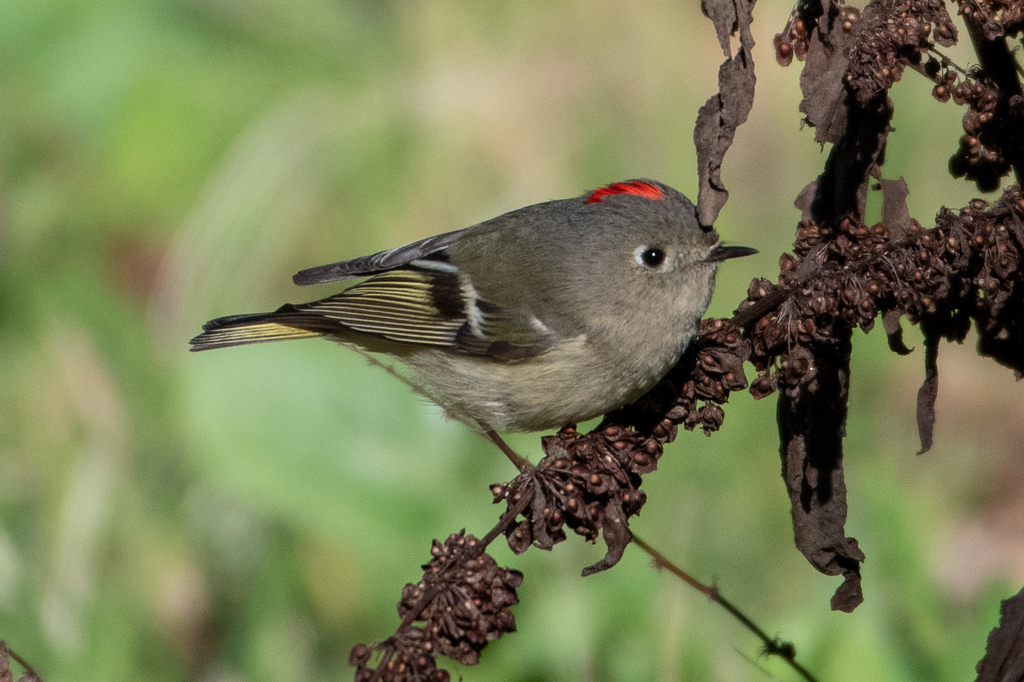
Ruby-crowned Kinglet
Photo © Jonathan Eisen
Photo © Jonathan Eisen — CC BY 4.0 — Source: iNaturalist photo #60807232Identification
The ruby-crowned kinglet is one of North America's smallest songbirds, measuring just 9 to 11 cm long with a wingspan of 16 to 18 cm and weighing only 5 to 10 grams. Despite its diminutive size, it is instantly recognizable by its olive-green upperparts, olive-buff underparts, two white wing bars, and distinctive broken white eye ring. The most striking feature—the male's scarlet-red crown patch—is often concealed by surrounding feathers, revealing itself only when the bird is agitated or displaying.
Females are identical to males except for the absence of the crown patch, and juveniles resemble adult females. The ruby-crowned kinglet is easily distinguished from the similar golden-crowned kinglet by its slightly larger, more elongated body and greener plumage. Though sometimes confused with Hutton's vireo due to similar wing-flicking behavior, the kinglet's slighter build, thinner bill and legs, and characteristic black bar on the wings set it apart. The bird's constant activity and rapid, jerky flight with bursts of wing beats are defining behavioral traits.
Range & Habitat
The ruby-crowned kinglet is found throughout North America, with its range extending from northwest Canada and Alaska south to Mexico. This mostly migratory species breeds in spruce-fir forests across the northern and mountainous regions of the United States and Canada. Three subspecies are currently recognized, with populations breeding in distinct regions: coastal temperate rainforest in southeast Alaska and the Pacific Northwest, central and eastern Canada and the eastern United States, and historically on Guadalupe Island off northwestern Mexico.
The subspecies vary in their migratory patterns and winter distributions. Some populations are resident or only short-distance migrants, wintering within the western United States, while others migrate as far south as northern Central America for winter. This widespread distribution and habitat flexibility make the ruby-crowned kinglet accessible to birdwatchers and photographers across much of the continent.
Behaviour & Diet
Despite its tiny frame, the ruby-crowned kinglet produces vocalizations that are remarkably loud and complex. Its song typically consists of three parts: a series of high-pitched notes (zee-zee-zee or tee-tee-tee), two to five low trills, and a repeated three-note "galloping" phrase (tee-da-leet, tee-da-leet). Individual birds vary their songs and often sing only one or two of these components, with the galloping phrase sung primarily by males.
The kinglet is mainly insectivorous but supplements its diet with fruits and seeds. It typically moves through branches and foliage in short hops, displaying the constant activity and characteristic wing-flicking that make it recognizable in the field. The bird is a notable breeder, constructing cup-shaped nests that may hang from branches or be concealed on tree limbs. Remarkably, it lays up to 12 eggs—the largest clutch of any North American passerine relative to its body size.
Best Time & Places to See It
Timing depends on your location and the subspecies present in your region. In breeding areas across northern and mountainous spruce-fir forests, the ruby-crowned kinglet is present during spring and summer. In wintering grounds—including the western United States and northern Central America—the species is most reliably found during fall and winter months when migratory populations arrive. Spring and fall migrations offer opportunities to encounter the species in lowland areas it may pass through.
The kinglet's preference for coniferous and mixed forests means birders should focus on forested habitats, particularly in mountainous and northern regions during breeding season. Its small size and cryptic habits mean patience and careful observation are essential, though its constant activity and distinctive wing-flicking behavior make it more conspicuous than many small passerines. Listen for its loud, complex song, which carries surprisingly well for such a tiny bird.
Photography Tips
Photographing the ruby-crowned kinglet presents both challenges and rewards. The bird's diminutive size demands telephoto lenses—at least 500mm—to capture sufficient detail. The white eye ring and wing bars are key field marks worth emphasizing in your compositions. The crown patch, though often hidden, can be revealed when the bird is agitated or singing; patience and multiple visits increase your chances of capturing this dramatic feature.
The kinglet's constant movement and characteristic wing-flicking behavior mean fast shutter speeds (at least 1/1000th of a second) are necessary to freeze action. Because the bird often forages high in coniferous trees, shooting against overcast skies or during golden hour can help manage challenging lighting. Focus on capturing the bird's active posture and behavioral moments—hovering among branches or with wings slightly raised—as these convey the species' energetic personality better than static perched shots.
Tombstone Territorial Park
Acadia National Park
Arches National Park
Badlands National Park
Banff National Park
Bic National Park
Big Bend National Park
Biscayne National Park
Black Canyon of the Gunnison National Park
Nothing matches these filters.
No community photos yet. Log in to add the first one.
No community observations of this species yet.