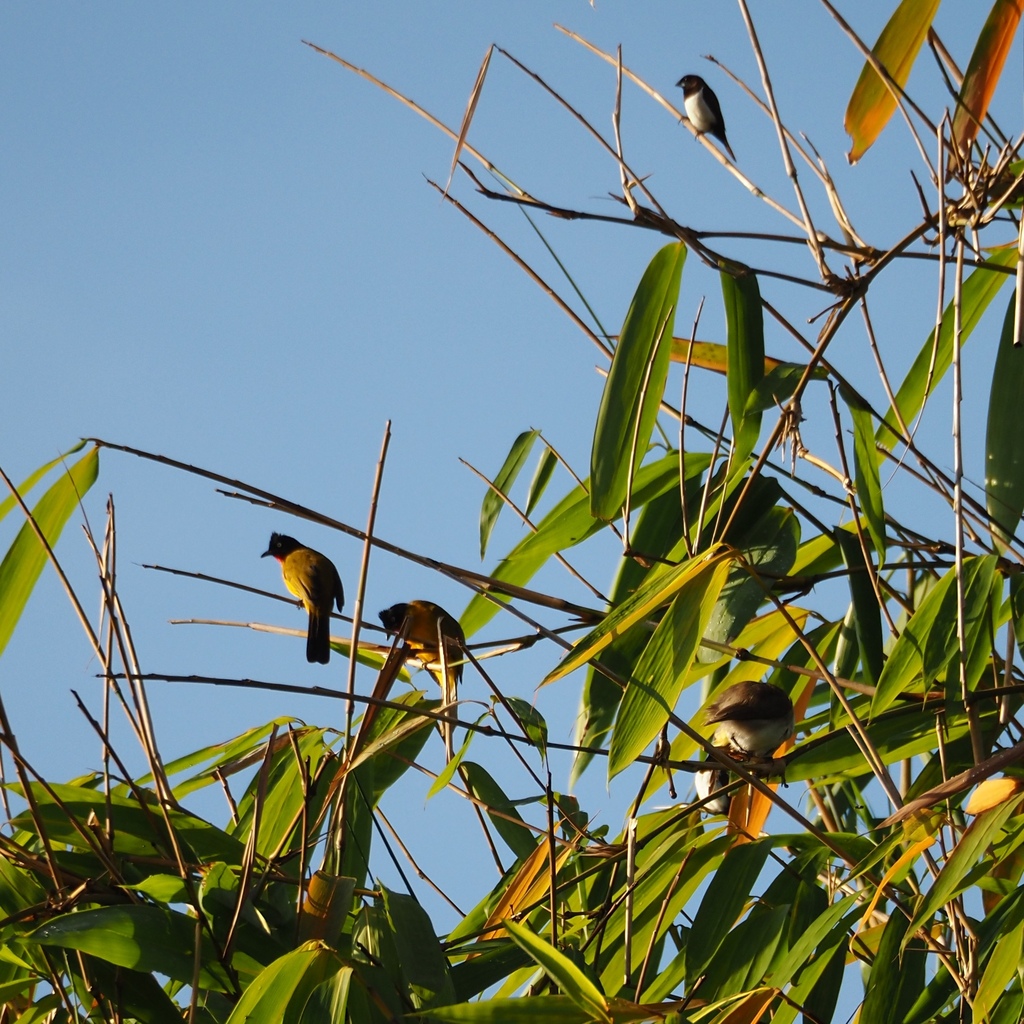
Ruby-throated Bulbul
Photo © JR Ferrer-Paris
Photo © JR Ferrer-Paris — CC BY 4.0 — Source: iNaturalist #336802881Identification
The ruby-throated bulbul is a compact passerine measuring 17–20 cm in length. It is readily identified by its striking plumage: a black head contrasts sharply with a deep red throat, while the back and wings are greenish-yellow. The underparts are bright yellow, and the tail is greenish-black. The bill and legs are black. Unlike many bulbul species, it is virtually crestless. Two subspecies exist with a subtle but useful difference: birds from Java and Bali (Rubigula dispar dispar) have yellow irises, while those from Sumatra (Rubigula dispar matamerah) display red irises.
Range & Habitat
The ruby-throated bulbul is endemic to three Indonesian islands: Sumatra, Java, and Bali. It inhabits forest and dense scrub environments, where it moves through the understory and middle canopy in search of food and nesting sites.
Behaviour & Diet
This species is primarily frugivorous but supplements its diet with insects, making it an opportunistic forager typical of bulbuls. It nests in bushes, laying a typical clutch of two to four eggs per breeding attempt. Like other bulbuls, it is generally social and vocal, though detailed behavioral studies remain limited.
Best Time & Places to See It
The ruby-throated bulbul is found year-round on Sumatra, Java, and Bali in suitable forest and scrubland habitats. Visitors exploring protected forests and nature reserves on these islands have the best chance of encountering this species. It is most active during early morning and late afternoon hours when foraging activity peaks.
Photography Tips
The contrasting black head and deep red throat make this bulbul visually striking, but the dense forest habitat where it lives can present challenging lighting conditions. Use a telephoto lens (at least 300 mm) to capture detail from a distance without disturbing the bird. Early morning light is ideal for rendering the rich colors of the plumage. Patient stalking of mixed-species feeding flocks in fruiting trees often yields the best photographic opportunities.
Nothing matches these filters.
No community photos yet. Log in to add the first one.
No community observations of this species yet.