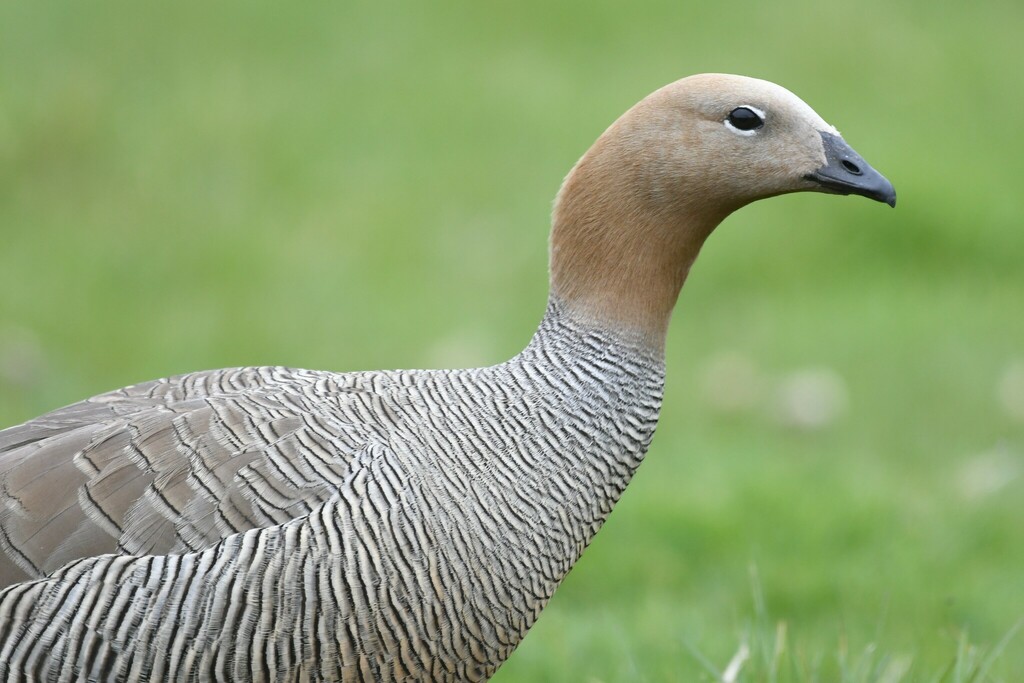
Ruddy-headed Goose
Photo © Tristan Jobin
Photo © Tristan Jobin — CC BY 4.0 — Source: iNaturalist photo #248869749Identification
The ruddy-headed goose is a compact waterfowl, measuring 45 to 52.5 cm (18 to 21 inches) in length. Males are noticeably larger, weighing 1.65 to 2.02 kg (3.6 to 4.5 lb), while females are considerably smaller at 1.20 to 1.50 kg (2.6 to 3.3 lb). The species is named for its distinctive red-brown head and neck, which provide immediate field identification. The back, breast, and flanks are gray and buff with brown barring, while the belly is warm cinnamon. The tail is black, and the wings display gray upperparts with a striking gray, black, and white pattern underneath. The bill is black and the legs and feet are orange with black markings. Juveniles resemble adults but appear duller overall, making them slightly less conspicuous in the field.
Range & Habitat
The ruddy-headed goose is found in South America, with its range encompassing the eastern Chilean and Argentinian parts of Tierra del Fuego, extending northward as far as Buenos Aires Province in Argentina, and also occurring on the Falkland Islands. The species favors open landscapes including meadows, Pampas wetlands, pond borders, and coastal grasslands where vegetation provides both cover and feeding opportunities.
Behaviour & Diet
Ruddy-headed geese are almost entirely vegetarian, feeding primarily on the ground rather than in water. On their breeding grounds, they consume small berries, roots, leaves, stems, and seeds of grasses and sedges. During winter months, they opportunistically feed on young wheat crops and in harvested fields of maize, sunflower, and sorghum. These birds show interesting movement patterns: populations in the Falkland Islands are year-round residents that make only local movements, while those in Tierra del Fuego and southern mainland Argentina are migratory, moving north as far as Buenos Aires Province for winter.
Breeding begins as early as September on the Falkland Islands and mid-October on the mainland. Pairs nest singly or in small loose groups, placing nests in long grass or among boulders and lining them with down. Clutches contain three to eight eggs, with males guarding females during an approximately 30-day incubation period. Males and females are vocally distinct: males produce a short, whistled "seep" while females make a short rasping quack.
Best Time & Places to See It
The Falkland Islands offer the most reliable viewing opportunities, as the species maintains a robust year-round resident population there. For mainland viewing, the breeding season (September through October and beyond) on the southern regions of Tierra del Fuego and mainland Argentina provides the best chances, though populations here have declined significantly and remain small. Winter visitors to Buenos Aires Province may encounter migrating birds in suitable grassland habitats, though sightings are less guaranteed than in the Falklands.
Photography Tips
Photograph these ground-feeding geese in open meadows and grasslands where they are often found. The striking contrast between the ruddy head and neck and the gray-and-buff plumage makes for compelling composition, particularly in good light that emphasizes the warm tones. Capture both perched and walking birds to showcase the orange-and-black leg coloring. The small, compact size of this species requires closer working distances than larger geese, so patient stalking through open habitat will be rewarded with intimate portraits.
Sea Lion Island
Sealion Island Settlement, Falkland Islands
+74 birds+3 mammals
Windswept tussock grasslands roll across volcanic terrain where Southern Ocean swells crash against rocky shores, creating one of the Falkland Islands' most dramatic wildlife theatres. This…
VIEW ISLAND & ARCHIPELAGOKidney Island
Stanley, Falkland Islands
+47 birds
Wind-scoured tussock grassland sweeps across this remote South Atlantic outcrop, where peaty soils and exposed rock formations create a landscape as austere as it is vital.…
VIEW ISLAND & ARCHIPELAGOMurrell Farm
falskland islands, Falkland Islands
+54 birds
Rolling grasslands sweep across windswept plateaux where the South Atlantic exerts its relentless influence on the vegetation, sculpting tussock grassland into a tapestry of browns and…
VIEW NATURE RESERVECape Dolphin
falskland islands, Falkland Islands
+54 birds+1 mammals
Where windswept grasslands meet dramatic coastal cliffs, the Falkland Islands' northern reaches reveal one of the Southern Hemisphere's most compelling seabird sanctuaries. The terrain here is…
VIEW NATURE RESERVEVolunteer Point
Stanley, Falkland Islands
+70 birds+3 mammals
Windswept grasslands meet volcanic black sand beaches where three penguin species converge in the South Atlantic's most theatrical wildlife theatre. This remote peninsula on East Falkland…
VIEW NATURE RESERVEWest Point Island
West Point, Falkland Islands
+67 birds+3 mammals
Windswept cliffs plunge dramatically into the South Atlantic, their rust-coloured rock faces sculpted by millennia of gales and spray. This northwestern outpost of the Falkland Islands…
VIEW ISLAND & ARCHIPELAGOReserva Nacional Magallanes
Punta Arenas, Chile
+78 birds+2 mammals
Where windswept steppe meets sub-Antarctic forest near the southern tip of continental South America, Reserva Nacional Magallanes unfolds across roughly 352 square kilometres of profound ecological…
VIEW NATIONAL PARKNo community photos yet. Log in to add the first one.
No community observations of this species yet.