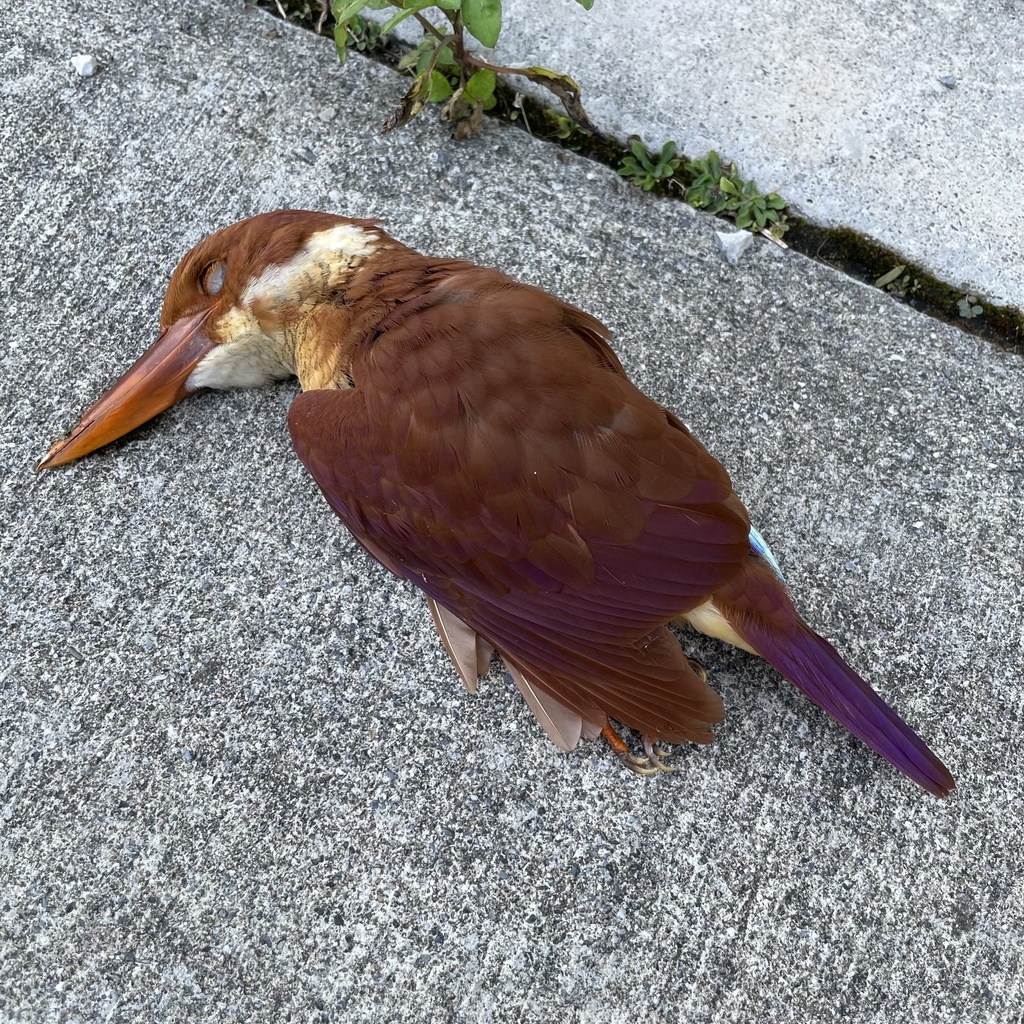
Ruddy Kingfisher
Photo © Takaaki Hattori
Photo © Takaaki Hattori — CC BY 4.0 — Source: iNaturalist #131551037Identification
The ruddy kingfisher is a medium-sized tree kingfisher reaching approximately 25 cm in length, making it unmistakable among Asian forest birds. Its most striking feature is the very large, bright red bill, matched by equally red legs that stand out against its distinctive plumage. The body is rust red, deepening to purple tones towards the tail, creating a warm, richly coloured appearance overall. Sexual dimorphism is minimal, though some sources suggest males display somewhat brighter plumage than females.
Range & Habitat
This species is widely distributed across east and southeast Asia, ranging from South Korea and Japan in the north, south through the Philippines to the Sunda Islands, and west to China and India. The ruddy kingfisher is migratory, with northern populations moving as far south as Borneo during winter months. While locally common in the southern parts of its range, it remains rare in Japan, where it is highly sought after by dedicated birders. The species shows a strong preference for forested habitats spanning temperate to tropical zones, favouring thick jungles and rainforests where dense vegetation provides ideal hunting and nesting cover.
Behaviour & Diet
Ruddy kingfishers are solitary or paired birds rather than gregarious, and their preference for heavily forested areas means their distinctive high, descending call is more often heard than the birds themselves are seen. Like other kingfishers, they primarily feed on fish, crustaceans, and large insects. However, they have adapted their diet in areas with less running water, where they are known to hunt frogs and other amphibians, demonstrating dietary flexibility suited to their forest environment.
Best Time & Places to See It
Northern populations of ruddy kingfishers arrive during breeding season and migrate south for winter, so timing depends on your location within the range. Visitors to southern parts of the range may encounter them year-round, as these areas support locally common populations. Japan offers the most challenging but rewarding experience for dedicated birdwatchers, as the species is rare there and highly prized by local birders.
Photography Tips
The ruddy kingfisher's preference for dense forest habitats makes photography challenging, and you are more likely to hear this species than to see it clearly. Focus on learning and listening for its distinctive high, descending call to locate birds. Early mornings in thick jungle and rainforest areas offer the best opportunities, and patience near water sources within forested areas may yield sightings. The bird's brilliant red bill and legs, combined with rust and purple plumage, are highly photogenic when you do encounter one, making the effort worthwhile for patient photographers.
Kaziranga National Park
Kohora, India
+422 birds+26 mammals
Dawn breaks over the floodplains of the Brahmaputra, where tall grasslands stretch endlessly beneath monsoon-heavy skies. This sprawling wilderness of northeastern Assam is a mosaic of…
VIEW NATIONAL PARKBako National Park
Kuching, Malaysia
+210 birds+17 mammals
Weathered sandstone cliffs rise dramatically from the South China Sea, their ochre faces sculpted by millennia of wind and tide into a landscape of extraordinary geological…
VIEW NATIONAL PARKKuching Wetlands National Park
Kuching, Malaysia
+103 birds+4 mammals
Where brackish waters meet mangrove stilts and freshwater swamps blend into coastal mudflats, one of Southeast Asia's most dynamic wetland ecosystems unfolds across Sarawak's northwestern coast.…
VIEW NATIONAL PARKTaman Negara National Park
Kampong Samas, Malaysia
+393 birds+48 mammals
Where ancient rainforest meets limestone peaks, one of Southeast Asia's oldest protected wilderness preserves sprawls across 4,343 square kilometers of primordial landscape. Dipterocarp giants tower overhead,…
VIEW NATIONAL PARKGunung Mulu National Park
Long Seridan, Malaysia
+280 birds+39 mammals
Where granite monoliths pierce the rainforest canopy of Sarawak, an ancient limestone karst landscape reveals one of Southeast Asia's most biodiverse strongholds. Soaring peaks cloaked in…
VIEW NATIONAL PARKWest Bali National Park
Gerokgak, Indonesia
+240 birds+8 mammals
Across West Bali's northwestern reaches, where the Indian Ocean meets volcanic slopes and limestone cliffs plunge toward turquoise shallows, sprawls a protected realm of roughly 325…
VIEW NATIONAL PARKBogani Nani Wartabone National Park
Bolaang Mongondow, Indonesia
+154 birds+4 mammals
Across North Sulawesi's rugged interior, where tectonic uplift has carved steep ridges and deep valleys through ancient volcanic terrain, Bogani Nani Wartabone National Park sprawls across…
VIEW NATIONAL PARKSembilang National Park
Banyuasin, Indonesia
+56 birds+3 mammals
Where tidal mangroves grade into freshwater swamp forest and the Musi River delta spreads across more than 7,000 square kilometres, Sembilang National Park represents one of…
VIEW NATIONAL PARKWay Kambas National Park
Lampung Timur, Indonesia
+237 birds+20 mammals
Across the low swamplands of eastern Lampung, where freshwater wetlands merge into tidal mangrove forests along the Sunda Strait, sprawls one of Sumatra's most vital sanctuaries.…
VIEW NATIONAL PARKNo community photos yet. Log in to add the first one.
No community observations of this species yet.