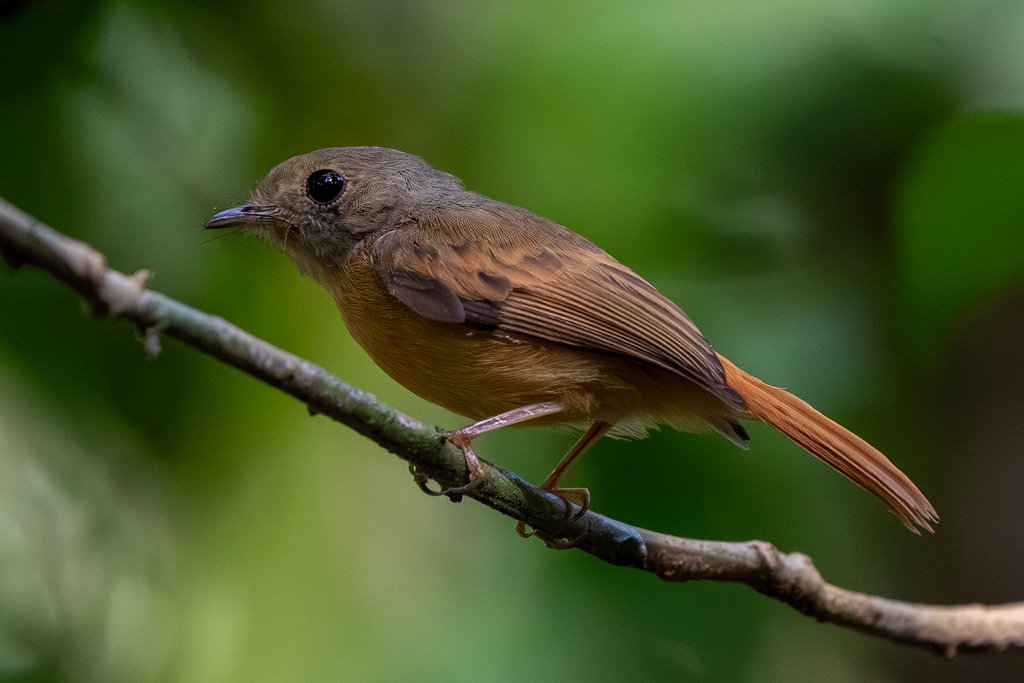
Ruddy-tailed Flycatcher
Photo © Anthony Batista
Photo © Anthony Batista — CC BY 4.0 — Source: iNaturalist photo #609350683Identification
The ruddy-tailed flycatcher is a tiny bird, measuring just 9.0–10.3 cm long and weighing only 7 g, making it easily overlooked in the canopy. Its most distinctive features are the rufous rump and tail that give the species its name, contrasting with grey-olive upperparts. Look for the warm buff throat and cinnamon breast fading to pale buff on the belly, plus a rufous eye ring that frames the face. Males and females appear similar, though young birds are brighter above with a browner tail and breast.
In the field, listen for its distinctive vocalizations: a clear "see-oo see" call and a repetitive "eek eek eek eek eek" song. The bird sometimes flicks both wings upward simultaneously, producing a faint whirring sound—a useful identifying behaviour when visibility is poor.
Range & Habitat
This species ranges from southeastern Mexico south through Central America and into the entire Amazon Basin, extending as far south as northern Bolivia and north-central Brazil. It occurs both west and east of the Andes cordillera, with populations found from the Guianas to Ecuador and Colombia. Eight recognized subspecies show subtle plumage variations across this vast range.
The ruddy-tailed flycatcher inhabits wet lowland forests from sea level to around 1,000 m altitude, and locally up to 1,200 m in suitable mountain forest habitat. It also uses adjacent tall second growth, always remaining in humid forest environments where insects are abundant.
Behaviour & Diet
This is a mainly solitary flycatcher, though it occasionally joins mixed-species feeding flocks. It forages actively for insects, particularly leafhoppers, gleaning them from foliage with precise movements or capturing them in acrobatic aerial pursuits. Its hunting technique combines the patience of a gleaner with the agility of an aerial insectivore.
During breeding season, the female constructs a remarkable pear-shaped pouch nest woven from plant fibres and leaves, positioned 2–6 m high in undergrowth and suspended from a twig or vine. She lays two chocolate-blotched white eggs and incubates them alone for 15–16 days, with the male contributing nothing to egg or chick care.
Best Time & Places to See It
The ruddy-tailed flycatcher is resident throughout its range, so it can be found year-round. However, patience and persistence are required—this tiny, solitary bird blends easily into dense foliage. Early morning hours often yield the best sightings, when the bird is most vocal and active. Search the undergrowth and mid-story vegetation of humid forests, particularly in areas with tall second growth adjacent to primary forest.
Photography Tips
Photographing this diminutive flycatcher requires patience and a telephoto lens. Position yourself in humid forest at dawn and listen carefully for its distinctive calls to locate individuals. The bird's small size and preference for dense foliage make it challenging, but its active foraging behaviour—especially acrobatic aerial sallies—offers brief photographic opportunities. The rufous tail and warm cinnamon breast are most visible when the bird is in flight or perched in good light. Avoid sudden movements; approach slowly and allow the bird's curiosity to work in your favour.
Amacayacu National Park
Amazônia National Park
Anavilhanas National Park
Arenal Volcano National Park
Bahuaja Sonene National Park
Barra del Colorado National Wildlife Refuge
Braulio Carrillo National Park
Cahuita National Park
Campos Amazónicos National Park
Nothing matches these filters.
No community photos yet. Log in to add the first one.
No community observations of this species yet.