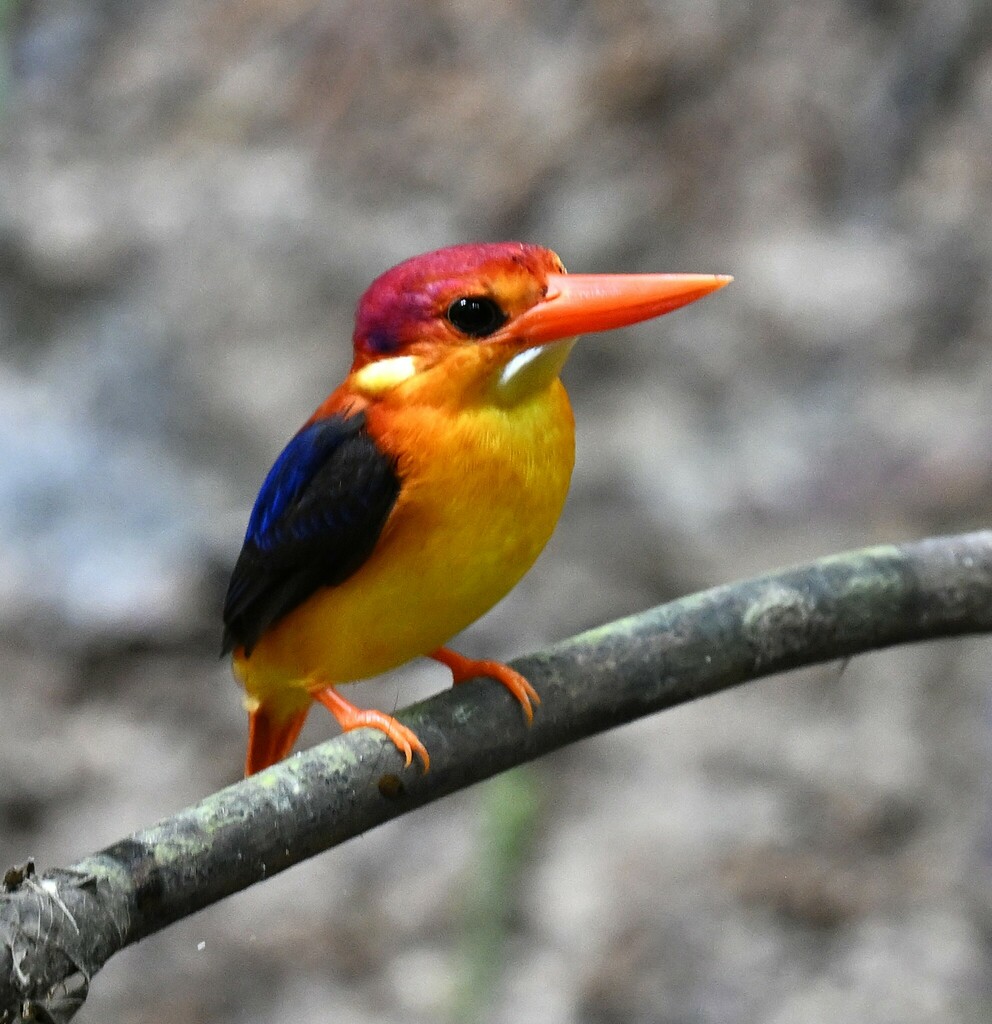
Rufous-backed Dwarf Kingfisher
Photo © Chrissy McClarren and Andy Reago
Photo © Chrissy McClarren and Andy Reago — CC0 1.0 — Source: iNaturalist #255828096Identification
The rufous-backed dwarf kingfisher is instantly recognisable among kingfishers of Maritime Southeast Asia by its striking plumage combination. Look for its brilliant red bill, yellow-orange underparts, and the distinctive lilac-rufous upperparts that give the species its name. The rufous back is particularly diagnostic. This is a small member of the kingfisher family, making it easy to overlook in dense forest habitats, but its vivid colours make identification straightforward once spotted.
Range & Habitat
This tropical kingfisher is endemic to Maritime Southeast Asia, with its range extending across the Malay Peninsula, Sumatra, Java, Borneo, the Lesser Sunda Islands, and the Philippines. Five subspecies are recognised across this distribution. The species favours lowland forests, typically in close association with freshwater features such as streams and ponds, where it finds both shelter and hunting grounds.
Behaviour & Diet
The rufous-backed dwarf kingfisher is an active and opportunistic hunter, feeding on a diverse diet that reflects its adaptability to lowland forest streams. It takes insects and spiders from vegetation and water surfaces, hunts worms and small crabs in shallow water, and also captures small fish, frogs, and lizards. Its foraging behaviour is typical of dwarf kingfishers—alert, quick movements interspersed with patient perching as it scans for prey.
Best Time & Places to See It
To find this species, focus your search on lowland forest areas near streams, ponds, and other freshwater habitats throughout its Maritime Southeast Asian range. The five subspecies occupy different geographic regions, so your specific location determines which population you encounter. Patience and careful observation along forest waterways are essential, as the species, despite its colourful appearance, can remain inconspicuous in shaded forest understory.
Photography Tips
The vibrant red bill and yellow-orange underparts provide excellent contrast for photography. Position yourself quietly along streams at dawn or dusk when the bird is most active. The small size and preference for shaded forest streams means fast shutter speeds and good light management are crucial. Patience is rewarded—once you locate a regular hunting perch, you can anticipate the bird's movements and capture its dynamic hunting behaviour and distinctive plumage in good light.
Bako National Park
Kuching, Malaysia
+210 birds+17 mammals
Weathered sandstone cliffs rise dramatically from the South China Sea, their ochre faces sculpted by millennia of wind and tide into a landscape of extraordinary geological…
VIEW NATIONAL PARKKuching Wetlands National Park
Kuching, Malaysia
+103 birds+4 mammals
Where brackish waters meet mangrove stilts and freshwater swamps blend into coastal mudflats, one of Southeast Asia's most dynamic wetland ecosystems unfolds across Sarawak's northwestern coast.…
VIEW NATIONAL PARKTaman Negara National Park
Kampong Samas, Malaysia
+393 birds+48 mammals
Where ancient rainforest meets limestone peaks, one of Southeast Asia's oldest protected wilderness preserves sprawls across 4,343 square kilometers of primordial landscape. Dipterocarp giants tower overhead,…
VIEW NATIONAL PARKTaman Negara Bukit Lambir National Park
Miri, Malaysia
+153 birds+7 mammals
Rainforest cascades down sandstone ridges where crystal streams carve through ancient geology, creating a landscape of profound biological richness in Sarawak's interior. This 68-square-kilometre sanctuary protects…
VIEW NATIONAL PARKGunung Mulu National Park
Long Seridan, Malaysia
+280 birds+39 mammals
Where granite monoliths pierce the rainforest canopy of Sarawak, an ancient limestone karst landscape reveals one of Southeast Asia's most biodiverse strongholds. Soaring peaks cloaked in…
VIEW NATIONAL PARKTaman Nasional Baluran
Situbondo, Indonesia
+189 birds+9 mammals
Across the northeastern tip of East Java, where monsoon winds sweep down from the Bali Strait, a landscape of contrasts unfolds within 374 square kilometres of…
VIEW NATIONAL PARKWest Bali National Park
Gerokgak, Indonesia
+240 birds+8 mammals
Across West Bali's northwestern reaches, where the Indian Ocean meets volcanic slopes and limestone cliffs plunge toward turquoise shallows, sprawls a protected realm of roughly 325…
VIEW NATIONAL PARKMount Merapi National Park
Hargobinangun, Indonesia
+150 birds+3 mammals
Where the volcanic slopes of central Java rise into mist and montane forest, Mount Merapi National Park guards one of Indonesia's most dynamic landscapes. Spanning roughly…
VIEW NATIONAL PARKBerbak National Park
Tanjung Jabung Timur, Indonesia
+24 birds
Across the lowland peatswamps and tidal forests of eastern Sumatra's coast, Berbak National Park sprawls over more than 3,000 square kilometres of one of Southeast Asia's…
VIEW NATIONAL PARKWay Kambas National Park
Lampung Timur, Indonesia
+237 birds+20 mammals
Across the low swamplands of eastern Lampung, where freshwater wetlands merge into tidal mangrove forests along the Sunda Strait, sprawls one of Sumatra's most vital sanctuaries.…
VIEW NATIONAL PARKNo community photos yet. Log in to add the first one.
No community observations of this species yet.