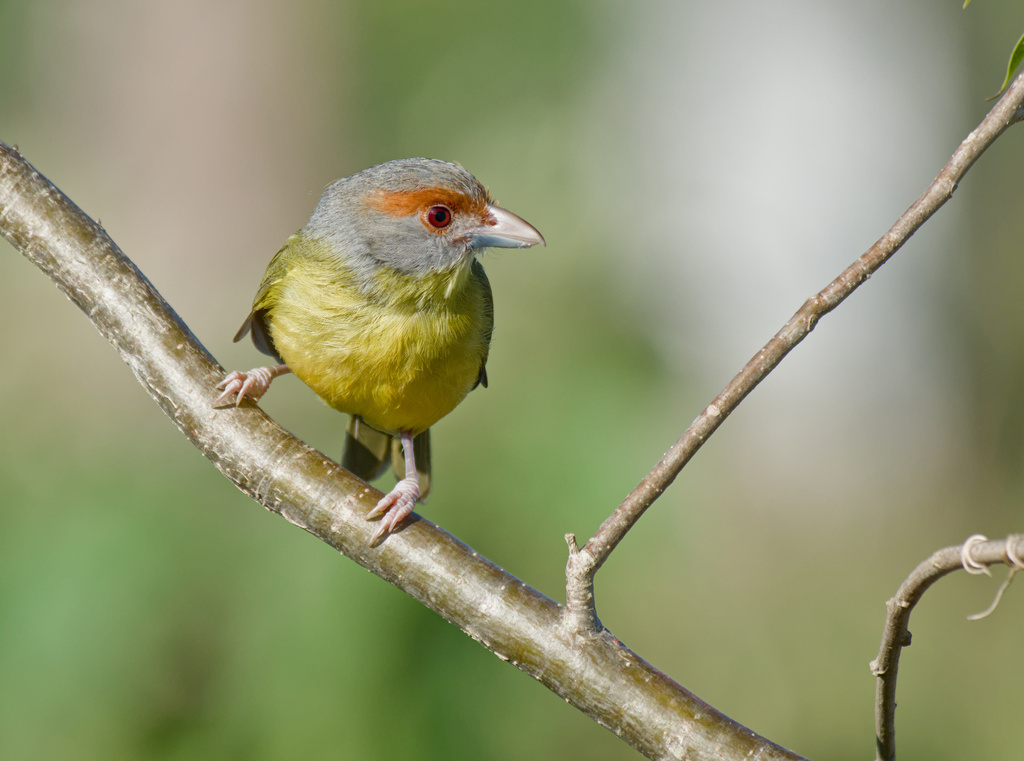
Rufous-browed Peppershrike
Photo © Blake Ross
Photo © Blake Ross — CC BY 4.0 — Source: iNaturalist photo #356533260Identification
The Rufous-browed Peppershrike is a compact passerine, approximately 15 cm long and weighing 28 g. It is bull-headed with a thick, somewhat shrike-like bill that is typically blackish below and pinkish-grey above. The head is grey with a distinctive strong rufous eyebrow, while the crown is often tinged with brown. The upperparts are green, contrasting with a yellow throat and breast that shade into a white belly. Some subspecies, particularly those from north-western Peru and western Ecuador, show greenish-yellow napes and cheeks rather than grey.
The song is a distinctive whistled phrase with the rhythm "Do you wash every week?" with extensive variations depending on individual and regional populations. The bird is often heard but can be difficult to spot, as it typically feeds high in the foliage.
Range & Habitat
This species is widespread and often common throughout its extensive range, which spans from Mexico and Trinidad south through Central America, Colombia, Venezuela, and the Amazon Basin to Argentina and Uruguay. Twenty-two recognized subspecies reflect its broad geographical distribution across this vast territory.
The Rufous-browed Peppershrike favours woodland, forest edge, and cultivated areas with scattered tall trees, showing considerable adaptability to semi-open habitats throughout its range.
Behaviour & Diet
The peppershrike feeds primarily on insects and spiders gleaned from high foliage, though it has been observed taking small lizards as well. It typically forages in the upper canopy, which explains why it is often heard but seldom seen by observers below.
Breeding birds construct a flimsy cup nest high in a tree, with a typical clutch of two or three pinkish-white eggs lightly blotched with brown. Like other vireos, the species ejects parasitic cowbird eggs from its nest, a defensive strategy against brood parasitism.
Best Time & Places to See It
The Rufous-browed Peppershrike's wide distribution and common status throughout much of its range make it accessible to travellers across Central and South America. Look for it in woodland edges and semi-open areas with mature trees from Mexico through the Amazon Basin to southern South America.
The bird's loud, distinctive song is often the best indicator of its presence, particularly during breeding season. Patient observation in suitable habitat, listening for the characteristic whistled phrase, will often reward the dedicated birdwatcher or nature photographer.
Photography Tips
This species presents a genuine challenge for photographers due to its preference for feeding high in dense foliage. Success requires patience and positioning yourself in shaded woodland edges where tall trees are present. Early morning hours often provide the best light for photographing birds in canopy environments.
The bird's grey head with distinctive rufous eyebrow and contrasting green and yellow plumage provide good photographic subjects when finally located. Using longer focal lengths and being prepared for the bird's active, restless behaviour will improve your chances of obtaining sharp, well-composed images of this often-elusive vireo.
Amacayacu National Park
Amazônia National Park
Anavilhanas National Park
Araucárias National Park
Arenal Volcano National Park
Bahuaja Sonene National Park
Baritú National Park
Baru Volcano National Park
Brasília National Park
Nothing matches these filters.
No community photos yet. Log in to add the first one.
No community observations of this species yet.