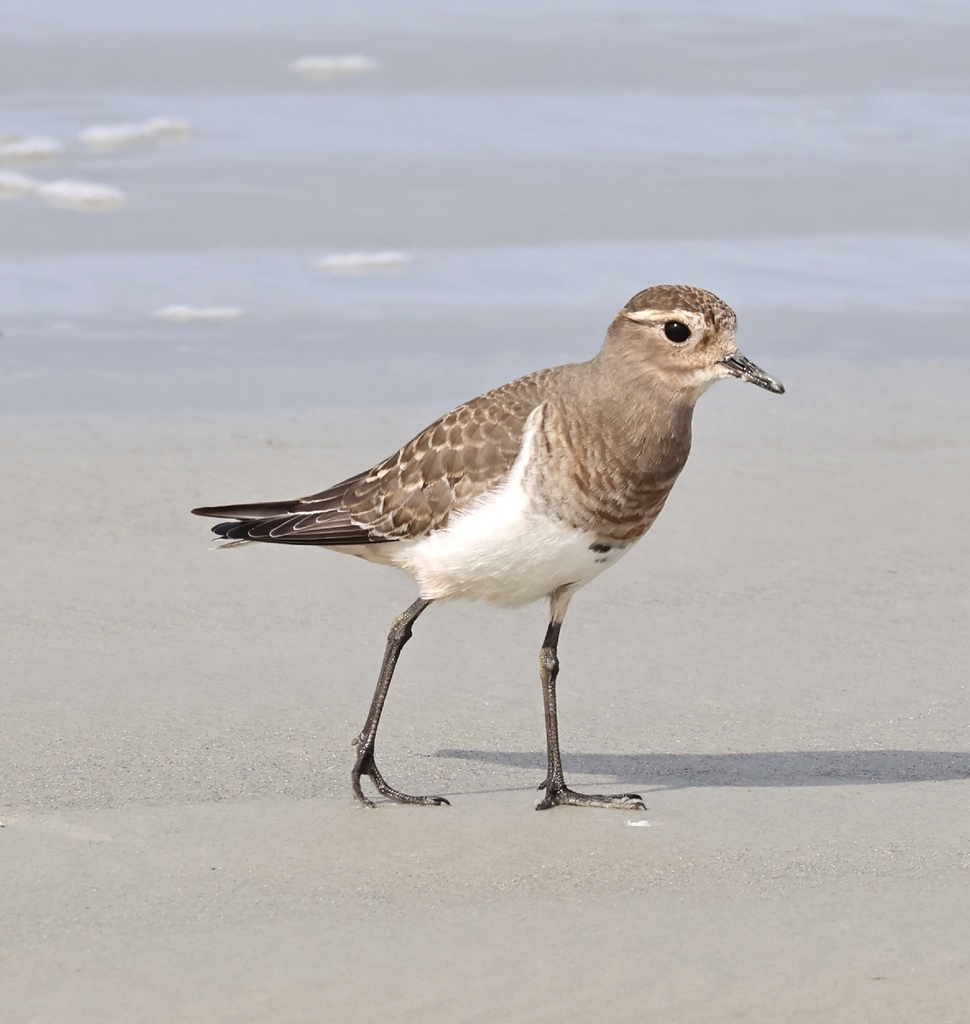
Rufous-chested Dotterel
Photo © Miguel
Photo © Miguel — CC BY-SA 4.0 — Source: iNaturalist #366346809Identification
The Rufous-chested Dotterel is a small plover, measuring 19–22 cm in length and weighing 71–94 g. In breeding plumage, males are distinctive: they sport a gray face with a bright white supercilium, gray throat, and brown crown, with the namesake bright rufous breast crossed by a bold black band below; the rest of the underparts are white and the upperparts brown. Females are similar but noticeably duller in coloration. Non-breeding adults lose the vivid rufous and gray tones, replacing them with pale brown; their upperpart feathers display bright fringes and the supercilium becomes creamy. Juveniles resemble non-breeding adults but show darker brown upperparts and breast.
Range & Habitat
This species is endemic to southern South America and nearby islands, found on the Falkland Islands and coastally to somewhat inland in Argentina, Uruguay, extreme southeastern Brazil, and Chile. It has occasionally been recorded as a vagrant in Paraguay and Peru. During breeding season, the Rufous-chested Dotterel prefers short grasslands away from the coast, though it also inhabits boggy or stony areas around inland lakes and coastal shingle. Outside breeding season, it shifts to eroded and flooded grasslands, marshes, streams, coastal mudflats, beaches, and rocky shores.
Behaviour & Diet
This migratory species breeds in far southern Chile, Argentina, and the Falkland Islands, with most populations moving north to central Chile and extreme southern Brazil as far as northern regions during the non-breeding season. Adults depart breeding grounds promptly once young become independent. The birds forage in grasslands and along pond, waterway, and shoreline edges, often defending small feeding territories during breeding season and gathering in flocks of 30 or more outside it. Their diet consists primarily of small invertebrates—including adult and larval insects and molluscs—supplemented by plant material such as algae.
Best Time & Places to See It
Breeding occurs primarily in October and November, with September also included on the Falkland Islands; nests are simple ground depressions, often in open terrain, with clutches of two or occasionally three eggs incubated by both parents. For optimal viewing, visit the Falkland Islands or southern Argentina and Chile during breeding season to observe territorial birds in grassland habitats. During non-breeding months, scan coastal mudflats and inland waterway edges from central Chile northward, where birds congregate in small flocks.
Photography Tips
The striking breeding plumage of males—particularly the contrast between the bright rufous breast, black band, and white underparts against the gray-brown head—makes this species rewarding to photograph during the breeding season. Use a tripod and patient positioning near grassland territories to capture males in their characteristic upright posture. The species' often-approachable behavior in flocks during non-breeding season offers additional opportunities; photograph birds against coastal or wetland backdrops to showcase their habitat preferences. Early morning or late afternoon light will best reveal the subtle plumage details of females and non-breeding birds.
Cabo de Hornos National Park
Campos del Tuyú National Park
Cape Dolphin
Chiloé National Park
Lago Puelo National Park
Los Glaciares National Park
Monte León National Park
Murrell Farm
Parque Provincial Península de Magallanes
Nothing matches these filters.
No community photos yet. Log in to add the first one.
No community observations of this species yet.